
Seeking News, Making China: A Conversation with John Alekna
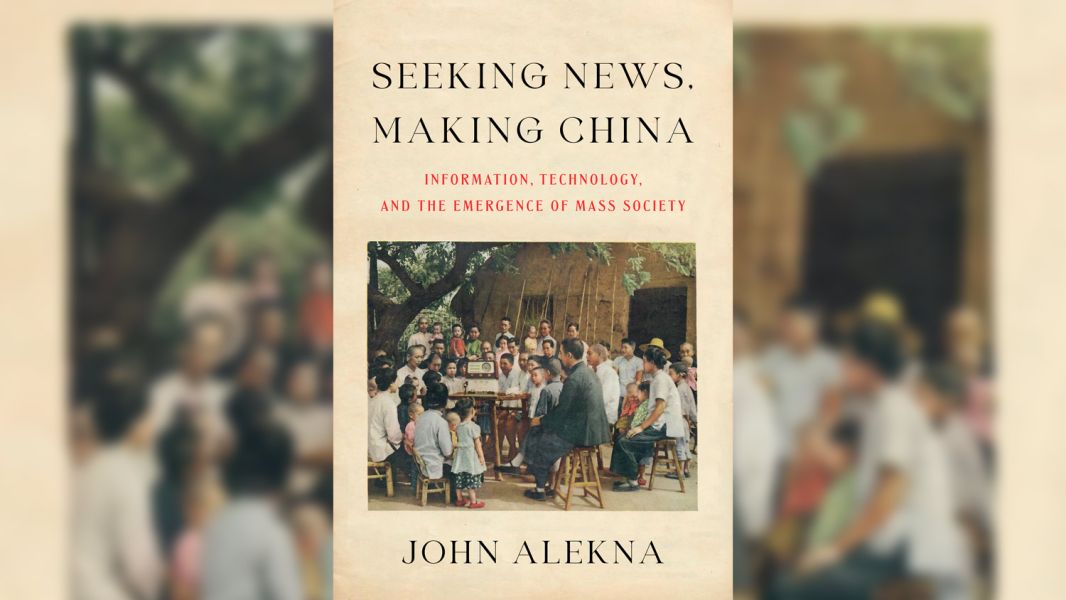
In Seeking News, Making China: Information, Technology, and the Emergence of Mass Society (Stanford University Press, 2024), John Alekna explores how the rise of radio and the circulation of news transformed China’s political and social landscape. He shows how new technologies of communication created a Chinese ‘newsscape’ that linked distant regions, shaped how people understood politics and community, and redefined the relationship between citizens and the state. By tracing these shifts across the twentieth century, the book reveals how media innovation and political power became deeply entwined in the making of a modern mass society.
Laura De Giorgi: One of the core arguments of your book is the idea that, when we reflect on the emergence of mass society in China in the twentieth century, we must pay attention to the interplay between social practices and technologies of communication—a fluid interaction that changes over time in what you call the ‘technopolitical process’. To highlight this nexus, you have also coined the concept of ‘newsscape’. Why this choice? How does this concept inform our analysis of China’s path to a mass society?
John Alekna: In the simplest terms, the newsscape is the way in which new, time-sensitive information (‘news’) moves through society and the physical landscape. The contours of the newsscape are determined by communication technologies (telegraph, broadcasting, newspapers, roads), human behaviour (socio-religious calendars, habits, the tendency to gather), and natural geography (rivers, mountains, distance). Using this framework helps us analyse how the circulation patterns of news create power. Tracing the changes in these information circulation patterns over time, therefore, reveals changes in the political structures of society. We might say, then, that the newsscape is a snapshot of the technopolitical process in time.
This changes our understanding of the emergence of a mass society in several ways. First, we can understand mass society—which I define as a society capable of theoretically universal political, economic, and informational consumption—as one that does not emerge from war or party reorganisation alone. Shifting away from these distinctive political developments allows us to see a longer-term technological story—one that sits outside the usual litany of governments and political movements. In fact, I argue that shifts in information technology and the newsscape were chronologically prior to political transitions and stretch across supposed geographical or temporal regime disjunctures. Technologies of news allow for new political possibilities as much as the reverse. The technopolitical process is unitary; one cannot separate the technology from the politics.
This understanding helps us decentre narratives of the rise of the nation-state or party as the primary event in China’s twentieth-century sociopolitical history. The technopolitical changes I trace through changes in the newsscape show that fundamental change was occurring almost regardless of the official ideology or leadership. Thus, I write that the ‘mass society’ may take the form of the nation-state, a multinational empire, capitalist consumerism, or peasant communism, but it is not any of those alone. Rather, it is a form of organisation common to all.
While centring materials and technology at the expense of ideology, my framework avoids technological determinism—that is, the idea that a certain technology necessitates a telos towards which all societies will move. The unity of the technopolitical process also implies that politics (decisions, choices, ideas) still matters to the form, expression, and consequences of technological development. The technopolitical process is dialectical.
LDG: At the centre of your analysis of the Chinese newsscape is radio broadcasting, which you describe as a medium in which social practices connected to different communication technologies converged, going beyond the divide between the written and the aural, the urban and the rural. Do you think this centrality is somehow connected to specific aspects of Chinese society and culture?
JA: The short answer is no. At the beginning of the twentieth century, most of the world’s population was illiterate, living in rural agrarian communities. China was not an outlier in this regard. It resembled Tsarist Russia, much of the colonised world (Africa, South Asia), and semi-colonised areas (Latin America, the Middle East). The true outlier was the industrialised West, with its extremely high literacy rates, mass political parties, widely distributed newspapers, and extensive railroad, telegraph, and steamship networks.
I would liken the case of communications to Marx’s famous interpretation of culture as the superstructure built upon the base of material, economic, and class relations. In this analysis, culture is a veneer on the underlying communications structures. So, for instance, China’s early modern newsscape—before the twentieth-century emergence of mass society—was much like societies at a similar level of development around the world. News was sung by itinerant singers, it was passed on market days, it was pasted up at crossroads, or passed along in letters. Plays, pamphlets, and religious festivals, bureaucratic movement, school calendars, and the agricultural cycle were key to how society learned about itself and the outside world. The China of 1919 and France of 1789 were not dissimilar in terms of their newsscapes. So, what happened in China in the twentieth century was also what Western European societies went through in the nineteenth century—what some might call ‘modernisation’, which is a term I purposefully avoid because of its vagueness and teleological implications. Analysing news and technological systems offers a more concrete way of understanding this process and shows the degree to which the resulting ‘culture’ depends on the underlying structures.
China created a mass society around radio. This differed from the industrialised West, which initially built its mass society around newspapers. But this difference did not lead to fundamentally different outcomes, because China’s twentieth-century newsscape revolution was essentially intermedial, as I show. Furthermore, China’s development resembled the technopolitical path followed by other late-industrialising societies in what is today called the Global South. Very few of the changes I trace can be causally connected to ‘Chinese culture’, even if one were to assume that ‘Chinese culture’ is a historical, reified force—which I do not.
LDG: It is a common view that there were several factors—such as linguistic diversity, geographical constraints, technological underdevelopment—that hindered efficient use of the potentiality of radio broadcasting. What is wrong about this assumption?
JA: The common view is largely correct. All these things constrained the potential of radio to transform the newsscape directly. But I do not understand the ‘radio’ or ‘broadcasting’—both of which are umbrella terms for several different activities—as acting alone. Rather, they occur only within a deeply intermedial context. Text becomes speech, and then text again. Radio broadcasts transmit published reports, and small local newspapers transcribe and republish them. Because until the late 1950s broadcasting was not heard so much as read, and because so much of the wired broadcasting until the end of the Maoist era was locally controlled, language did not present as much of a problem as one might assume. Certainly, linguistic differences were a barrier, but layers of human and technological mediation made these issues less profound. Local wired broadcasting was conducted in local dialects. The introduction of standard Mandarin on the airwaves was gradual.
Though I do not interpret radio as being a unique or even independent technology, it did have characteristics that lent themselves to overcoming the problems of geography and technological underdevelopment. Compared with other countries where radio emerged as a sociopolitical force in the twentieth century, China’s newspaper circulation was exceedingly small, its railroad network miniscule (a couple of trunks lines), and roads barely passable across long distances. Telegraph and telephone connections were expensive, slow (with many relay points), and unreliable. Moreover, China was divided politically just as much as it was infrastructurally. The two points are related: the technopolitical process moves in tandem; you cannot have political development without infrastructural development. Because it passed over great distances and over political divisions, radio could overcome these problems of geography, infrastructure, and politics. I try to show in my chapters how exactly this occurred, how information and administration passed through society, from the most important cities to the smallest villages.
LDG: You also stress the historical continuity of the technopolitical process from 1919 to the Cultural Revolution. Why this span of time? Are there any moments that you deem as turning points? And are there any moments of divergence between the two faces of this process, the technological one and the political-ideological one?
JA: In one sense, these are arbitrary dates. They are chosen as much for their historiographic and political meaning as anything else. As everyone with basic China literacy will know, the May Fourth Movement of 1919 kickstarted a movement of national revival commonly seen as the origin of modern Chinese politics and nationalist ideology. But, as I show, it took place in an informationally premodern society—one in which most people were deeply disconnected from one another and almost no-one received news in the modern, mass media sense. The entire movement comprised maybe a couple of tens of thousands of people (being extremely generous) out of a population of 400 million. On the other end of this timespan, we have the total politicisation of the Cultural Revolution, with hundreds of millions of people participating. What I try to answer in this book is how this occurred.
I hope I can be forgiven for pointing to 1923 and the introduction of broadcasting as a turning point. Although not discrete (forms of wireless transmission had preceded it), this introduction allowed for a ‘leapfrogging’ (as one article of the time put it) of what was conceived as a stage of development. In other words, China could jump from a premodern form of political-informational organisation to a hypermodern ‘mass’ one—in theory, anyway. Much of the book is concerned with the extent to which this actually occurred and how.
I find another turning point in the Japanese occupation. During this period, we find a quantum leap in the total broadcasting power and number of receiving sets in the occupied zones. Why? Well, it is not as though their policy regarding broadcasting was much different from any other regime in China or many in the world—in fact, the broadcasting model for Japan was based on the British one. Instead, what Japan had was the industrial manufacturing capacity to build radios and broadcasting stations and the wherewithal—that is, effective political control of the most populated areas—to carry out social campaigns to broaden listening. Japanese broadcasting and receiving infrastructure dominated the Chinese newsscape well into the 1950s.
Your question about divergence brings me to a rather philosophical point: I don’t believe that the political and the technological can diverge. Any technological development is necessarily a political development, in that it changes the way in which society operates or, in the case of communications, how society organises itself. This was certainly true of radio, and it is still true of social media and the mobile communications revolution of our lifetimes. They have necessarily changed politics and society.
LDG: Last, I would like to go back to the idea that the search for news is a universal human need and a fundamental driver of change. We need and are thirsty for news to make sense of our lives and experiences, to act and to envision future possibilities. Social life and material practices are created and shaped by the desire for information and communication. You write that ‘[p]eople wanted a mass society because it was better at delivering large volumes of information’ (p. 262). I find this quite a strong and interesting statement.
JA: A strong statement designed to be provocative, but one that is historically demonstrable. The reorganisation of the newsscape preceded mass political development in most places. Elsewhere around the world, the newspaper preceded the mass party and the nation-state. Radio preceded Roosevelt, Mussolini, Hitler, and Churchill, and allowed them to wield forms of power that were different from those of their predecessors. Still, technology did not necessitate or predetermine these developments. Historians of technology are very squeamish about appearing to imply otherwise—for good reason. If taken to extremes, technological determinism implies a lack of human agency; it denigrates the importance of culture, ideology, and free will. That is why I, and many in the field, speak in terms of possibility rather than necessity. Technology creates the possibility of certain outcomes but does not determine them.
But we are still faced with a conundrum. A universal phenomenon requires universal explanation. And mass society is as near to a universal phenomenon as I can imagine—in other words, it appears to be a determined outcome. There is no area of the world today that is not dominated by a mass political, mass economic, mass cultural society. Why? The claim that this is just an artefact of imperialism or capitalism is unsatisfying. It ignores, as many have done in the case of China, the choice and desire of colonised and semi-colonised peoples to build such a society. Such a view—that political, economic, and cultural modernity are a Western, imperial imposition—risks Orientalising the rest of the globe into world-historical passivity and reinscribing a unique relationship between the West and modernity that we seek to leave behind. Likewise, ascribing the universality of mass societies to capitalism doesn’t work either. It denies the reality that Chinese societies (and others) reorganised themselves in the twentieth century outside capitalist frameworks. Industry, wage labour, the profit motive—all played a secondary role in creating Chinese mass society.
Human nature is complex and contradictory. But as anthropology has shown, people are generally the same everywhere, with the same range of personalities, behaviours, thoughts, and desires. These cross ethnicities, cultures, economic organisation, class structure, and chronologies. We may find other cultures and times strange and different, but they are not incomprehensible. In fact, I would argue that it is quite easy to explain and understand difference. People are fundamentally comprehensible to one another, as testified to by the fact that people have moved between cultures, in every conceivable direction, throughout history.
All this is to say that it is empirically demonstrable that humans when organised in societies share common patterns and behaviours, from the most isolated hunter-gatherers to the most densely organised contemporary megacity. There is much to be gained by denying this. Ethno-supremacists of all sorts are an obvious case, but scholars, too, from anthropologists to historians, benefit from exaggerating difference, making themselves seem more professionally competent, daring, persevering. Claims appealing to ‘human nature’ or universal behaviours also seem old-fashioned. I appreciate that sweeping claims about causation and underlying tidal forces seem specious or even suspicious in their totalising effect. But I think such claims are sometimes still justified, especially when, as in this case, one is trying to explain a universal phenomenon (the mass society). Surely some mechanism is promoting its universal emergence?
My proposition that the desire for news (the push for time-sensitive information at greater volumes, at greater speeds, with greater regularity and reliability) was an important mechanism is driven by several historically informed observations. First, in Chinese villages economic reorganisation (participation in regional or national markets, non-subsistence farming, land and/or capital redistribution and reform, class re-formation) occurred after political restructuring. And this political restructuring occurred after or alongside the infrastructural, technological, and behavioural changes in the newsscape. Therefore, the mass society of China’s twentieth century was not an economic—and especially not a capitalist—phenomenon. Furthermore, it was also not a primarily top-down political phenomenon. People did not need to be commanded to buy, install, or build radio receiver networks. They demanded them. When some ways of receiving news existed, people wanted more, almost regardless of the content, and told the authorities so. I show this through local archival sources, across periods and regimes. But it also makes sense within the newsscape revolutions of our own lifetimes. Were Western people without news and information at the end of the twentieth century? No. One might even have perceived society to be saturated with newspapers, magazines, radio, and broadcast television. And yet, over the past quarter-century, new technologies have emerged—and been nearly universally adopted—that further multiply even this already high volume of time-sensitive information. (There are, of course, exceptions. What I mean is adoption by a very high percentage of any given population.) Why? Do I need to listen to a podcast while playing a YouTube video and reading a PDF document at the same time? Do I need to scroll through social media feeds? The answer again is obviously no. And yet, I and others do it constantly, even while feeling its ill-effects at the social and personal levels. Something fundamental is clearly driving this tendency across cultures. What I am arguing in this book is that this is also a historical phenomenon, rejecting the arrogance of assuming that my impulses and desires—my humanity—are fundamentally different from someone whose time, culture, and class background (for instance, an early twentieth-century illiterate Chinese farmer) are different to my own.
One final point. As I show, the technopolitical process proceeded across a wide range of regimes, with widely varying ideologies. The movement towards a mass society proceeded regardless of whether a multi-ethnic empire, communist regime, or semi-capitalist dictatorship was in charge. In the expansion and restructuring of the newsscape to bring greater volumes of information, resistance rarely emerged under any ideology. None of these ideologies (the nation-state, an empire, or a communist utopia) was a fundamental, widespread telos for most people at any point. I would argue that most people are apathetic. The informed and motivated are a minority (just look at the low voting rates of developed democracies). But people are not apathetic about their access to information. People buy computers and mobile phones (as their forebearers bought radios or helped install wired broadcasting) in much larger numbers than participate in overt political processes. News has a much more fundamental appeal than the nation.