
Custodianship in a Time of a Political Depression
Soft Resistance, Retention, and Commemoration in Post-NSL Hong Kong
The chaos and sheer human density of Kowloon are often synonymous with Hong Kong. Multilevel arcades of little restaurants sit alongside street markets selling keepsake magnets. In these busy streets, up a quiet staircase, hide a few surviving independent bookstores.
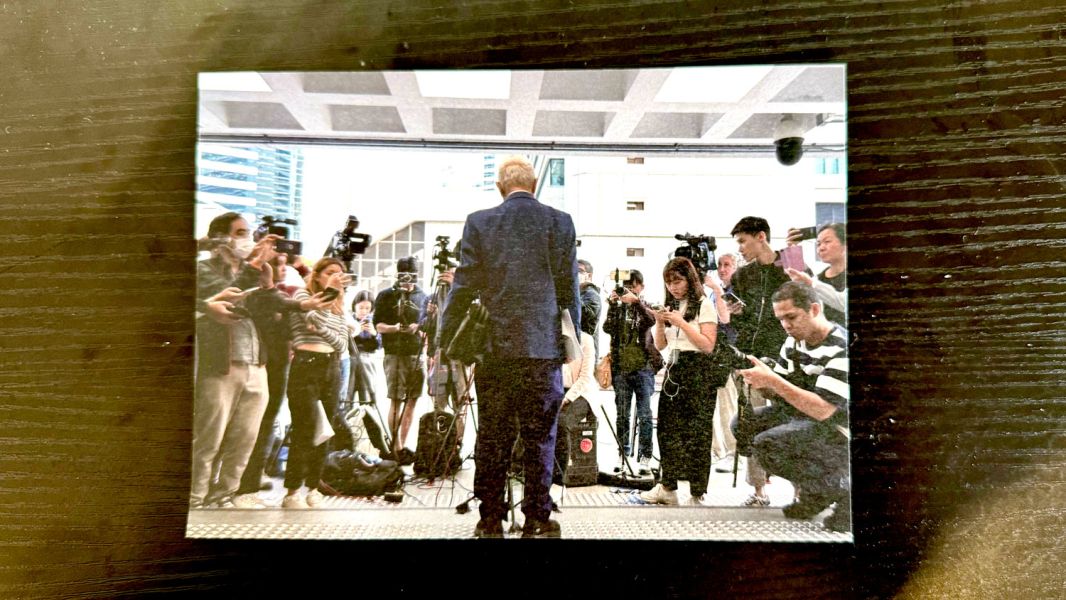
These bookstores became regular stops on my fieldwork visits in Kowloon. By the door in one such bookstore, and only visible as you exit, sits a small rack of postcards for sale. These were not images of Victoria Harbour, but photographs taken outside the High Court: press conferences and faceless crowds behind barriers—each stamped ‘Witness’. One afternoon, the woman behind the desk struck up an unexpectedly warm conversation. After she apologised for November being ‘quiet season’, I asked about the postcards. She explained that former Stand News (立場新聞) journalists were selling prints of prominent National Security Law (NSL) cases involving media figures, so people could ‘remember the court cases on the press’.
Recent media articles lament that Hong Kong is ‘a city lurching into oppression while clinging onto the remnants of the rule of law’ (Yang 2024). With each passing day, new headlines report on the law being used to shut former pro-democracy cafes, the arrests and trials of former pro-democracy protestors, and increasing legal pressure targeting civil society organisations and local media. For a city once known as the ‘city of protests’ (Garrett and Ho 2014: 347), Hong Kong’s political landscape is now almost unrecognisable. Yet, in the corner of a quiet Kowloon bookshop, the postcards—small, unassuming, almost austere—capture a broader impulse that has been animating Hong Kong in recent years: an urgent desire to hold onto, to record, to keep traces of a political world that is being erased in real time.
Between June 2019 and June 2020, Hong Kong experienced the largest pro-democracy protests in its history, triggered by a proposed amendment to criminal extradition laws before quickly shifting focus to universal suffrage. In response, on 30 June 2020, Beijing imposed the National Security Law (NSL) on Hong Kong via promulgation of the Standing Committee of the National People’s Congress. The NSL introduced new criminal laws and sweeping institutional reforms to Hong Kong’s legal system, including a parallel enforcement apparatus, with designated national security judges. In short, the NSL effectively created a new legal order in Hong Kong, collapsing longstanding institutional guarantees around human rights and the rule of law.
Under this new legal order, mass public protest has disappeared. The NSL has resulted in the arrest or exodus of much of Hong Kong’s pro-democracy leadership, the shutdown of 22 local media groups (most notably, Apple Daily [蘋果日報] and Stand News), and the disbanding of more than 90 civil society organisations, including nongovernmental organisations, student unions, and groups such as the Civil Human Rights Front (Lee and Chan 2023; Chow et al. 2024). At the time of writing at the end of 2025, the NSL and subsequent legislation had resulted in more than 320 Hongkongers being arrested; 180 individuals and five companies had been charged, with 160 individuals and one company convicted or awaiting sentencing (Hong Kong Free Press 2025).
Yet, despite this sweep of legal repression, political dissent survives, albeit in a new form. What has emerged in the wake of the NSL is a quieter, more personal type of dissension—a dynamic often called ‘soft resistance’ (软对抗). This marks a significant departure from Hong Kong’s historical protest movements, which focused on achieving notably public goals of governmental accountability or legislative reform. While this new type of private resistance is pervasive in the city, in interview after interview, former protestors have described to me how—despite engaging in such acts—this type of resistance is ultimately of ‘no use’ (HK21, a student) as the ‘people are powerless’ (HK24, an activist). But if soft resistance is of ‘no use’, why do former protestors continue to engage in it?
When asked this question, former protestors responded with extended narratives, often framed through deeply emotional vocabularies of loss, bereavement, or guilt. Interviewees repeatedly narrated the post-NSL years as a period marked by the collapse of political horizons, a diminished sense of personal agency, and deep pain for the loss of a political culture that once anchored their everyday life. These emotional registers map onto what commentators have termed ‘political depression’—not just in a clinical sense, but as a sociocultural descriptor of political fatigue, diminished horizons of agency, and ‘a period of bereavement where one mourns the death of the body politic’ (Lusson 2017).
By paying analytical attention to political depression, a new trend within political dissent becomes visible. Practices that were once oriented towards political change are now imbued with custodial meanings focused on preserving pre-NSL political culture, memory, and identity—a normative orientation I term ‘custodianship’. Building on the Oxford English Dictionary’s (2016: s. 2) definition of custody as ‘the charge or care of something or someone; protection, defence; guardianship’, I use custodianship to describe a political orientation redirected towards ‘care’, ‘protection’, and ‘defence’ rather than immediate political impact. Across interviews, custodianship describes a shift in meaning attached to familiar practices, and not the emergence of a new repertoire of dissent. By foregrounding interviewees’ own descriptions, the analysis highlights how grief, guilt, and loss operate as interpretative vocabularies through which former protestors explain why familiar practices persist despite the collapse of their political efficacy.
Drawing on 65 hours of semi-structured interviews with 46 former protestors who joined the 2019 demonstrations and multi-sited fieldwork in Hong Kong between 2023 and 2024, this essay demonstrates that former protestors have reoriented their political dissent towards a commitment to preserving Hong Kong’s political culture of protest as institutional guarantees disappear. The article focuses on two domains of soft resistance in which custodianship is most apparent: retention—that is, the safeguarding of physical and digital traces of pre-NSL political culture; and commemoration—private, ritualised acts of remembrance, particularly around enshrined protest dates. In both cases, political depression provides the emotional context within which custodial meaning takes shape, demonstrating how political culture endures through preservation, even as the space for dissent narrows.
Retaining Traces
Across interviews, former protestors described systematically collecting and safeguarding physical artefacts of pre-NSL political culture. Many reported buying and storing banned books (with a particular focus on localist authors), holding on to paraphernalia or symbols from the 2019 protests, and purchasing the last issues of Apple Daily. These interview moments were particularly memorable, as interviewees proudly displayed these items—signalling that safekeeping itself had become a meaningful political act.
This impulse to safeguard extends into digital traces, too. HK1 (a white-collar worker) showed me their archived WhatsApp group conversations from the 2019 protests, explaining with uneasy laughter: ‘I could never bring myself to delete them … [I]t is, in a very small way, still an active protest.’ This sentiment was echoed by HK17 (a student), who also had kept their 2019 WhatsApp group posts: ‘I think I have some PTSD [post-traumatic stress disorder] … I see the pictures, I will cry.’ As the emotional charge of group conversations that took place at the height of the mobilisation makes deletion unthinkable, archiving and safekeeping become ways to process emotions of loss, while keeping the past accessible. Collectively, these accounts highlight both the anticipatory and the reactive forms of post-NSL retention: some act before disappearance, others after erasure, yet all function to safeguard traces of pre-NSL political culture for a future audience.
When asked why retention matters, interviewees described feelings of loss, displacement, and guilt. For example, HK39 (a media professional) explained why they purchased the last issue of Apple Daily:
It’s my memory. Let my kids know that, let them remember this one … I bought several copies, just because it’s a piece of history … [P]sychologically we are passive protestors in our hearts all the time … I keep these things to remember the day [of Apple Daily’s closure] … [W]e fight for the freedom of speech, we fight for the liberty of Hong Kong … This is the reason why we keep things. Many of the protestors are arrested … We have to keep in mind what happened that year … I feel like an outsider in my own city … Everything has changed … In our heart we can always keep the past Hong Kong, so we keep all the past materials if we can.
This constellation of grief, guilt, and fear of erasure echoes the affective dimensions of political depression: an exhausted yet heightened sensitivity to loss (Bandurski 2022). For this former protestor, guilt operates as a relational impulse—one that seeks ‘to re-establish injured relations and balance unequal arrangements’, and it is through the familiar practices of recording political histories that this impulse is expressed (von Kellenbach and Buschmeier 2022: 2). Affect here reveals how this informant understands the act of retention: a means to process emotions of loss (‘I feel like an outsider’) and survivor’s guilt (‘protestors are arrested’), while safeguarding a different, pre-NSL Hong Kong, and simultaneously orienting towards the future (‘so we keep all past materials if we can’). They explicitly name this as dissent: ‘We are passive protestors … all the time.’
HK29 (another media professional) described through a similarly emotional narrative buying ‘a lot of books’ about Hong Kong history and the 2014 Umbrella Movement. When I asked why, they responded:
It shows a mini protest, a personal protest to the government. I still do it [that is, buy and store books about Hong Kong’s political history]. You can erase that history, not let me report it, but I will still be there because I wanted to remember something … It happened to me that one day I saw a picture of Edward Leung [a prominent localist activist, imprisoned after the 2016 ‘Fishball Revolution’] and I forgot his name, and I realised there are so many things we have to remember about this movement … [T]he previous generation of Hongkongers have been fighting for so long for democracy … I don’t want to forget these people’s efforts, even Edward Leung … I still have to remember what he did; he kind of sacrificed his whole life to inspire many Hongkongers … I hope to keep [the books] as a record for my children, or I will give it to a second-hand bookstore, and someone will pick it up and know it happened.
This former protestor initially framed their act as ‘a personal protest to the government’. Yet, the emotional texture of the narrative—epistemic anxiety and a deep sense of loss—reveals a different normative orientation. For them, the affective landscape of political depression provides the vocabulary to make sense of their own actions: fear, loss, and guilt are the terms through which book-buying acquires a custodial orientation. In this post-NSL affective terrain, this informant remains attached to the meaning embedded in dissent—now embodied in the books—even though such acts no longer yield instrumental outcomes (Berlant 2011). Through these affective cues, the interviewee portrays book-buying as meaningful for safeguarding memory for future publics—children, unknown readers—who might ‘pick it up and know it happened’.
Political depression provides the affective vocabulary through which retention is understood as a custodial effort to protect political memory, assert continuity, and refuse the erasure of the post-NSL legal environment. The next section turns to commemoration, as former protestors, even if alone, carry the meaning of these traces towards an undefined future.
Commemoration
Many interviewees described, in an almost linear narrative, the continuation of pre-NSL practices of commemoration and ritualised behaviour: lighting candles on 4 June, listening to protest anthems in private, and visiting historical protest sites on key anniversary dates. These actions were generally portrayed as attempts to preserve Hong Kong’s pre-NSL political culture, deliberately invoking commemorative ritual to safeguard meaning rather than mobilise politically. As with retention, interviewees insisted these practices carried no instrumental utility, instead explaining their enactment through deeply emotional narratives marked by quiet sadness, longing, and a sense of political dislocation.
When asked why they continue to engage in such acts, former protestors responded with deeply emotional registers associated with loss, obligation, and duty. Consider the below reflections on visiting historical protest locations on enshrined dates:
By doing this I can reinforce a relationship between me and the place … I can remember on this square this happened and on this street this happened. A lot of memories are connected. Whenever I visit the place, I know what has happened at this place … I remember what happened in 2019. It reinforces my memory; I was trying to embed my memory into the place and at the same time trying to make me connect to other people and the land. (HK12, a student)
I know nobody will know it [that is, that they are at the historical protest location]; it’s important to remember something. It’s my way to remember it, to be there and see how quiet it has been … Now I will still do it on my own. (HK29, a media professional)
These narratives—delivered in strained, almost pained tones—show affect operating as an interpretative medium through which former protestors make sense of new legal constraints. The verbs ‘reinforce’, ‘remember’, and ‘connect’ reveal how emotion is embedded within the former physical spaces and their associated memories, binding individual actions to a wider political collective. HK12’s description of walking along the protest route that reinforces ‘a relationship between me and the place’ and HK29’s solitary reminder that ‘nobody will know it’ reflect an emotional terrain marked by loss, quiet grief, diminished agency, and a desire to hold on, resonating with the affective climate of political depression without naming it directly.
These narratives illustrate how relational and circulatory patterns of private commemoration align ‘individuals with collectives—or bodily space with social space—through the very intensity of their attachments’ (Ahmed 2004: 26). Heritage scholarship similarly recognises how visiting physical sites to offer respect or recognition can sustain and energise visitors’ own ‘self-recognition and values’ (Smith 2022: 633) through the embodied and emplaced dimensions of ‘feeling the past’, as affective and sensory engagements with physicality sustain collective attachments (Macdonald 2013: 107). Private commemoration thus becomes legible to participants as custodianship: emotion circulates through place and memory, preserving the sense of belonging and identity once enacted through mass protest (often in that very space).
Some interviewees described becoming more politically aware in the post-NSL period. This heightened awareness often took an emotional form. For example, in discussing 4 June, HK17, a self-described localist student, shared how they only began commemorating 4 June after the NSL:
We should remember this date because the enemy for the people who got suppressed on 4 June and Hong Kong people is the same … For me, I didn’t really light a candle for that day [before the NSL] … but I do think we should remember it because I didn’t memorialise it before 2019 but [only] after 2020.
HK17’s narrative encapsulates several dynamics central to this essay. First, this informant captures how new emotions of anger and loss are mediated through inherited repertoires of commemoration and ritual, providing a toolkit to express new emotions (Swidler 2001; Byelikova and Mykhailenko 2025). Moreover, their narrative highlights how foregrounding affect accentuates this new normative orientation. Here, political depression does not generate new practices, but provides inherited ones with renewed purpose, giving meaning to continuity. Despite not engaging before the NSL, HK17 considers post-NSL 4 June commemoration, and the political culture attached to it, alive.
Political Depression and Meaning
In mid-2025, one interviewee from this study was visiting the United Kingdom. At a quiet cafe in London, they gave me a small gift, saying, ‘I thought you might like this postcard, for a memory’ (see Figure 1).
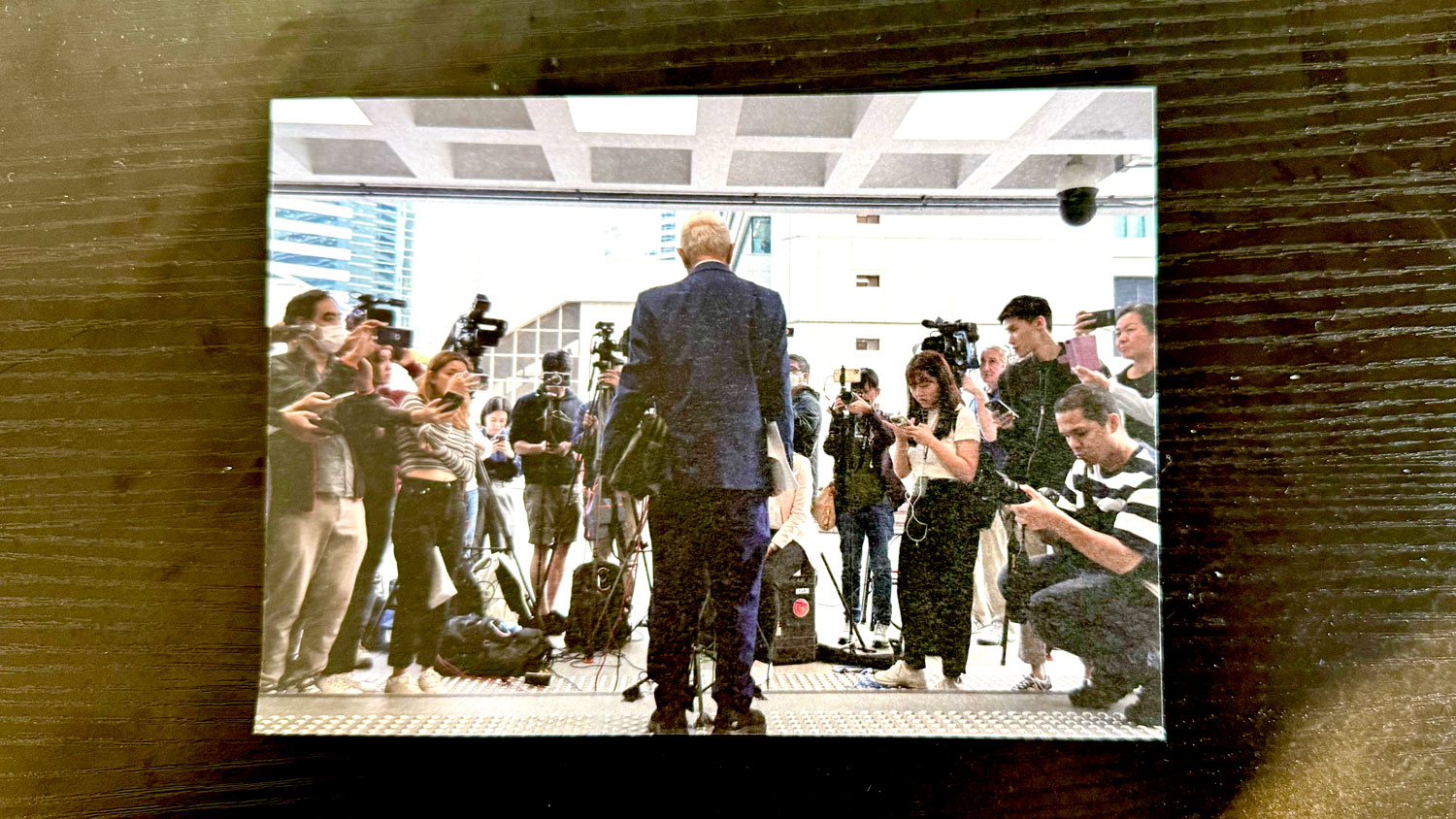
Soft resistance represents a fundamental transformation in the normative meaning of dissent. In the absence of state recognition or the expectation of political reform, former protestors orient their dissent towards custodianship. Although their post-NSL practices vary widely—from buying history books to lighting candles at home—interviewees frequently explained them through deeply emotional vocabularies of loss, identity, and responsibility. These narratives reveal how familiar practices are understood as having a custodial meaning—caring, safeguarding, and potentially even transmitting pre-NSL political culture.
Paying analytical attention to political depression offers insights that conventional explanations of dissent under repression cannot provide—including how former protestors feel, make sense of, and ascribe meaning to their own practices of retention and commemoration. In so doing, this essay complements recent quantitative studies linking memory, identity, and continued political engagement in post-NSL Hong Kong (Lee et al. 2025). At the same time, dominant approaches in the scholarship often focus on rational adaptation to risk (Becker 1968) or everyday resistance as tactically modest (Scott 1985, 1990; Wedeen 2015), yet such frames cannot account for why former protestors persist in acts of dissent once political or legal calculations render such behaviour futile. Across interviews, political depression surfaced as a sociocultural vocabulary through which former protestors narrated the post-NSL years: grief at the collapse of political opportunity structures, guilt towards those imprisoned or exiled, and a pervasive sense of diminished agency. These emotional registers illuminate how former protestors understood the meaning of their own post-NSL dissent. Political depression is analytically valuable because it reveals what familiar practices come to signify as formal political avenues disappear. In narrating loss, hopelessness, or guilt, former protestors articulate a culturally situated mode of reasoning that renders custodianship—rather than political reform or mobilisation—as the normative orientation of soft resistance.
These findings hold broader implications for scholarship on authoritarian legality and rule-of-law backsliding. This essay confirms sociolegal warnings about the difficulties of using law for social re-engineering or displacing embedded practices and norms (Kurkchiyan 2003), while complementing work that emphasises strategic adaptation in contexts of repression (Chua 2012, 2014). Custodianship, however, offers another pathway: normative reorientation. As liberal institutional protections collapse, grassroots actors treat pre-NSL culture as almost object-like: something to be protected, remembered, and transmitted. Whether buying a history book on the 2014 Umbrella Movement or teaching their children about 4 June, former protestors act with awareness that meaning itself is endangered. Rather than producing withdrawal or apathy, the affective landscape of political depression sharpens the perceived duty of former protestors to preserve meaning. The post-NSL legal environment therefore generates a deep reflexivity—a heightened attentiveness to the preservation of liberal and democratic values, even as the space for dissent narrows. In the words of HK30, a white-collar worker: ‘Maybe I did it more after NSL than before. The effect of the NSL is to question whether I should be apolitical.’
References
Ahmed, Sara. 2004. ‘Collective Feelings: Or, the Impressions Left by Others.’ Theory, Culture & Society 21(2): 25–42.
Bandurski, David. 2022. ‘Political Depression 政治抑郁.’ The CMP Dictionary, 5 October. Taipei: China Media Project. chinamediaproject.org/the_ccp_dictionary/political-depression.
Becker, Gary S. 1968. ‘Crime and Punishment: An Economic Approach.’ Journal of Political Economy 76(2): 169–217.
Berlant, Lauren Gail. 2011. Cruel Optimism. Durham, NC: Duke University Press.
Byelikova, Yuliya, and Olena Mykhailenko. 2025. ‘Transforming Survivor Guilt into Social Activism: Ukrainian Women Refugees in Germany.’ Migration and Diversity 4(1): 21–35.
Chow, Olivia, Thomas E. Kellogg, and Eric Yan-Ho Lai. 2024. Anatomy of a Crackdown: The Hong Kong National Security Law and Restrictions on Civil Society. Washington, DC: Center for Asian Law, Georgetown University. www.law.georgetown.edu/law-asia/wp-content/uploads/sites/31/2024/03/24_ASIAN_LAW_NGO_REPORT_FINAL.pdf.
Chua, Lynette J. 2012. ‘Pragmatic Resistance, Law, and Social Movements in Authoritarian States: The Case of Gay Collective Action in Singapore.’ Law & Society Review 46(4): 713–48.
Chua, Lynette J. 2014. Mobilizing Gay Singapore: Rights and Resistance in an Authoritarian State. Philadelphia, PA: Temple University Press.
Garrett, Daniel, and Wing-chung Ho. 2014. ‘Hong Kong at the Brink: Emerging Forms of Political Participation in the New Social Movement.’ In New Trends of Political Participation in Hong Kong, edited by Joseph Y.S. Cheng, 347–83. Hong Kong: City University of Hong Kong Press.
Hong Kong Free Press. 2025. ‘Explainer: Hong Kong’s National Security Crackdown—Month 59.’ Hong Kong Free Press, 31 May. hongkongfp.com/2025/05/31/explainer-hong-kongs-national-security-crackdown-month-59.
Kurkchiyan, Marina. 2003. ‘The Illegitimacy of Law in Post-Soviet Societies.’ In Law and Informal Practices: The Post-Communist Experience, edited by Denis J. Galligan and Marina Kurkchiyan, 25–46. Oxford, UK: Oxford University Press.
Lee, Francis L.F., and Chi-kit Chan. 2023. ‘Legalization of Press Control under Democratic Backsliding: The Case of Post–National Security Law Hong Kong’. Media, Culture & Society 45(5): 916–31.
Lee, Francis L.F., Samson Yuen, and Gary K.Y. Tang. 2025. ‘Protest Memories and Individual Persistence: Examining Participants’ Intention to Remember a Movement under Democratic Backsliding.’ Social Movement Studies, online first. doi.org/10.1080/14742837.2025.2481050.
Lusson, Robert. 2017. ‘Political Depression.’ HuffPost, 13 January. www.huffpost.com/entry/political-depression_b_5879574ae4b077a19d180dbe.
Macdonald, Sharon. 2013. Memorylands: Heritage and Identity in Europe Today. London: Routledge.
Oxford English Dictionary. 2016. ‘Custody.’ Oxford English Dictionary. www.oed.com/dictionary/custody_n.
Scott, James C. 1985. Weapons of the Weak: Everyday Forms of Peasant Resistance. New Haven, CT: Yale University Press.
Scott, James C. 1990. Domination and the Arts of Resistance: Hidden Transcripts. New Haven, CT: Yale University Press.
Smith, Laurajane. 2022. ‘Heritage, the Power of the Past, and the Politics of (Mis)Recognition.’ Journal for the Theory of Social Behaviour 52(4): 623–42.
Swidler, Ann. 2001. Talk of Love: How Culture Matters. Chicago, IL: University of Chicago Press.
von Kellenbach, Katharina, and Matthias Buschmeier. 2022. ‘Introduction: Guilt as a Force of Cultural Transformation.’ In Guilt: A Force of Cultural Transformation, edited by Matthias Buschmeier and Katharina von Kellenbach, 1–25. Oxford, UK: Oxford University Press.
Wedeen, Lisa. 2015. Ambiguities of Domination: Politics, Rhetoric, and Symbols in Contemporary Syria —With a New Preface. Chicago, IL: University of Chicago Press.
Yang, Joshua. 2024. ‘Hong Kong’s Bureaucrats Don’t Make Good Authoritarians.’ Foreign Policy, 28 June. foreignpolicy.com/2023/09/25/hong-kong-authoritarian-crackdown-censorship-china-ccp.