

City in the Sky: Drones, Shenzhen, and the ‘Low-Altitude Economy’
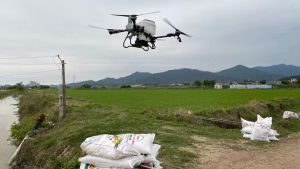
Imagine this scenario: you ordered takeout during lunch rush hour, but the delivery bros were overbooked, so a drone dropped from the sky to deliver your meal; on your commute, while ground traffic was jammed, flying cars allowed you to take an ‘air taxi’ to work … These scenes seemingly out of science fiction movies will become part of people’s daily lives in the era of the ‘low-altitude economy’ [低空经济].
This invitation to envision an aerial future appeared on Sina Finance in an article titled ‘2024, the First Year of the Low-Altitude Economy’ (PEDaily 2024). What it references is the first appearance of the term ‘Low-Altitude Economy’ in the Report on the Work of the Government presented to the National People’s Congress in January 2024, which signalled the aspiration to transform the airspace below 3,000 metres into a space that generates economic value. In the section titled ‘Major Tasks for 2024’, the report states the goal to ‘actively foster emerging industries and future-oriented industries’, which includes developing ‘new growth engines in fields such as biomanufacturing, commercial spaceflight, and the low-altitude economy’ (State Council 2024). Soon after this report, the Ministry of Industry and Information Technology, the Ministry of Science and Technology, the Ministry of Finance, and the Civil Aviation Administration of China issued the ‘Implementation Plan for the Innovation and Application of General Aviation Equipment (2024–2030)’, proposing to promote the low-altitude economy to reach a market scale of RMB1 trillion by 2030 (PEDaily 2024).
While various local governments, including those of Shanghai and Beijing, have heeded the call to develop the low-altitude economy, it is Shenzhen, the city with a longstanding reputation for innovation and the de facto ‘drone capital’ of the world—a title earned through the presence of leading drone makers such as DJI—that has ‘flown’ to the forefront in the race to build a low-altitude future. In fact, it was via the WeChat post of a friend with whom I went to high school in Shenzhen that I first encountered the term. When I saw her last in 2019 back in Shenzhen, where I had lived from 1986 to 1996 before heading to college in Shanghai, I rode in her brand-new Maserati and listened to her adventures in ‘real estate e-commerce’. A Shenzhen University alumnus who had returned from graduate school in England and later worked in Japan, she became an enthusiastic participant in the low-altitude economy in the making, and she has engaged in drafting development plans and inviting ‘angel investors’ to join the cause.
I recall pausing at the seeming contradiction of ‘real estate e-commerce’, even though my experiences with the Zillow app while house hunting in the United States did come to mind. To me, the term indicated the interpenetration of the physical world and the digital space—something the cultural studies scholar Scott McQuire (2008) has described as characteristic of the ‘media city’. Elsewhere, I have referenced the ‘media city’ concept as part of an analysis of a light show in Shenzhen in 2018–19 celebrating the fortieth anniversary of the city’s founding wherein the facades of highrises were turned into data flows via algorithmically rendered moving images, emblematising the malleability of the built environment (Yang 2023b). But I have also come to wonder whether the ‘media-architecture complex’ as McQuire defines the term best captures Shenzhen’s trajectory. After all, this is a place whose presence in the global information and communication technology sector has transformed dramatically over time—first, as a manufacturing hub (that is, ‘Made in China’ 中国制造) and counterfeiting capital of tech devices exemplified by shanzhai phones (‘Faked in China’ 中国山寨), and later as a city of innovation (‘Created in China’ 中国创造), before becoming the nation’s high-tech centre for artificial intelligence (‘Made in China Intelligently’ 中国智造). The venturing of my interlocutor from real estate e-commerce from 2019 into the realm of the low-altitude economy in 2024 speaks at once to the speed of change characteristic of the city’s development and the momentum the city appears to generate as a core engine in the Guangdong–Hong Kong–Macau Greater Bay Area (GBA)—newly named in 2017 but long known as the Pearl River Delta.
I have therefore come to think of the city as a media-infrastructure complex. This understanding rests on the recognition that just as Shenzhen’s urban environment becomes highly mediated via digital means, Shenzhen itself has become integral to what Hong Kong–based academic Pun Ngai calls China’s ‘infrastructural capitalism’. For Pun, infrastructural capitalism
encompasses both the concrete infrastructures of roads, cities, high-speed rail, and logistics transportation—themselves linked to extractive capital in China and overseas—and their intersections with the digital infrastructures of e-commerce and the platform economy that increasingly take advantage of physical as well as human infrastructures. (2024: 351)
While Pun is primarily concerned with the potential for Chinese workers to accrue ‘infrastructural power’ vis-a-vis that of the state, I am more interested in the interactions between media technologies and infrastructural formations as they implicate Shenzhen in recent decades. This is particularly salient in the period after the global recession of 2008–09, which Pun marks as the onset of infrastructural capitalism in China, and which also coincides with China’s multifaceted global project the Belt and Road Initiative, officially launched in 2013.
The concept of the media-infrastructure complex draws attention to the city’s entangled history with media technologies from mobile phones to drones, especially the ways in which media makers in Shenzhen negotiate various processes of globalisation from above and below. The tensions and contradictions that have informed and emerged from the recent phenomenon of the low-altitude economy have piqued my interest. By probing the central role played by drones in this discursive and imaginary formation, I hope to explore how technological agents carve out future scenarios for Shenzhen, the GBA, and the nation. The conception of Shenzhen as a media-infrastructure complex, I argue, is helpful in illuminating the multidimensional reconfiguration of Shenzhen as a ‘City in the Sky’ (天空之城) through vertical, aerial, digital, and more-than-human means.
Drones, the ‘Human-Less Machines’
The English term ‘drones’ originated in World War II, referring to ‘the small robotic planes used for target practice’ (Benjamin 2013: 13). Commentators in the West have also described drones as ‘unmanned aircraft systems (UAS), unmanned aerial vehicles (UAV), remotely piloted aerial vehicles, or remotely piloted aircraft systems’ (Hildebrand 2021: 5). The Chinese name for drones, however, has a distinctive flavour. Wurenji (无人机), after all, directly translates as ‘human-less machines’ or ‘human-less aircraft’, with the character ji (机) present in both jiqi (机器, ‘machine’) and feiji (飞机, ‘airplane’). Elsewhere, I have noted that the two characters in this name simultaneously point to the drone’s human-made status and its capacity to move seemingly without direct human control (Yang 2023a). This combination often evokes a sense of fascination with technology in the Shenzhen/Chinese context—an optimism that contrasts with the dystopian vision often seen in Western media representations such as The Terminator (Richardson 2015). For instance, in 2022, I came across a Shenzhen third-grader’s mini graphic novel on WeChat called Happy 2042 (快乐的2042). One of the pages shows three drones flying over a building and delivering packages. As the accompanying text notes, 2042 will see ‘no more delivery workers’, as all goods are distributed door-to-door via drones with ‘big bellies’ within minutes of receiving orders (Xulagudeyouhuo 2022).
The striking resemblance of this third-grader’s imagination to the scenario of the ‘low-altitude economy’ depicted in the Sina Finance article comes as no surprise. As I interacted with informants who were the beneficiaries of Shenzhen’s (and China’s) economic boom of the past few decades, e-commerce had become so normalised in the city that having groceries delivered to your door was already a common practice before the Covid-19 pandemic in 2019. Yet, the convenience for some relies on the hard work of others—namely, the army of delivery workers employed in the booming platform economy or, as a viral journalistic report puts it, ‘trapped in’ (困在) a web of algorithmically prescribed efficiency dominated by companies such as Meituan (Chuang 2020). If the pandemic provided any lesson, it is that this arrangement is predicated on an uneven distribution of mobility and risk, with the rural-to-urban migrants turned couriers bearing the brunt of the ‘hypermobility’ required of their work—and all the dangers that come with it, including traffic accidents—to deliver goods to their privileged customers’ homes (Yang 2025)
When I was in Shenzhen briefly in January 2024, I witnessed a scene that put the contradictions of this ‘mobility business’ on full display. Visiting the Nanshan District, where many of my friends in the tech sector reside, I decided to rent a bike from the seemingly ubiquitous share-bike stands to travel to my next destination. Using an app on my mother’s Chinese phone, which allows convenient access to Alipay and WeChat Pay, I unlocked a bike and started riding, only to quickly discover that the directions given on my Baidu map did not always reflect the route’s compatibility with bikes. More often than not, when I arrived at an intersection, I had to lift the bike up and across a bridge—the kind designed for pedestrians to cross a street of high-speed traffic—to continue the journey.
As such, my trip on that Friday evening was significantly lengthened and, before long, the evening rush hour traffic began. When I encountered another of these infrastructural units meant to smooth the flow of cars without traffic lights, I gave up, returned the bike to a nearby stand, and decided to walk instead. It was then that I noticed another kind of traffic on the pedestrian bridge: two delivery workers in yellow Meituan jackets carrying goods on their e-bikes trying to navigate down and up the ramp in the middle of the steps leading to the overpass, with obvious difficulty. After I inconspicuously snapped some pictures, I arrived at the top of the bridge. The road below was filled with cars moving at a snail’s pace, confirming the frequent complaints about traffic among my car-owning friends in Shenzhen. Automobiles—a symbol of middle-class mobility—are here juxtaposed with the delivery workers’ struggle for mobility on bikes. And the infrastructure of the overpass meant to facilitate the flow of the former class is now an obstacle for the latter—something I would not have experienced at first hand if not for my curiosity to try out a share-bike instead of the privileged and speedier routine of taking a cab (see Figures 1 and 2).

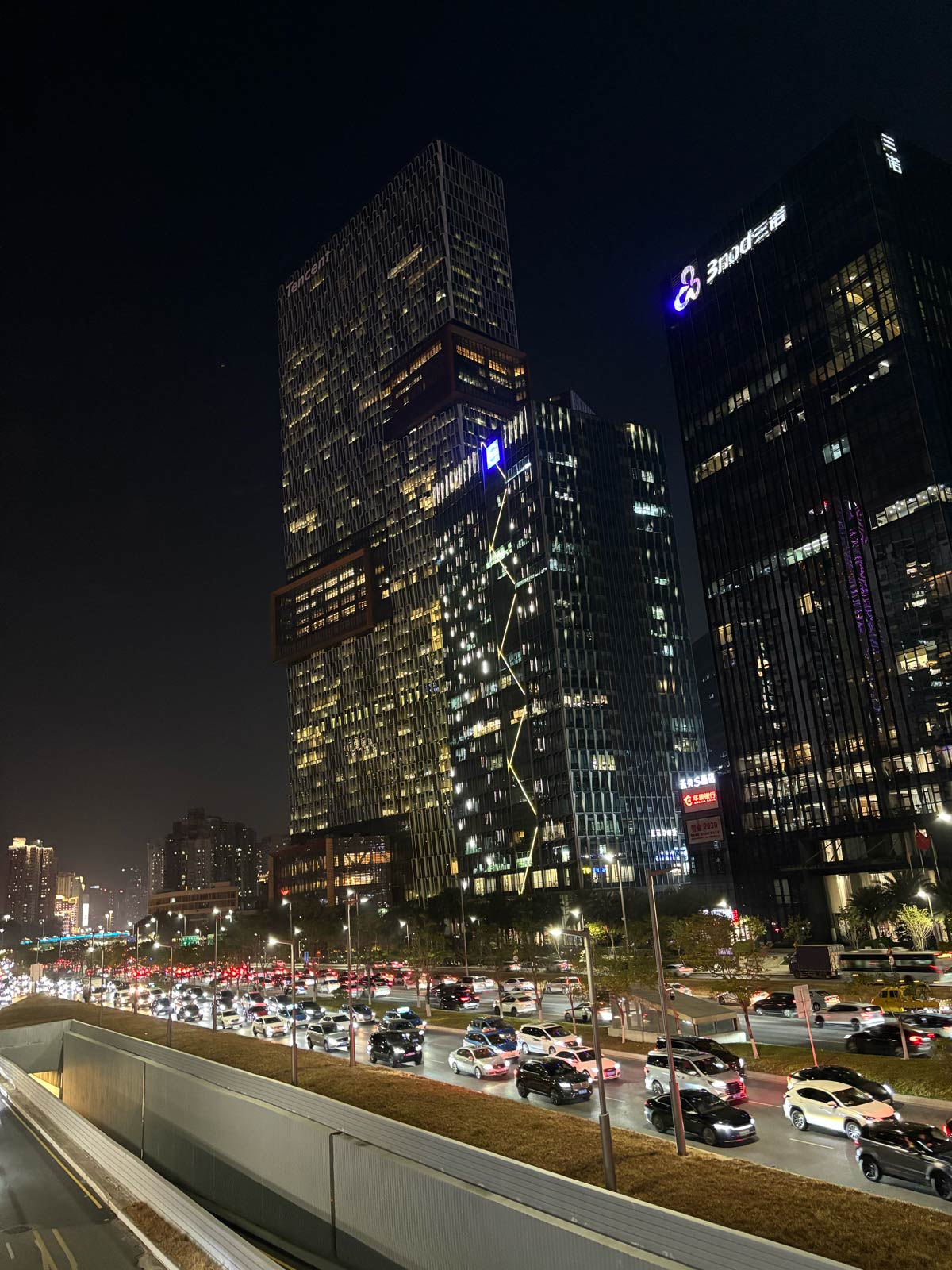
As I began to investigate the forces that gave rise to the ‘low-altitude economy’, I could not help but think of my encounter with those two traffic jams on and below a pedestrian bridge in the high-tech Nanshan District of Shenzhen. It appears that a city known for speed is being held back by its own aspiration to move faster. This contradiction is manifest in the urge to buy and drive one’s own car despite limited parking spaces and rampant road congestion (if not the additional work hours required to maintain it). It is also shown in the delivery riders’ troubled navigation of the city’s many pedestrian bridges intended to speed up the movement of cars but potentially slowing the door-to-door delivery of goods. As anthropologist Max Hirsh (2016: 103) suggests, special border zones such as Shenzhen ‘owe their very existence to the privileging of movement—of goods, of people, of foreign capital; and their spatial layout revolves invariably around infrastructures of mobility—train stations, highways, air- and seaports—that connect them’. Hirsh points out that this privileging of mobility may come into tension with intercity rivalry (with Hong Kong, for example) and the state mandate to contain its growth. But what may also be observed is that the desire to accelerate mobility, which informs the expansion of a horizontal road into a three-dimensional structure that is the pedestrian bridge, can also cut into the efficiency it aspires to enhance.‘Building a road into the lower airspace’ (把‘路’修到‘低空’去) is a line from the Shenzhen Unmanned Aerial Vehicles Association’s announcement of the Eighth World Drone Conference (or the International Low-Altitude Economy and Drone Exhibition) that was held in Shenzhen in May 2024, with the theme ‘Low-Altitude Economy, the Future’ (低空经济, 未來已來). The conference exhibition poster depicts a range of ‘human-less’ (无人) devices, from self-driving cars to electric vertical take-off and landing aircraft (eVTOL), from uncrewed ships to robots against the silhouetted backdrop of Shenzhen’s key architectural landmarks. If skyscrapers may be seen as vertical extensions of the city into the sky, these ‘human-less machines’ appear to further stretch the three-dimensional limit of that future ‘City in the Sky’, even as it leaves open the question: what of the humans in this future?
A More-than-Human Formation
According to the International Digital Economy Academy (or IDEA, whose Chinese name is the more location-specific 粤港澳大湾区数字经济研究院), ‘low altitude’ refers ‘in principle to the airspace with a vertical distance of less than 1,000 meters from the ground directly below, which can be extended to 3,000 meters according to the characteristics and actual needs of different regions’. What is considered ‘low’, then, is best understood as a ‘virtual concept’. The same article, reposted on the website of the Shenzhen UAV Industry Association (深圳无人机行业协会), goes on to suggest that this ‘low-altitude airspace is the most common natural resource found above the earth’s surface’. Unlike air and other material and energy in this space, this airspace is ‘an immovable space resource with significant location value’, with ‘characteristics of a public pond’ (公共池塘资源特性), albeit positioned ‘in an awkward “sandwich layer”’ (夹心层) (Shenzhen UAV Industry Association 2024a).
Notably, the writing emphasises that the airspace ‘is a natural resource that has existed since ancient times’, the lower portion of which is now waiting to be converted into ‘economic resources’ (Shenzhen UAV Industry Association 2024b). The invocation of ‘location value’ points to the need to reconfigure the physical space through an informational apparatus. In the words of Li Shipeng, the head of the low-altitude economy research branch of IDEA, ‘the low-altitude airspace is not only a physical space for low-altitude flying but should become an important productive element [生产要素] for realising new commercial and social values’. A ‘prerequisite’ for expanding this economy, Li adds, is to ‘build a unified low-altitude intelligent integrated infrastructure to transform low altitude into a calculable airspace’. This means using ‘modern digital technology’ to ensure ‘large-scale, sustainable, and high-quality rapid development in a safe and controllable manner’ (Nanfang Daily 2023).
To turn physical airspace into a value-generative economic resource, then, relies on digitising that space so that the ‘roads’ in the sky can be equipped with proper ‘traffic rules’ enforceable through ‘advanced communication, computing, sensing, flight control and other technologies’ (Chen et al. 2024). What is being envisioned is nothing less than a media-infrastructure complex that blends ‘hard infrastructure’ with ‘soft infrastructure’. The former involves ‘physical infrastructure’ that includes ‘low-altitude flight take-off and landing transfer, cargo loading and unloading, passenger waiting, aircraft charging (recharging), flight testing and other infrastructure’ and the latter refers to ‘information infrastructure’, entailing ‘low-altitude flight communications, navigation, surveillance, meteorological detection … as well as low-altitude flight digital management service systems’ (Zhao and Wang 2024). This media-infrastructural formation appears central to the future growth of the low-altitude economy, and it is no accident that Shenzhen has become a pioneering site for developing this new, three-dimensional, and ‘comprehensive economic form’ that can bring a multitude of industries into convergence (Shen 2024).
One of the oft-mentioned entities in the low-altitude economy discussion is the Shenzhen-based drone company DJI (大疆). According to the People’s Daily, with its ‘flight control, gimbal, image transmission, self-developed imaging system … currently accounting for more than 70 per cent of the global market’, the firm is ‘at the forefront of the transformation of drones into productivity tools’ and ‘is leading the popularisation of drone applications in multiple vertical industries’ (Yang 2024). In 2023, DJI reportedly sold more than 300,000 agricultural drones worldwide, ‘with flight tracks covering more than 100 countries and regions’ (Chen et al. 2024). Its spokesperson attributes its success to ‘core technologies’ as well as a ‘supply chain and production and sales system’ plus ‘after-sales maintenance and other full business chains’ (Yang 2024).
Self-branded as ‘the future of possible’, DJI’s scale of global success is closely tied to its technical knowhow. For Lü Renli, researcher and director of the General Aviation Department of the Civil Aviation Administration and the author of multiple ‘Blue Books’ for Chinese aviation and civilian drones, there are specific, even ‘disruptive’, technical breakthroughs that have allowed DJI to outpace others in the construction of the new low-altitude economy. Backing the ‘stable hovering and simple control function’ of the ‘Phantom 1’ aerial photography drone released in 2012, for example, were ‘the drone’s computing power, algorithms and communication capabilities … utilising and combining the lightweight and miniaturisation technology of key components in the mobile communications industry’. In other words, it is the ‘digital indigeneity’ of these ‘human-less aircraft’ that distinguishes them from those piloted by humans in previous developments in aviation technology (Lü, R. 2024).
The celebration of DJI’s ‘human-less machine’ as a pioneer figure in the low-altitude economy also points to the recognition that more-than-human capabilities are needed to manage this ‘archetype of new-quality productive forces’ (新质生产力) (Lü, R. 2024). To that end, IDEA launched the ‘Open SILAS (Smart Integrated Lower Airspace System)’ to ‘connect numerous cities, organizations, and businesses to collectively create a system of standards’ that can be applied nationally in the future. The hope is to mobilise artificial intelligence and related technologies to address the traffic that might ensue when the low-altitude economy scales up to a high degree of heterogeneity, density, frequency, and complexity (Xinhua Insight 2024). Again, as Li Shipeng mentions in an interview with the People’s Daily, Shenzhen’s ‘many years of accumulation and sedimentation in the fields of electronic information, big data, artificial intelligence, etcetera’ have granted the city ‘a unique advantage’ (Lü, S. 2024).
It is telling that Open SILAS is sometimes dubbed the ‘digital brain of the low altitude’ (Ye 2024). At work is an image of the city as an organism not unlike a human—with a brain-like unit for control—but also endowed with capabilities that exceed those of a human. This more-than-human aspiration also arguably relates to the human–nonhuman hybrid vision afforded by drone photography. As I have argued elsewhere, drone footage has become a trope in official representations of China’s infrastructural projects, including those in the GBA (Yang 2023a). These slow-moving images typically position the viewer as an explorer who can identify with the drone’s eye view to marvel at the large-scale constructions carried out by the state. A similar pattern can be discerned in televisual coverage of the low-altitude economy, whether it is footage that shows the drone delivery of goods or the human-carrying eVTOLs for point-to-point transportation. These scenes—invariably shot in perfect weather and featuring no more than one flying vehicle against the backdrop of a pollution-free blue sky—invite the viewer to imagine inhabiting a clean and safe airspace above the congested infrastructure on the ground.
Having witnessed the traffic jam on and below that pedestrian bridge in Shenzhen last January, I couldn’t help but notice the contrast between this vision of a lone traveller roaming a clean lower airspace and the busy web of flying objects often seen in sci-fi movies, if not the dystopian look of a polluted sky typical of Chinese cities. The anticipated congestion in the sky, after all, is what prompts the need for a ‘lower-altitude brain’ to manage and control the space. Companies such as Meituan are also featured in these videos as enabling speedier deliveries of medical supplies, food, and consumer goods, highlighting the capacity of their drones to overcome the geographical barriers faced by human couriers (Xinhua Insight 2024). But the spectre of an airspace jam is arguably already looming. After all, Shenzhen has reportedly ‘opened 212 cargo drone routes’ and launched more than 900,000 cargo drone flights since 2023. Nationwide, the first half of 2024 saw China registering ‘more than 600,000 new drones, and the total number of drones increased by 48 per cent compared with the end’ of the previous year. There is ample indication that ‘China’s low-altitude economy is entering a new stage of rapid growth’, with ‘more than 14,000 drone companies holding valid civil unmanned aircraft operation certificates, and more than 225,000 people as licensed drone operators.’ There appears to be an urgent need to properly carve out and distribute ‘airspace resources’ as the ‘flat economy’ transforms into a ‘three-dimensional economy’ (Ye 2024).
The GBA and ‘City in the Sky’
In this admittedly very preliminary study of the low-altitude economy, it is notable how many border-crossing activities between Shenzhen and Hong Kong (among other cities in the GBA) have informed its development. The CEO of DJI, Wang Tao, for example, was educated at Hong Kong University of Science and Technology (HKUST) before founding the company in Shenzhen. Li Shipeng, the IDEA spokesperson, is affiliated with the Chinese University of Hong Kong’s Shenzhen campus and HKUST’s Guangzhou branch. The latter in April 2024 established the Low Altitude Systems and Economy Research Institute (LASERi), which ‘will serve as an anchor to initiate collaborations with the Shenzhen IDEA Research Institute and HKUST as a first step’ (HKUST 2024).
Several years ago, the GBA was perhaps still a slogan for the future promulgated through state media spectacles, such as the 1,000-drone formation of ‘Greater Bay Area, Greater Future’ in Guangzhou (Wang 2021). Now, that future appears to be closer, with the idea of a GBA ‘lower-altitude economy circle’ becoming more palpable. With its total economic output surpassing RMB14 trillion, the GBA has seen the rapid growth of low-altitude economy businesses, including ‘tourism and entertainment, cross-border flights, intercity flights, air commuting, and medical ambulances and emergency rescues’ (Fang 2024). For some, the GBA has evolved ‘into two “low-altitude economic cross-belts”’, referencing ‘the production and manufacturing service belt with Guangzhou, Zhuhai and Foshan as the core’ and ‘the productive financial service belt with Hong Kong, Macau and Shenzhen as the core’ (Fang 2024). For others, such as Li Shipeng, there remains the issue of ‘cross-border transportation’ between Shenzhen and Hong Kong due to the lingering presence of ‘juxtaposed controls’ or, literally, ‘two customs in one location’ (一地两检). In Li’s view,
those working and living in the northern part of Hong Kong may be able to order take-outs via drones from Shenzhen in the future; things like this are technically possible, and it mainly depends on whether the government has effective policies and measures to encourage and control them. (Chen 2024)
In Li’s eyes, geographic boundaries may be easily crossed thanks to technology, but political demarcations are perhaps more challenging to overcome even as economic imperatives tend to demand the dissolution of borders.
My conception of Shenzhen as a media-infrastructure complex, then, aims precisely to draw attention to these tensions and contradictions—some latent and others already visible—in the unfolding phenomenon of the low-altitude economy. As someone who grew up watching Hong Kong TV and consuming imported goods from Hong Kong in 1980s and 1990s Shenzhen, I have experienced the highly securitised and yet porous Shenzhen–Hong Kong borders at first hand. More recently, friends in Shenzhen and Hong Kong alike have reported that Hong Kong residents are increasingly travelling north to Shenzhen for entertainment, leisure, and even grocery trips to Costco—a reversal of flows from a few decades ago—due to the excruciatingly high costs of living in the Hong Kong Special Administrative Region and the rapidly improving quality of life in Shenzhen. The latest formation of the low-altitude economy simultaneously reminds us of the continuity of border-crossing activities that persist from the past into the present and points to the multidimensional reconfiguration of borders in the making of the GBA.
Certainly, my initial investigation has generated more questions than answers: What kinds of cultural imaginaries stem from the vision of building Shenzhen as a ‘City in the Sky’—a name also used to describe DJI’s newly completed futuristic headquarters in Nanshan, designed by Foster and Partners and informed by a sort of drone aesthetics? How does the low-altitude economy figure in the troubling geopolitical conditions in which China finds itself, especially amid the intensifying US–China high-tech rivalry and post-pandemic economic slowdown? How might the aspirations for the more-than-human haunt the (differently classed and gendered) humans who remain trapped in the (dehumanising) systems of industrial, platform, and infrastructural capitalism? As the low-altitude economy continues to engage vertical, aerial, digital, and more-than-human means in shaping the contours of Shenzhen and the GBA, critical questions like these are worth bearing in mind.
References
Benjamin, Medea. 2013. Drone Warfare: Killing by Remote Control. London: Verso Books.
Chen, Kaixing 陈凯星, Wang Pan 王攀, and Mao Siqian 毛思倩. 2024. ‘从“创新之城”到“天空之城”—来自深圳的低空经济“近观察” [From “City of Innovation” to “City in the Sky”—A Close Look at Shenzhen’s Low-Altitude Economy].’ 经济参考报 [Economic Information Daily], 3 June. www.news.cn/fortune/20240603/e51484eac62740de9bb77962048441e5/c.html.
Chen, Peizhen 陳佩珍. 2024. ‘IDEA研究院低空經濟分院執行院長李世鵬: 未來, 我國會引領低空經濟在全球的發展 [Li Shipeng, Executive Director of the Low-Altitude Economy Branch of the IDEA Research Institute: In the Future, Our Nation will Lead the Global Development of Low-Altitude Economy].’ 香港經濟導報 [Economic Herald], 5 September. www.jdonline.com.hk/content_88197.html.
Chuang. 2020. ‘Delivery Workers, Trapped in the System.’ Chuang, 12 November. chuangcn.org/2020/11/delivery-renwu-translation.
Fang, Junming 方俊明. 2024. ‘記者觀察: 灣區「低空經濟」多優勢率先起航 [Reporter’s Observation: The GBA’s “Low-Altitude Economy” Takes the Lead with its Many Advantages].’ 香港文匯網 [Hong Kong Wenwei Po], 10 March. www.wenweipo.com/a/202403/10/AP65ed6a58e4b0ad017f0d3aca.html.
Hildebrand, Julia M. 2021. Aerial Play: Drone Medium, Mobility, Communication, and Culture. London: Palgrave Macmillan.
Hirsh, Max. 2016. Airport Urbanism: Infrastructure and Mobility in Asia. Minneapolis, MN: University of Minnesota Press.
Hong Kong University of Science and Technology (HKUST). 2024. ‘The Low Altitude Systems and Economy Research Institute has been Established, and HKUST(GZ) Takes the Lead in Taking Off!’ Press release, 12 April. Guangzhou: Hong Kong University of Science and Technology (Guangzhou). www.hkust-gz.edu.cn/2024/04/12/the-low-altitude-systems-and-economy-research-institute-has-been-established-and-hkustgz-takes-the-lead-in-taking-off.
Lü, Renli 吕人力. 2024. ‘低空经济的背景、内涵与全球格局 [Background, Meanings and the Global Landscape of the Low-Altitude Economy].’ 人民论坛 [People’s Forum], 19 August. finance.sina.com.cn/jjxw/2024-08-19/doc-inckeanh4585086.shtml.
Lü, Shaogang 吕绍刚. 2024. ‘深圳低空经济蓄势高飞 [Shenzhen’s Low-Altitude Economy is Poised to Take Off].’ 人民日报 [People’s Daily], 6 July. paper.people.com.cn/rmrb/html/2024-07/06/nw.D110000renmrb_20240706_1-06.htm.
McQuire, Scott. 2008. The Media City: Media, Architecture and Urban Space. London: SAGE.
Nanfang Daily. 2023. ‘抢占低空经济先机 构建数字“高速空路网” [Seize the Opportunity of Low-Altitude Economy and Build a Digital “High-Speed Air Network”].’ 南方日报 [Nanfang Daily], 26 May. epaper.southcn.com/nfdaily/html/202305/26/content_10061993.html.
PEDaily 投资界. 2024. ‘2024 低空经济元年 [2024, the First Year of the Low-Altitude Economy].’ 新浪财经 [Sina Finance], 16 April. finance.sina.cn/2024-04-16/detail-inarywyy1720493.d.html?from=wap.
Pun, Ngai. 2024. ‘China’s Infrastructural Capitalism and Infrastructural Power of Labor: The Making of the Chinese Working Class.’ positions: asia critique 32(2): 341–69.
Richardson, Kathleen. 2015. An Anthropology of Robots and AI: Annihilation Anxiety and Machines. London: Routledge.
Shen, Yingchun 沈映春. 2024. ‘低空经济: “飞”出新赛道 [Low-Altitude Economy: “Flying” A New Track].’ 北京日报 [Beijing Daily], 13 May. theory.gmw.cn/2024-05/13/content_37319960.htm.
Shenzhen UAV Industry Association. 2024a. ‘低空经济专题|风起云涌的低空经济(一) [Special Topic on the Low-Altitude Economy: The Surging Low-Altitude Economy (I)].’ News, 15 January. 深圳无人机行业协会[Shenzhen UAV Industry Association] website. www.szuavia.org/news_cen.php?cid=105&id=7304.
Shenzhen UAV Industry Association. 2024b. ‘低空经济专题|风起云涌的低空经济(二) [Special Topic on the Low-Altitude Economy: The Surging Low-Altitude Economy (II)].’ News, 15 January. 深圳无人机行业协会 [Shenzhen UAV Industry Association] website. www.szuavia.org/news_cen.php?cid=105&id=7305.
State Council. 2024. ‘2024年政府工作报告 [Report on the Work of the Government (2024)].’ 中国网 [China.Org], 14 March. www.china.org.cn/chinese/2024-03/14/content_117057714.htm.
Wang, Zhuangfei 王壮飞. 2021. ‘“大湾区 大未来” 千驾无人机点亮广州夜空 [“Greater Bay Area, Greater Future”: Thousands of Drones Light Up the Night Sky of Guangzhou].’ 中国日报 [China Daily], 20 April. cn.chinadaily.com.cn/a/202104/20/WS607e73a3a3101e7ce974a2f2.html.
Xinhua Insight. 2024. ‘Open SILAS—深圳低空, 标准先行 [Open SILAS—Shenzhen Low-Altitude, Standards First].’ 新华视点 [Xinhua Insight], 24 June. mp.weixin.qq.com/s/K2lb-Ct51TcQvYAsjL8F3Q?poc_token=HDMC2majefv7F2fdYBV4xWvDac3r24zK2gB6K6jG.
Xulagudeyouhuo. 2022. ‘來源於生活, 創造未來 [Originating from Life, Creating the Future].’ WeChat, 28 August.
Yang, Fan. 2023a. ‘Making the Future with the Nonhuman: Shenzhen, the Greater Bay, and “Made in China Intelligently”.’ China Perspectives 135: 9–16.
Yang, Fan. 2023b. ‘Window of the World: Transparency, Digital Placemaking, and Shenzhen Urbanism.’ City, Culture and Society 34: 100518.
Yang, Fan. 2025. ‘The Human–Nonhuman Entanglement of Urban Chinese Foodways: Food Delivery, the Platform Economy, and Digital Culture in China.’ In Modern Chinese Foodways, edited by Jia-Chen Fu, Michelle T. King, and Jakob A. Klein, 129–48. Cambridge, MA: MIT Press.
Yang, Junfeng 杨俊峰. 2024. ‘把“路”修到低空去 让低空 [Build the “Road” into Low Altitude, Let the Low-Altitude Economy Fly Better and Further].’ 人民日报海外版 [People’s Daily Overseas Edition], 30 January. www.chinanews.com.cn/cj/2024/01-30/10155158.shtml.
Ye, Zi 叶子. 2024. ‘打造低空经济“数字大脑” [Building a “Digital Brain” for the Low-Altitude Economy].’ 人民日报海外版 [People’s Daily Overseas Edition], 20 September. www.ce.cn/cysc/tech/gd2012/202409/20/t20240920_39145204.shtml.
Zhao, Xianlong 赵显龙, and Wang Tao 王涛. 2024. ‘低空基础设施的开发与开放 [The Development and Opening of Low-Altitude Infrastructure].’ WeChat, 7 June. mp.weixin.qq.com/s/900YslslddVeSmYKy1ijmQ.