
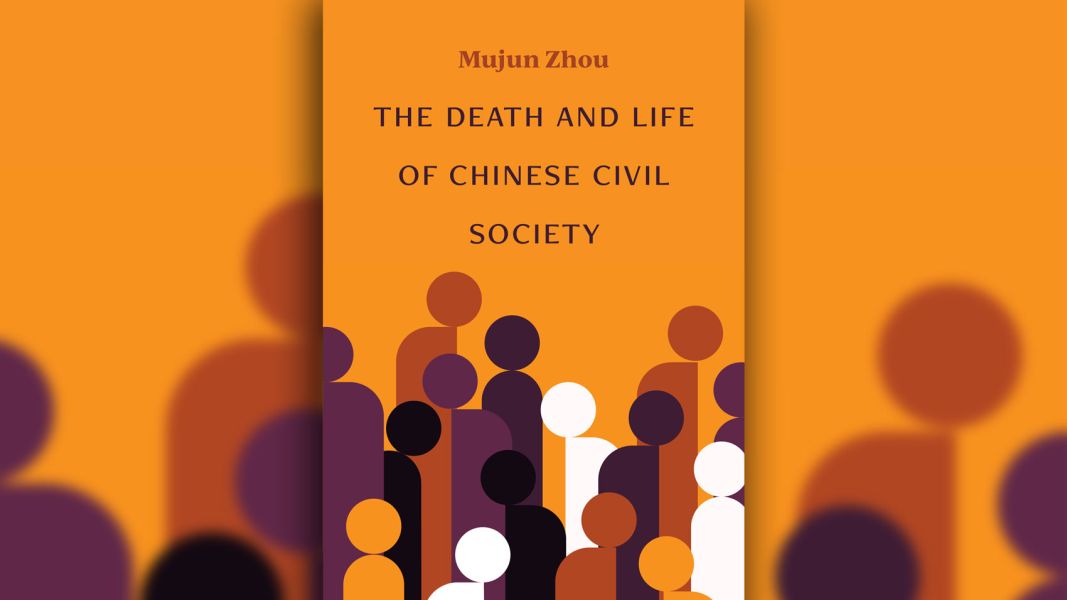
The Death and Life of Chinese Civil Society
A Conversation with Mujun Zhou
In her new book, The Death and Life of Chinese Civil Society (University of Michigan Press, 2026), Mujun Zhou provides an ambitious and insightful account of the concept of ‘civil society’ (公民社会) as an ideational movement that informs, inspires, and at times conflicts with the development of Chinese civil society, from the early 1990s to the present. The book draws on her decades-long empirical work to describe the strengths and limitations of two fundamental concepts: ‘civil society’ and the ‘public sphere’. The result is a critique of those who guard the term ‘civil society’—whom she calls the ‘liberals’—examining their world view, the structural conditions shaping them, and their tensions with other activists and intellectuals.
Bin Xu: Your book highlights the ideational aspect of civil society, including its ‘life and death’, since the 1990s. This focus differs from the dominant paradigm in the field of Chinese civil society that emphasises associations’ organisational features and their strategies for dealing with the authoritarian state. What made you choose this perspective and what does it reveal?
Mujun Zhou: When I began to study social movements and nongovernmental organisations (NGOs) in China around 2010, I encountered a long-running debate in this field about whether China had a civil society. In this debate, which began in the 1990s, some scholars held a positive opinion and used the concept to denote newly emerging organisations in China’s transition to a market economy, such as NGOs and homeowners’ associations. Others emphasised that civil society was only a Western concept; they argued that many organisations that had been treated as elements of Chinese civil society were either highly embedded in the state or lacked the capacity to promote civic participation and democracy. In my view, this kind of debate could easily reach a stalemate, because one’s position would be largely contingent on how one defines the concept of civil society.
Yet, being immersed in many public debates in China during that time, I felt strongly that the idea of ‘civil society’ was far from a mere academic dispute. Public intellectuals of different kinds were talking about civil society theories, drawing on the concept to criticise social problems or envision a desirable political future. Many grassroots activists were also drawn to the concept and from time to time employed it in their public expression. This illustrated to me a plain fact: even if China did not have a civil society that conformed to Western ideals, civil society as an idea had already become influential in this country. Based on these concerns, I began to examine the ideational dimension.
The conventional approach in this field, which emphasises the associations’ organisational features and their strategies for dealing with the state, is both effective and indispensable. But my approach reveals a vital aspect that has long been overlooked: ideas are powerful because they create new facts. In the book, I devote substantial space to describing how the liberal camp, formed on an abstract idea, thematised social problems and pushed the state to address them. Of course, I do not mean to suggest that the power of ideas is limitless. I also elaborate on how the influence of the liberals was contingent on concrete social conditions, as well as the many unintended consequences that arose from their interventions in social movements.
BX: If I may use a drama analogy, the ‘protagonists’ of your analytical story are what you call the ‘liberals’. Who are they and have they evolved over time? Is there any internal diversity among them and do they accept this label themselves?
MZ: In the Chinese context, ‘liberal’ is a fluid concept. The liberals of the 1990s were mainly social science scholars working in universities and research institutes. They discussed the idea of civil society within what I call the ‘thought sphere’ (思想界), in which scholars debated political and philosophical theories to criticise social problems and engage with public issues. This group expanded in the 2000s as the media sphere and the NGO sphere developed. The new liberal camp then included not only scholars but also journalists, human rights lawyers, and some NGO practitioners.
Even in the 1990s, the liberals exhibited diverse ideological positions. Among those who were labelled liberals, there were classical liberals, who believed in the superiority of the market and private property. There were also social liberals, who saw liberty and social justice as being of equal importance. The liberal camp became more heterogeneous in the 2000s, with members often disagreeing on issues such as populism and cooperation with the state. Nonetheless, I contend that the liberals were still a group bound by shared values. What brought these people together was the idea of civil society, or an imagining of politics that treated the state and society as antithetical.
Not everyone within the liberal camp accepted the label. The term became increasingly controversial after the late 2000s. On the one hand, during that period, many actors, such as environmental activists, became more pragmatic. They preferred to emphasise that their work was aimed at solving practical problems, rather than promoting abstract political ideas. On the other hand, many political ideals proposed by other intellectual groups, notably the New Left, began to gain traction. Many liberal activists would also absorb some New Left discourse, such as that about social justice and even class. However, from a historicist perspective, the ‘liberals’ as a label is worth analysing. First, the ‘liberals’ is a term that has been widely used in China’s public sphere since the 1990s. Second, it was widely believed that liberals were associated with a distinctive political ideal, which was to promote Chinese civil society. Third, major actors in the group had invested great efforts in combining the ideal with various forms of political practice.
BX: The most intriguing part of your empirical analysis is the complexity of relationships between liberals and other parts of China’s civil society, such as labour activists and feminists. These relationships have been informed by the liberals’ framings of their fellow travellers—for example, through their use of the broad term weiquan (维权, ‘rights protection’). Can you talk more about the complexity of such relationships?
MZ: A major thread in my book is tracing how the liberals projected their image of politics, which centred on a binary view of state–society relations, onto people in wider society and the political consequences of this. With respect to the interpretation of weiquan, liberals emphasised the urgency of constraining and checking state power. This is a highly relevant political agenda in an authoritarian environment. However, liberals’ understanding of the state was abstract. They tended to ignore the many concrete roles the state could play in protecting rights, especially those of the socioeconomically disadvantaged. That explained their relative silence on many labour rights issues. During the 1990s and 2000s, the market-oriented reform of state-owned enterprises cost many workers their jobs and social security, triggering numerous protests. However, because market-oriented reform largely aligned with liberal political ideas, liberals rarely joined these protests. In their early years, liberals did pay considerable attention to the rights and interests of migrant workers, yet they focused more on how the household registration (户口) system hindered the free movement of migrant workers as labour in the market—namely, the civil rights of migrant workers. They rarely concerned themselves with the social rights of migrant workers.
Similarly, the liberals’ understanding of society was also abstract. They tended to be blind to many forms of power inequality within society itself. For example, when criticising the state’s family planning policy, most liberals only critique the state’s interference with individual reproductive freedom, while ignoring the issue of gender inequality in society. Therefore, many feminists criticise liberals for, in their view, wanting to take the right of reproductive decision-making back from the state only to return it to patriarchal families, while completely disregarding whether women will be empowered after the family planning policy is relaxed.
Nevertheless, I want to emphasise that my analysis of the relationships between liberals and other groups of activists demonstrates significant subtleties. As early as the 2000s, the New Left criticised the liberals, labelling their weiquan discourse ‘neoliberal’ and arguing that it primarily represented the interests of the urban middle class. This interpretation is also parochial. In the 2000s and the early 2010s, the liberals were actively involved in many social justice issues and many of them had incorporated some of the New Leftists’ concerns. This was why they were able to build alliances with people from diverse social groups. However, liberals’ overly reductionist thinking regarding state–society relations prevented them from grasping the complexity of politics and human conditions. As a result, the alliances they built were temporary and fragile.
BX: I am curious about the transnational aspect of ‘civil society’ as an ideational movement. How did the international context during the 1980s and 1990s and the revival of the concept of ‘civil society’ (including its various interpretations, ranging from conservative to neoliberal) shape Chinese liberals’ understanding of it? How do other transnational processes (for example, in feminism) influence their later understanding of the concept?
MZ: The text can, and should, be read from a transnational perspective. It addresses the political and social consequences of the global dissemination of the idea of civil society by offering a highly contextualised documentation of how Chinese actors received this idea and put it into practice.
The international context surrounding the revival of civil society was multifaceted. The democratic transitions in Central and Eastern Europe were, of course, a major impetus. However, other factors were equally critical. One was the rise of neoliberalism in major Western countries, where the concept of civil society gained prominence as policymakers sought to utilise charitable organisations to fill the void left by the retreat of the welfare state. Another factor was the institutional transformation of international development organisations. Since the 1990s, many of these organisations began advocating for civil society frameworks when launching development projects in the Global South. All these global dynamics played a role in how the idea of civil society was transmitted to China. Some liberals drew inspiration directly from resistance movement leaders in Central and Eastern Europe—notably, Václav Havel and Adam Michnik. These liberals tended to associate civil society with the promise of peaceful transition to democracy. Other liberals encountered the concept through their collaboration with international development organisations. These people usually equated the concept of civil society with NGOs or voluntary activism.
Transnational processes also influenced Chinese activists’ subsequent understanding of civil society. For instance, the global #MeToo movement inspired various forms of local activism against sexual harassment in China. However, I would like to highlight another macro-process here—one I did not fully elaborate on in my book. To a certain extent, the decline of civil society as an ideational movement in China is tied to the waning hegemony of the West. For the liberals, as well as many ordinary Chinese people in the 1990s and 2000s, civil society was a compelling idea because it was viewed as an integral component of Western democracy, which was then widely romanticised as a political ideal. However, as Western democracies have encountered their own profound crises over the years, people have become increasingly wary of Western-originated ideas, including that of civil society.
BX: A central theoretical intention of your book is to engage with Jürgen Habermas—who died earlier this year—especially his influential concept of the ‘public sphere’. How do you situate your book in this important theoretical debate?
MZ: Habermas substantially updates his theory of the public sphere in his two-volume monograph The Theory of Communicative Action. On the one hand, by exploring the idea of communicative rationality, which he posits as inherent to the human capacity for language, Habermas universalises the discussion of the public sphere. Rather than viewing the public sphere strictly as a product of specific historical contexts, such as the rise of bourgeois capitalism in the West, Habermas points to the latent potential for cultivating a public sphere across diverse environments, including non-Western contexts. On the other hand, by further distinguishing between system and lifeworld, Habermas anchors the public sphere in the concept of solidarity. He argues that it is through open and critical public discourse that the social integrative power of solidarity can override the systemic power of the state and the market; it is also through these often-contentious debates that people with different identities and interests come to recognise one another, thereby generating the collective strength needed to defend their lifeworld. I have been deeply inspired by these theoretical frameworks since I encountered them during my graduate studies.
Yet, Habermas’s theory offers very few clues for exploring the dynamics of the really-existing public sphere. The analytical framework derived from his work is rather fossilised. Aside from suggesting that rational critical public discussion requires an autonomous space that brackets state and commercial power—a space that he and other scholars locate within civil society—Habermas tells us little about the empirical mechanisms through which critical and reflexive public opinion is forged. It is therefore necessary to bring sociology back into Habermas.
My book represents an initial attempt at this synthesis. I deploy the concept of the interstitial space to analyse the emergence of China’s public sphere and its historical transformation. I define an interstitial space as one in which the exercise of power has not yet been fully institutionalised. This concept offers two primary analytical advantages. First, it widens our scope in the search of the public sphere. It implies that a public sphere does not require absolute autonomy to generate critical public opinions. Social activism that leads to the production of critical public opinions could emerge interstitially from within dominant institutions of power. Second, the concept provides a clue for understanding the changing dynamics of a public sphere over time. I emphasise that activism in an interstitial space is highly susceptible to institutionalisation. Hence, we must trace the ongoing interactions between interstitially emerging actors and the powerful institutions surrounding them. We must also consider the many unintended consequences these interactions may create.
BX: Finally, why did you choose the word ‘death’ in the title of your book: The Death and Life of Chinese Civil Society. Do you mean to argue that Chinese civil society is dead? Or that the concept of ‘civil society’ is dead? Or perhaps you imply something else?
MZ: The initial title of my book was ‘Interstitial Publics: The Rise and Fall of Civil Society as an Ideational Movement in China, 1992–2019’. However, the editors at the University of Michigan Press felt the title was too academic, which would hinder its marketability. One of the editors suggested the title The Death of Chinese Liberalism. This was a bit too sensationalist for me and it did not quite capture the analytical complexity and subtleties for which my book was striving. Eventually, I kept the word ‘death’. The current title is a tribute to Jane Jacobs’ classic sociological work The Death and Life of Great American Cities, in which she illustrates the dynamic process of American urban renewal. On the one hand, arbitrary urban planning dismantled the vibrant community ecosystems that had originally existed within cities. On the other hand, she highlights how interconnected community networks work to protect and preserve these ecosystems.
We must understand ‘death’ and ‘life’ in tandem. Some elements of Chinese civil society that once played important roles in the formation of critical public opinion are indeed defunct. A case in point is the NGO sector. Although the number of NGOs, or ‘charitable organisations’, in China keeps growing, they operate in close cooperation with the state and systematically shy away from agitational activities. While they may still be capable of providing services to disadvantaged groups, they no longer actively engage in critical public discussions. However, I do not think civil society or social movements are entirely dead. As China’s economic growth slows and the international environment rapidly shifts, social conflicts remain numerous and varied. The Chinese State is far from omnipotent; it cannot solve every systemic problem, nor is it capable of stifling all dissent. Critical public opinions will inevitably continue to find expression through other channels and in alternative ways.