

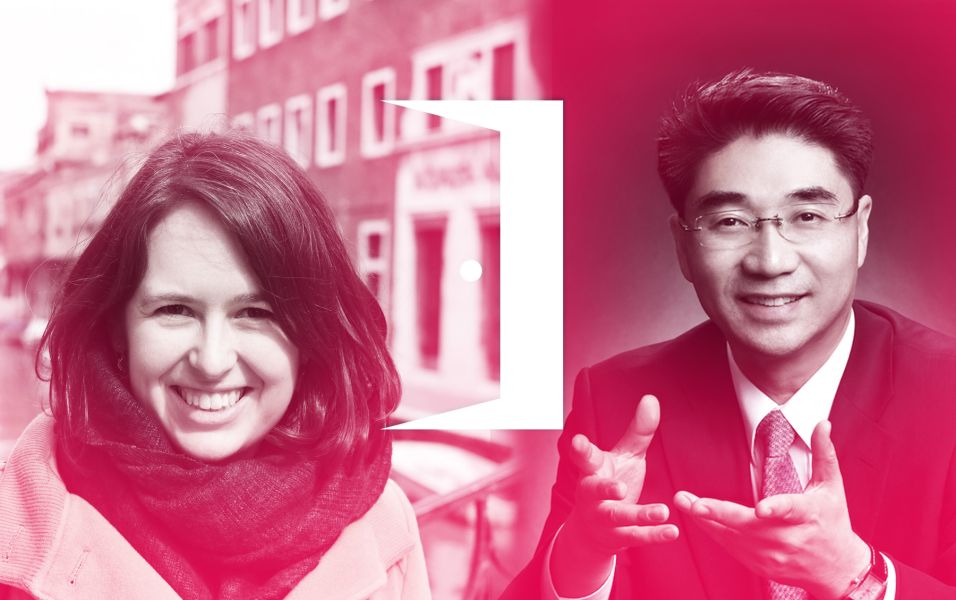
Episode 11 | To Feed and to Cure
The need for food and medicine is universal. Yet, few subjects have stirred as much nationalistic debates on both sides of the Pacific as the development and application of biotechnologies. Why, in a country scarred by famine like China, did the public turn against genetically modified crops? Should medicine be a commodity, and if so, what role should a nominally socialist state play in bringing new drugs to market? Can a company be both patriotic and globally successful? And can Chinese and American scientists collaborate to find a cure for cancer? For this episode, Yangyang spoke with sociologist Abigail Coplin and physician-scientist Chenjian Li on the power and limitations of biotechnologies, and how the body can become a geopolitical battleground and a site for profit.
Guest Bios:
Abigail Coplin is an Assistant Professor of Sociology and Science, Technology, and Society at Vassar College. Her research analyzes the development of China’s biotechnology and agrobiotechnology industries to unpack how scientific innovation, business, and regime legitimacy co-evolve in the contemporary People’s Republic of China, how the Chinese state contends with scientific experts and incorporates expertise in its governance schemes, and how China’s pursuit of high-tech development is restructuring relationships among Chinese society, industry, and the party-state. She is currently completing a book manuscript titled Domesticating Biotechnological Innovation: Science, Market, and the State in Post-Socialist China.
Chenjian (C.J) Li is a professor in the School of Life Sciences at Peking University and a research fellow at the Hoover Institution of Stanford University. His expertise is in the field of neurodegenerative diseases, neuroscience and higher education. Li attended Peking University and Peking Union Medical College, and received his Ph.D. in Molecular Genetics from Purdue University. Before returning to Peking University in 2013, he was an assistant- and associate professor at Weill Medical College of Cornell University, and then Aidekman Endowed Chair at Mount Sinai School of Medicine.
Related Materials:
Coplin, Abigail E. 2025. ‘Deng Xing Wang 邓兴旺: Plant Biologist.’ In Chinese Encounters with America: Journeys That Shaped the Future of China, edited by Deborah Davis and Terry Lautz, 241-268. New York, NY: Columbia University Press.
Economy, Elizabeth and Chenjian Li. 2025. ‘Bottom-Up vs. Top-Down: Inside the US and Chinese Innovation Systems with Chenjian Li.’ China Considered Podcast, 16 October. https://www.hoover.org/research/bottom-vs-top-down-inside-us-and-chinese-innovation-systems-chenjian-li
Zhou, Yu and Abigail E. Coplin. 2022. ‘Innovation in a Science-Based Sector: The Institutional Evolution behind China’s Emerging Biopharmaceutical Innovation Boom.’ China Review, 22(1): 39-76.
Full Episode Transcript:
Yangyang (00:00)
Every few months, my mother in China messages me with a stern warning: Do not consume food containing genetically modified organisms. Sometimes she forwards me an essay she saw online that claims GMO products are biological weapons engineered by American imperialists to harm the Chinese nation. Over the past few years, her warnings have expanded to include the COVID-19 vaccine. Do not take it, it’s dangerous.
I regret to say I have not followed my mother’s wishes, nor have I found a way to assuage her anxiety. Twenty years ago, when I was a university student in China, my mother tried to persuade me to drop physics and become a biology major. She had heard that physics is the discipline for the twentieth century, while the twenty-first century is the era of biology.
It might be difficult to reconcile my mother’s faith in the promise of biotech and her fear of its products, but she is far from alone. What the conspiracy theories and contradictory views expose are contested boundaries between the self and the foreign and between preservation and change. To ask what the biological sciences can or cannot do is also to probe what it means to be human and to feel safe in this world.
I’m so excited to discuss this rich and timely topic with two leading scholars. First up, we have Dr. Abigail Coplin, Assistant Professor of Sociology and Science, Technology and Society at Vassar College, and a former chemistry major. Abby, thanks so much for joining us.
Abigail Coplin (01:35)
Thank you so much for having me. It’s such a pleasure to be here.
Yangyang (01:38)
I know I admire anyone who actually studies chemistry or biology because chemistry was actually my worst subject in high school.
Abigail Coplin (01:46)
Well, my math is far too sloppy for physics, so I admire you.
Yangyang (01:50)
And I’m an experimentalist, so not that much math either, but and… but you have been studying biotech development in China and US-China relations for scientific exchange for many years. And much of your earlier work is actually on GMO and its reception in China. And as I know it, like genetic modification in agriculture is not new in China, right? And I don’t really recall there was so much public controversy when I was a child.
So how did the Chinese public suddenly decide to turn against GMO? Like when did it start? Was there a specific trigger? Were there more longer-term reasons?
Abigail Coplin (02:27)
Yeah, so interesting question, for a variety of different reasons. And particularly in this political moment, a lot of attention into biotech and the US-China relationship is really focused on biomedical applications. Because for a really long time, as you say, in China the story was all about agriculture. China has been investing in agro-biotech and genetic modification in particular since the 863 program, when Chen Zhangliang and some other early returnees really advised the government that this was an industry in which China could get in at the cutting edge rather than having to catch up like semiconductors. And so actually the first genetically modified product to be commercialized, much to — you know, most Americans don’t realize — was actually not the flavor-saver tomato, but rather a genetically modified tobacco in China that actually ended up quickly pulled from the Chinese market because they could not export it to the US and Europe at the time. And so, as you say, you know, I think when people look at how big the controversy around genetically modified organisms became in China, they assume that — you know, it’s the same story that we see elsewhere, that it’s the same politics in the US, et cetera.
And that’s actually not the case. For one thing, as you allude, for a really long time, especially the early 90s, et cetera, or kind of through the early 2000s, the Chinese public was actually pretty supportive of genetically modified organisms. At best, they were kind of apathetic and were saying, you know, we have real food security problems, and this is a way of solving it.
At best, actually, people saw it as a form of high-tech food and kind of imbued it with the same kind of techno-optimism that we see in other spaces. That, as you say, however, starts to change around 2008, 2009. There’s a few incidents in which a variety of genetically modified rice ends up being — Greenpeace, actually, you know, publishes that they are finding a genetically modified rice that had gotten a safety certificate for field trials, but not been fully approved yet for the market, that they’re finding samples in grocery stores, et cetera. Similarly, there’s the golden rice scandal, where it turns out that American researchers affiliated with Tufts were feeding Chinese children in rural areas golden rice but that the consent forms had not explicitly said that it was a genetically modified product. And so there’s like a number of different incidents that kinda ratchet up public distrust of GMOs. But what’s important to realize there is that it actually gets entangled with broader food safety concerns and notions of regulatory failure and so it’s a very different politics than it is in the US. There’s a sense of, you know, if you can’t keep melamine out of infant formulas, how are you going to regulate GMOs?
One of the other things that’s interesting about it though, well, two other aspects. One, as you say, the discourse is couched in this really hyper-nationalistic language that really puts the stake of the nation at stake in terms of how it’s being discussed. I think that stems actually from how agro-biotech, the discourse in which agro-biotech has been situated in China generally, that it is always framed by the government, by scientists, by everyone as kind of this very nationalist project, right? That it is about solving food security for the nation, that it is about the good of the nation. And so then those who end up criticizing the technology end up kind of couching their language in the same discourse. The other thing that’s really distinctive about it, however, is that the criticism that you see around the controversy, around the GMO controversy in China, tends to be really directed at scientists themselves. I was doing interviews, ethnography, etc. There were images circulating around Weibo at the time that were basically a bingo card of all my research informants and labeling them as the transgenic black gang.
And so I think what we have going on there, it’s this interesting moment to kind of look at scientists and their ability to depoliticize what’s intrinsically a scientific controversy, right? You have this issue that is scientific in nature, right? Are GMOs safe or not? You would think that, particularly in the Chinese system, that an alliance of officials and scientists might be able to kind of depoliticize that, or at least that they would be the main people involved in decision making. But the scientists end up blamed for the controversy and yet end up really incapable of kind of putting the genie back in the bottle. And they end up incapable of kind of bounding it as something that only those with a particular kind of scientific expertise should be able to weigh in on. And so I think what that tells us is that scientists are frequently in a very powerful yet very precarious position. They’re kind of hybrid state-science actors in various ways. And so, you know, they get to have a really big role in policy making and advising the government on an industrial policy and building new institutions. And yet at the same time, the hybridity of their position means that the public often deems them, sees them, as state actors and state actors that you can get away with criticizing, in a way that you can’t get away with criticizing, you know, central-level officials.
Yangyang (08:10)
So thank you so much, Abby. And so speaking of the power and precarity of scientists, the public expectations and possible misunderstandings, we do have a scientist himself joining us on this show today. And so I’d like to bring in our second guest, who is a physician-scientist and works in both the United States and China. Dr. Chen Jian Li is a neuroscientist, a professor at Peking University School of Life Sciences, and a research fellow at Hoover Institution. CJ, thank you so much for joining us.
C.J Li (08:39)
Hello. Thank you for inviting me.
Yangyang (08:41)
So you grew up in China and you studied at Peking University before coming to the US for graduate school and you worked at a number of American universities, right, including Cornell University and Rockefeller before returning to your alma mater Peking University. So from your illustrious transnational and interdisciplinary career, from both your personal experiences and your observations, how do the Chinese people view advancements in biotech or in science and technology in general?
Do they believe in the power of science, as the state propaganda often says about science and technology as productive forces? Are they fearful of rapid technological changes as we often see here in the US? Are the public skeptical? How much of these experiences and reactions from the Chinese public mirror or differ from perceptions here in the US? And does that affect how a scientist like yourself work?
C.J Li (09:37)
Wow, that’s a set of very big questions that I think it needs probably three hours to explain, but I’ll be brief. Just very quickly, you forgot to mention that I had my medical training in Peking Union Medical College, that’s one of my aspects that I think is important for what I’m doing. In terms of the response to biotech slash pharmaceutical development, I think in general Chinese people are positive. It’s never monolithic. People have different views, but if you look at how modern medicine has brought better lives, better treatments and much longer lifespans into Chinese society. So by and large I think people are welcoming because they have seen how things are changed. Decades ago, if you suffer from a knee degeneration, then you limp for the rest of your lives. Today people just go and have an artificial knee. As simple as that. People see that as a pretty convincing advancement. Of course, medicine has its limits.
We, as physicians and scientists, biomedical scientists, often sort of feel inadequate in treating patients. Just yesterday we lost a dear friend to cancer, the famous economist Gao Shengwen. No matter how hard we tried, we lost him to cancer. So these are painful reminders that we are still far away from conquering and curing diseases and maintaining a healthy life for all the people. Not to say that medicine in China is very, very imbalanced. You have the wealthy and the powerful people enjoying pretty much the fruit of worlds, the global development, whereas the middle class and the lower class people have limited access to modern medicine. So the imbalance is pretty big. Now that brings people to different attitudes because if you are not being well taken care of, of course you give less positive response, right?
So but I will say by and large the response has been quite positive, which in turn fuels the investment from the financial world and the emphasis from the central government and local government into investing, encouraging scientific research as well as therapeutic developments. So by and large I would say it’s a positive cycle.
Yangyang (12:48)
So, CJ, on the note of like disparities and class differences, I’m curious. For example, last year we had Professor Lei Ya-wen talking about like the public attitudes toward technological developments. And there is a class difference as well. It seems like people who come from more modest backgrounds, who are working class, have more faith, even like blind faith, in the power of science and technology, even if it makes their own employment and lives more precarious.
On the other hand, it’s the people who are relatively more privileged who may have more questions and be more skeptical about scientific development and whether and what are the social costs and public consequences. So I’m curious, does that reflect in medicine in terms of the people who have access to the most advanced medical care measures may actually be a bit more skeptical because they can afford to be? While the people who are in an economically more disadvantaged situation, may have more faith, with just like, medicine, this is science and it would help me. Is that your observation?
C.J Li (13:53)
I think it’s more complicated than that. I would put it in a different perspective. For people who are very well educated, they believe in modern science, modern medicine for sure, but they are the people also could see through the inadequacy of current medical treatments, right? For example, PD1 inhibitor, a wonderful award-winning drug. But if you’re very educated, you know that PD1 inhibitor is effective to about 25% of those people who are treated with. And the other 75% are what we call the non-responders. If you know that fact, then you have a pretty cool-headed objective assessment of that great advancement.
Whereas the general public or people are less knowledgeable, they will say, Wow, this is a great drug, look at A, B, C, they are treated and they’re almost cured. So that’s one factor. The second one is more complicated, is for the underprivileged one, they have much less access to the modern medicine, right? We know some of the medicines are pretty expensive, especially those who are imported into Chinese society. Many people just simply do not get a chance to use them. Then it remains mysterious and remains very attractive. So all these things are mixed with one in another. So I can’t say categorically one way or the other.
Yangyang (15:38)
Thank you, CJ, for this rich, informed and nuanced response. Just for our audience, what does the PD1 inhibitor do?
C.J Li (15:45)
PD1 inhibitor is one of the cancer treatments. It’s very effective to some of the people, but it remains ineffective to, let’s say, seventy percent plus minus of the people who are treated.
Abigail Coplin (16:05)
Can I maybe actually jump in with a quick comment related to this? I do think that there is a little bit of a difference in public perception when it comes to medicine and biotech. I think when you look at AI and some other high-tech fields, like there are very clear-cut class divergences where there is some more skepticism among the upper classes. But I don’t think that that, based on the data I’ve seen, applies to medicine and biotech.
Explicitly, like actually China’s increasingly large and vocal middle class wants access to the world’s cutting-edge medicines, and have actually pushed the government. You know, I think that was one of the drivers why you see in about 2015 substantial drug reforms in China, that they really harmonized the drug approval system with the rest of the world to speed up approvals in China. They changed the definition of what constitutes a new drug from being new in China to new in the world, which really catalyzes a lot of innovative research and increased expenditure on R&D. Like part of it was people want access to these cutting edge treatments. You had trends where, you know, consumers who were able were going abroad to get treated. Needless to say, they would prefer to be able to do that in China.
Yangyang (17:28)
Thank you so much, Abby. And actually staying with you on this point, you mentioned like since twenty fifteen, the Chinese government has had these regulatory reforms to ease new drugs coming from research into the market and partly due to public demand. And I was wondering whether you can give us like a brief history of biomedical industry in China in terms of like you have a recent paper where you put that into like three rough time periods where 2015 on is like the last period. So give us a sketch of that.
Abigail Coplin (17:55)
I would say that the first stage is really the early market reform era. And so we’re talking late 80s, early 90s, and there’s a couple of key actors and key dynamics there. One is you do start to get some early returnees, people like Chen Zhangliang and Zhang Ji Fa, just to name drop a couple of people who come back to China in the 80s and take up positions at — you know, Peking University, at Huazhong Agricultural, all these institutions. And you simultaneously have a push within the government, I mean, towards market reforms. And part of that is the Chinese Academy of Sciences, universities, et cetera, being expected to be more financially independent. And so they start tinkering with all kinds of modalities of commercialization of some of the technologies that they’re developing. So just to give an example, you end up with firms like SinoBioWay, which is you know, one of China’s first biotech firms. It’s founded as a university-owned firm at Peking University by Chen Zhangliang and some other researchers there. And in contrast to the US, where you have a little bit of you know, academic entrepreneurship and hybridity is the common modality of biotech globally.
But there are very clear demarcations when you do an academic startup in the US. You know, you don’t use your students in your startup, you don’t use your academic lab equipment, etc. Some of these early companies, there’s a lot more fluidity in terms of personnel, in terms of finances, et cetera. They’re used to supplement professors’ salaries. I will give you a really nerdy metaphor that I kind of think about differences organizationally between the US and China, which is that in the US, academic spin-offs tend to be more like an ionic bond. Like the IP is kind of taken into the new entity, and you know, there’s a little bit of a clear boundary there. Whereas in these early Chinese firms in China, these early minying, which was itself kind of a category that was super flexible, right? Like no one could really clearly define what a minying enterprise was, and that’s kind of how it catalyzed a lot of interesting organizational forms but they have a little bit more of a covalent relationship, right? That there’s more shared personnel, more shared finances, et cetera. But those early people, those early organizations do really start to seed the industry and start to seed government interest in the industry.
The second period I would say is kind of the early 2000s. And one of the big stories there is not only, you know, a continuing number of firms on the ground but also a rapid uptick in the number of returnees coming back in the biological sciences. And their impact is immense. They’re building new institutions. You have people like you know, Wang Xiaodong and Deng Xing Wang who are building the National Institute of Biological Sciences. You have people like Rao Yi who are really changing the tenure system at leading universities in China, science in China and kind of changing what basic science looks like, which is a really key input in the biotech industry. You have them training students and you also have them founding companies themselves. If you look at the C-suites of most biotech companies in China, over 90% of the founders, CSOs, etc., are recent returnees. And so it’s that kind of 2010 to 2015-ish period that you really see this rapid influx.
Then I would say, as I alluded before, in 2015, you start to see some government interventions that are really important for China’s rapid growth, at least in the biopharmaceutical industry specifically that there is this redefinition of what constitutes a new drug. There is kind of a clearing out of the pipeline, an effort to increase the speed of drug approvals so that it’s more in line with the US and Europe. For a long time, it was taking years and years for new drugs to make their way through at the time Chinese FDA, now the National Medical Products Association. And so there was an effort to kind of harmonize the regulatory structures and so on one hand, this meant getting you know, drugs to Chinese consumers faster. As I said, we have an increasingly vocal middle class who wants access to these. It also kind of opened up global markets to Chinese companies as well. China in 2017 joins the ICH GCP. And so that means that when, you know, Wang Xiaodong starts, well, at the time BeiGene, but now BeOne in English, you know, there these firms that really have a global attitude in terms of their model of development, that they’re looking to access not only the Chinese market, but also the global markets. Likewise, I will just say as a final point, kind of in that era, you see a major switch in the government’s focus too, in terms of how it is approaching health regulation generally.
While previously it was very much so about contending with infectious disease, starting about 2015, with policies like, you know, Healthy China 2030, et cetera, you see a different kind of imaginary that’s really focused on contending with chronic disease, engaging in preventative medicine, you know, dealing with things like cancer. You have a more well-off population who’s living to be older, they are more likely to be developing these kinds of diseases and a real effort to increase access and lower costs for the population more generally.
Yangyang (24:04)
Thank you, Abby, for this really rich history that is told in several minutes of almost half a century of history. And so yeah, no, no, no, this is greatly appreciated. And our listeners are in for a treat. So but CJ, coming back to you actually, speaking of like so I guess to some extent you’re also one of the overseas returnees during the 2010s. And in addition to being a physician-scientist, you’re also a biotech entrepreneur yourself.
So what are the key obstacles or bottlenecks you see in terms of biotech entrepreneurship and development in China today? For example, very recently you spoke about a Chinese government program, which you call Bridge Over Troubled Waters, where basically state funding acts as venture capital to seed biotech startups. Can you tell us a bit more about that?
C.J Li (24:51)
Yeah, entrepreneurship in United States, in other Western countries, as well as in China, have a common obstacle, which is the first investment, right? We professors, we do good research and that ends with a good publication. Impactful, long-lasting, can be repeated and all that, and you get your reputation in academic world. But then if you want to translate that good results in science into a product, whether it’s a drug or a method, or a test kit or something, then it’s a different ball game. A good professor may or may not be a good entrepreneur because the skill sets are very different. That’s the first thing. I think I want to start with the intrinsic obstacle that to be a good professor, sometimes the quality and the way you do things is contrary to a good entrepreneur’s. For example, professors are usually quite stubborn. You stick to one question that nobody thinks is important and you put 20 years in it, right? And eventually you prevail. But to do entrepreneurship, nobody’s gonna fund you for twenty years to work on some obscure, nobody-knows-how things. You really have to have a clear-cut, a three-year plan, five-year plan, milestone driven. So I wanna put that as the very first thing that is universal to everywhere.
People wanna do translational work, it starts with ourselves. The mentality, the skill set, the way we work should be different. Now the second biggest obstacle is the first investment in United States in biotech. I would say the first investment is about two million US dollar-ish to translate an academic result into something that is quite workable. Now, that two million dollars is not that much in the eyes of financiers, right? But for a professor to come up with a two million dollar from your own pocket it’s almost impossible or very hard. Same thing in China. So for professors to translate the first investment is always the hardest one because nobody is clear what you want to do and the success rate is pretty low. So that has been one of those major obstacles. Now in today’s world there are multiple ways to overcome that investment, the venture capital world is catching up and also the universities as well as government with both the central government and local government are chipping in, they have these grants very much like the SBIR from NIH. SBIR is a small business translational grant, it’s a small amount that gets you started and then you go on with of course VC and all that. So the Chinese government is giving those grants to professors and say, well you have a good one, go out and try it out. If you fail, we’ll just write it off. If you are successful, then we should be part of your company. I think that is a big help to bridge the first, what we call the death valley.
And long term wise, I think it could be a strong boost in promoting the translational work.
Yangyang (28:55)
So CJ, one thing I’m curious about is in this case, when the government, whether it’s the central government or local government, provides the seed funding, the venture cap, effectively the venture capital, that cost is effectively, that’s public money, it’s socialized. So I’m curious whether the state then places certain terms to that funding, right? In terms of pricing, in terms of access. Otherwise, as you mentioned earlier, there is huge disparities in terms of access to medical care in China. So what is the benefit of using public money for biotech startups if most of the public cannot have access to it?
C.J Li (29:29)
I think both the central and local governments as well as the universities are learning in the past decades. And first people were not so clear about the benefits of this translational work until they saw clearly with their own eyes that the development in therapeutic approaches and devices are benefiting the society. Not only the companies are making money, the founders are making money, but the public actually enjoys the fruit of these translational work, right?
Today if you go to any hospitals to replace a knee, you have a choice of getting the artificial knee from let’s say United States or Germany, but you also have pretty good local products. So that is educating the public that these translational work eventually will feed back to the society, and whether it’s agricultural products or it’s a medical device or it’s a treatment or a new drug. So I think by and large people do recognize it could be a positive feedback to the society and everybody will be better off to have them rather than not to have them. I think the awareness is becoming more spread.
Yangyang (31:01)
But in terms of like a yes or no question, do these government seed funding come with terms in terms of pricing control and guaranteed access?
C.J Li (31:11)
Not explicitly in that sense.
Yangyang (31:15)
Okay, but implicitly what are the conditions?
C.J Li (31:18)
Well, of course, when they have a percentage of your company, or even a small percentage, the say is much bigger, right? In any step you have to sign off with all the investors and they are the ones, you cannot ignore them. Not like in Western companies, if you have a small share, you don’t have much to say. But if it’s a government input, no matter, let’s say if they put in ten percent, but the say is bigger than ten percent. So in that sense, yes, they have a pretty strong voice. However, remember when they invest, they also want to be successful.
They want to have the five X return, ten X return, fifty X return. So in that sense they do have an incentive to make the company successful so that they can get their investment back big time, right? So it’s a trade-off and I think it’s a balance between these factors.
Yangyang (32:21)
So the government, as the angel investor, also has a financial stake in this that they would prefer to…
C.J Li (32:27)
Yeah, yeah, yeah. Of course.
Yangyang (32:30)
That is very interesting, I guess, as socialism with Chinese characteristics in quotation marks. But like Abby, you have also studied Chinese biotech startups from both biomedicine and agricultural products. And as we were just discussing, as CJ was just mentioning, right? In China’s unique political environment, the state does have ultimate power over private capital, and companies have to navigate a very complex and sometimes treacherous political terrain to both chase profits but also to maintain positive ties with the state, when a state may have varying incentives, and profit is one of them. And one strategy many firms, as you’ve written, have adopted is to perform patriotism, even when they chase global capital and global markets.
And the symbolism of patriotism, of course, can be more prominent in biotech because the products are intimately tied with individual body and the national body. So can you give us a few examples of how Chinese biotech firms perform their patriotism? And what do they hope to gain from these kinds of performances of loyalty and national identity?
Abigail Coplin (33:40)
Totally. Would be happy to discuss that, if I could just make two quick points tied to the prior conversation, actually, if that’s okay. Yeah.
Yangyang (33:49)
Absolutely, that’s much appreciated.
Abigail Coplin (33:50)
So one thing that I would say is it is important to note that actually the cost, in terms of like what is the public gaining, the cost of these drugs ends up being much lower in China to Chinese consumers than it is, for example, in the US. The government is savvy again to trying to increase access across different classes. And so because everyone has basically national, and not everyone but much of the population has national insurance, the National Medical Products Association basically has a list of drugs that they will reimburse, right? And the politics of getting your biologic or getting your new therapeutic listed on that are quite complicated. And frequently these companies are willing to take a 60 or 70 percent cut in the cost, the price of their drug, in order to be included on the list. And so, you know, for the firms that are successful, there is actually kind of a feedback that these drugs are more accessible financially than they would be in many other comparative cases because of that policy.
The other thing that I would just add is that this problem of the valley of death is intrinsic to the industry. And figuring out creative ways around it is one of the big puzzles of building a biotech industry anywhere. Biotech’s different than other high-tech sectors. It’s super high risk and super long timeline. And in many ways, when you’re talking about a 10 to 15 year timeline between bench to market, like it’s just not palatable to private venture capital. And especially in the initial stages. Likewise, as we start to move towards things like gene therapies and like gene editing for these increasingly specific diseases, on one hand, our understanding of science has made our therapies more effective, right? We don’t just say breast cancer now. We now know that it’s actually the phenotype that manifests a certain kind of cancer is multiple different signaling mechanisms, all in need of their own therapeutic. But it also means that the number of patients, you know, that is the target population for any drug, is kind of getting smaller and smaller. And so, you know, especially when you — I have friends who work in the N of one gene editing space, you know, when you get to these super specialized treatments, you’re talking about higher cost and a lower patient population. Venture capital is not gonna be particularly excited about that, but solving these horrific genetic diseases, solving these horrific diseases is in the social interest. And so actually figuring out other ways of kind of funding this is one of the big product problems of the industry globally right now.
But to actually answer your question, sorry for the tangent. Chinese firms in the biotech space and all of these high-tech spaces are perpetually operating in this really complex environment, right? In which they are always trying to navigate an ecosystem that is perpetually characterized simultaneously by the logics of the market and the logics of the state. And so you do end up with this dynamic of whether you’re private or state owned, you kind of engage in these displays of nationalism or patriotism. And I think that frequently they’re looked at by outside observers as being somehow indicative of state control, whereas the actual politics is a little bit more complicated, a little bit more strategic. You know, I write about how firms engage in kind of four different strategies of patriotic display, the kind of symbolic where you know you post photos of central Politburo members touring your company all around the walls of your entryway. Discursive, you talk about your business model in terms of state policy, in terms of state plans. Scientific, you know, if you’re BGI and you’re publishing a paper that’s about your new shallow sequencing method, you specifically tell a story that’s about differences between the Chinese population and global population, or Han members of the Han majority and ethnic minorities, et cetera, so kind of scientific things. And then like actually action based things. You actually step in and help the state solve complex social problems, both in times of crisis and in, you know, kind of normal times. So this would be, for example, there’s when COVID hits, you know, BGI, which is kind of China’s dominant genomics company, Wang Jian and his team very quickly at the onset of COVID in Wuhan, you know, goes into Wuhan and establishes the first FireEye laboratory, which is the first fully automated testing facility that’s capable of really running like 30,000 tests a day, et cetera. And so the idea here is that actually these kinds of patriotic displays, as I said, are not indicative of state control, but are actually strategic because they help firms get things. They’re often more about trying to attract the attention of the state more than they are about being controlled by the state. They’re about trying to legitimize yourself, trying to get access to some of this state capital that we were discussing before, about kind of proving yourself, and so also kind of making more opportunities for you as a firm.
To give an example again from BGI. I think when you look at the American media, they look at the fact that BGI runs the China National Gene Bank as being like, yes, this clearly shows that BGI is an arm of the Chinese government, right? Whereas the actual history behind that is much the opposite, that it was actually Wang Jian and the company itself that basically pitched the idea of building a gene bank to their allies in the Shenzhen government. And then ultimately the central government, they provided half the finances and all of the expertise to kind of get this off the ground. But by you know engaging in these kinds of performances, like you can get things. So they benefit from running the China National Gene Bank. Similarly, they’ve been able to really establish themselves as a trusted actor. And so that’s actually how they also generate their genetic data stores. They have these collaborative agreements with localities throughout China. Like as of 2022, which is now miserably out of date, they had 101 of them. But basically they get their non-invasive prenatal test embedded in the local insurance system. And, you know, they get consent forms, et cetera. They’re actually way better about getting consent forms than American prenatal testing companies are, if I’m totally honest, as someone who’s gone through it. But you know, they get their test in and basically give it to the localities at cost. And then they get the data that’s generated through these collaborations.
You know, they also sign up to do other things. They do cadre training programs, they do agricultural extension, they sign up to build hospitals. And so they actually end up taking on a fair amount of service provision within these localities. But they also get these massive genetic data stores that are systematic, stable. They solve a lot of problems that, you know, we haven’t been able to solve in the US. Even though we use the same modality, like clinical testing companies are still using the same modality of testing for data generation. It’s just that rather than summing across you know, all of these localities in China where everyone has the national insurance scheme. In the US, we have one company that’s working with New York Presbyterian, another company that’s working with Mount Sinai, and so everyone has these really cellularized data stores.
And so, yeah, basically you do these performances, but they’re strategic. They attract state attention, they get you things, but they do end up with this deep entanglement. But entanglement is where these firms are connected to the state through various kinds of ties and they’re various facets of the state, but that entanglement is very different than like centralized control.
Yangyang (41:54)
Yeah, one thing like Abby, I really appreciate about your scholarship is how you provide the nuance and the context because a lot of these like patriotic performances, they’re intended for a domestic audience for very specific domestic purposes. But when they are viewed from the outside, they’re often interpreted through a geopolitical lens and that it becomes like collapsed into this kind of geopolitical abstraction.
And in recent years, like with the rising tensions between the United States and China, a lot of scientific and technological developments in China have been viewed through this geopolitical lens, through the prism of national security and great power competition.
Abigail Coplin (42:31)
It puts firms in a really complicated bind, because the same strategies that are gonna help you within the domestic ecosystem are actually in some cases going to hinder your ability to become a global actor in many ways.
Yangyang (42:47)
Absolutely, like whether you are a Chinese company or a global company, that is this question that becomes even more complicated in a specific context. Like federal funding agencies like the NIH, the National Institute of Health, has placed a lot of investigations and extra scrutiny on these kinds of alleged or real Chinese ties. According to a report in Science Magazine, like over a hundred scientists based in the US have lost their jobs as a result of the NIH investigations. And many of them were actually tenured faculty.
So, one thing that is actually quite puzzling to me, and I guess to a lot of people, is why an agency like NIH, whose stated mission is public health, be so concerned about research collaborations with Chinese entities. If the Chinese people are healthier, or if American doctors and scientists have more knowledge about how Chinese patients respond to a certain drug or whatnot, that is also better for the health of the American public and the global public, right?
And since we talked a lot about biotech startups and the commercialization and commodification of biotech products, is whether or not that has been a driving factor in terms of this heightened scrutiny and this breaking up of ties. It’s not necessarily though that is a factor, as what CJ mentioned, of literal weaponization of the products, but it is the commercialization of it. So even though in terms of public health serving a global public, that goal is shared across borders. But in terms of chasing financial profit or having a profitable or successful firm, that is not necessarily a shared goal. There is competition, and sometimes that market competition is zero sum. So, what are your thoughts on that?
Abigail Coplin (44:38)
So a couple of things. One I would start by echoing CJ to say biotech is an industry that intrinsically the vast majority of products, other than you know, when we get into some material science stuff, are about curing disease and feeding people. And those interests really are globally shared. It’s also an industry in which the political discourse in both Beijing and DC is very different than the reality on the ground. It is, you know, I think both Beijing and DC imagine American biotech and Chinese biotech as kind of separate ecosystems, whereas the dynamics of the industry are actually deeply global and deeply cosmopolitan. On the personal level, all of these people went to grad school together. They sit on each other’s boards. Of course, they’re gonna ask their advisor to sit on their scientific advisory board when they start a company, regardless of where they are. On a firm-to-firm level, firms are just looking for technical complementarities with one another. And competition and collaboration can kind of coexist. You can be competing in one project but collaborating on another. And then just in terms of the broader global licensing dynamics, ties are actually increasing at the same time that there is this increased preoccupation with securitization, sorry. And so part of the dynamic there is that I think politicians on both sides fundamentally misunderstand the way that competition plays out in this industry. You say it’s zero sum, there’s actually not the same kind of first mover advantage in biotech that there is in something like semiconductors. Likewise, there’s a much lower barrier to entry. It’s an industry in which actually the second drug to hit the market that has you know, a better risk profile or a slightly cheaper, et cetera, can actually end up dominating the market. And so consequently, you actually to stay competitive, you need to stay engaged with those who are doing the best cutting edge science, which I think for the US and China means staying engaged with one another.
Yangyang (46:44)
I think there is also like a difference from being actually zero sum, which often it’s not, and then being perceived as zero sum, especially from a national security lens, yes.
Abigail Coplin (46:55)
Yeah. Yeah, no, and it’s exactly it’s like the politicians on both sides, and I will say I’m more familiar with the American case. Another thing that I will say that’s distinctive to biotech in some ways is that the understanding of it on a technical level is quite low. People have semiconductors on the brain. It’s an entirely different industry, different inputs, as I said, like you’re really looking at lower economic inputs, and you need basic science, patient capital, and scientists. If the US wanted to be competitive or protect American competitiveness in biotech, they would be spending a lot less time trying to regulate, you know, trying to block Chinese researchers from accessing NIH databases or regulating venture capital investing in Chinese drugs, and a lot more time trying to stop the cuts to the NIH and NSF and change the immigration policies that are making it harder and harder for the world’s best and brightest to train in the US and then stay as academics and entrepreneurs in the US. But yeah there is definitely this perception, but part of that is that like biotech, it ignites the imagination a little bit more than I think a lot of other high tech industries. People’s mind, when they’re not actually in the industry, very quickly goes to like a Gattaca place, right? That they end up going to like you know, ethnically targeted weapons or super soldiers, like these things that scientifically are these super, super, super, super, super low probability events, right? Like no academic or scientist, you know, no academic will ever say that anything is actually zero. But it’s highly, highly, highly improbable. And, cutting, you know, this oversecuritization, you’re talking about slowing the rate at which we are curing disease globally, cutting off Americans from cutting edge treatments, from lower cost drugs all over this theoretical abstract of weaponization.
And again like you’re not saying, you can’t have a BYD car or you can’t have a DJI drone, right? Which might be something that consumers want, but is not a necessity. If you’re really talking about securitizing and stopping, for example, American firms from in-licensing Chinese drugs, you are really talking about telling someone that they may die or continue to suffer from this horrific disease because of this abstract fear of supply chain weaponization. I don’t think the cost is worth the reward there personally.
Yangyang (49:41)
Thank you so much, Abby. And I think like coming back, like our conversation comes full circle, right? Like whether it is the fear of Chinese spies stealing American technology or the fear of GMOs being an American bioweapon, the root cause there is a shared root cause for it. And that is a fear of what is foreign, a fear of losing control and a fear of being violated.
And for the inaugural episode of our show when we launched last year, we actually did a retrospective on the COVID-19 pandemic. And I think if there is any lesson from the pandemic, it is that national bodies as well as individual bodies are all porous entities. And if the goal is public health, then the public must be global. And so CJ, I would like to come back to you for the last word. As a physician-scientist, as a biotech entrepreneur, as an immigrant who has crossed many borders and wears many hats, what is a scientist’s duty towards the global public, especially in a hostile domestic political environment?
C.J Li (50:42)
I think I’m glad I work in a field of medicine, in the biotech. I think I’m not naive to say all fields are immune to geopolitical influences, but I think the medicine aspect is the least, probably next to music or sports. I mean from my perspective I would love to keep some of the aspects not totally political, not totally geopolitical. Being aware of the potential of geopolitical factors, but I think medicine, drug making, developing new food products and all that, I think I tend to think of that as a global issue, as for the whole humanity issue. I mean honestly, I do not care if a cure of Alzheimer’s disease comes from Somalia or Canada or US or China or Japan, as long as somebody invent a way to cure Alzheimer’s disease so that all of us can benefit from that, right? So I think that field I will say if there is some subfields that are still open to collaboration rather than like a choking to each other, medicine I think it should be one, so that’s my personal view.
Abigail Coplin (52:17)
I could not agree more wholeheartedly.
Yangyang (52:19)
Dr. Chen Jian Li, thank you so much for joining the show and I do hope you and your colleagues find a cure for Alzheimer soon.
C.J Li (52:27)
I hope so too. We are working very hard. It’s difficult.
Yangyang (52:31)
And Dr. Abigail Coplin, thank you for joining us and for your illuminating boundary defying scholarship.
Abigail Coplin (52:36)
Thank you so much for having me. Pleasure speaking with you both today.

