
A Grey Beard in the Silver-Hair Market
One Month in China’s Retirement City
Laoye left Louisiana like an outlaw cowboy, abandoning all his earthly possessions, and hitting the road. The flat-screen TVs, the piles of clothes, the closet full of USB cords? No longer needed. Just a backpack of essentials and he was out the door. He would be back, he promised, but Louisiana was now squarely in his past. I still think the tale of his southern exodus is worthy of a Waylon Jennings song. He was on a mission to take his wife of more than half a century, Laolao, my mother-in-law, back to China. Her health had been deteriorating rapidly and he had decided to move her into a retirement community outside Beijing, where they had lived for decades before coming to the American South. That was two years ago. Now I found myself heading towards that same retirement community to visit my in-laws for a month. My friends wondered why in the world I would do such a thing. How could I possibly fit in there? Well, the stress of being department chair had turned my beard grey a few years earlier. I figured that might be enough for me to blend in while I got my Chinese back in shape.
Travelling to the place I would come to call Retirement City, my mind was filled with questions and concerns. I had not been to China for a full decade. Kept away by parenting, administrative duties, and a global pandemic, I knew much had changed in my absence. And what would I find at Laolao’s new home? What had become of her life after she and Laoye left Louisiana? As a historian of twentieth-century China, I was also curious to see what retirement looked like for the children of Mao Zedong’s China now that they were elderly. And I had been growing curious about retirement in general. Several decades ago, when I was in high school, I volunteered at a retirement home in Honolulu, bringing bunnies for old folk to spend time with, and the experience had left a deep and disturbing impression. That home, reeking of depression and confusion, was firmly in my mind as my family discussed visiting Laolao for an extended stay. Laoye, however, insisted that he had brought his wife to a different kind of community, one with pools and recreation centres. Knowing better than to question him, I packed my bags. After 10 long years, I was finally going back to China.
To Retirement City
I arrived in Beijing in mid-June, and it was already swelteringly hot. The Chinese capital had once been my adopted home for five years, but this time, it was just a transit stop on the way to Retirement City, located in Yanjiao, Hebei Province. Yanjiao might brand itself as a suburb of Beijing, but the term ‘suburb’ is a poor fit for a place like this. Rather than a quiet town with manicured yards, backyard pools, and oversized single-family homes like a stereotypical American suburb, Yanjiao is in fact fully urban, jampacked with scooters, huge shopping malls, and one-quarter of a million people.
Between Retirement City and the capital lay a security checkpoint. Once settled at Retirement City, one had to use an app to apply for an exit permit; entry and exit were tightly controlled at the facility, in part to make sure elderly patients did not stray. After the long drive from Beijing to Yanjiao, when Retirement City finally came into view, the first thing I noticed was the sheer size of the place. The only reference I had was that old folks’ home where I worked back in high school. That place only housed a few dozen residents. Retirement City is something else entirely: a massive enterprise comprising more than 50 highrise buildings and home to more than 7,000 retired folks, many of whom are former government employees from the capital. The buildings are currently divided into three communities. Subdivision One, the oldest, has slightly more modest buildings and amenities, especially compared with Subdivision Two. To reach Subdivision Three, residents must take an elevator to cross the sky bridge spanning a busy six-lane street. There are still plenty of empty apartments in Subdivision Three, but they are filling fast and a new fourth subdivision with larger housing options is already under construction. Further expansion is rumoured to be in the works.
The scale of Retirement City is only possible because Laolao and Laoye are part of a massive demographic group. As of 2025, there are about 300 million Chinese citizens aged 60 or over—part of China’s rapidly ageing society (Guo 2025: 18). While China’s senior citizens are increasingly active compared with previous generations, their sheer numbers represent a sizeable social challenge. State discourse around elderly care emphasises filial piety as part of a push for family members to take care of their own, following the ‘9073’ model: 90 per cent of elderly are cared for at home, 7 per cent are in community-based care, and only 3 per cent are in institutional care (Zhou et al. 2021: 720).
That 3 per cent, however, seems destined to increase with seniors such as Laolao moving to places like Retirement City. There are more than 200 million one-child families in China, and elder care can be a huge burden for only-children, who might find themselves supporting two parents and four grandparents. With her declining health, it made perfect sense for Laolao to move to Retirement City, which is officially a ‘medical retirement’ community attached to a full-service hospital. There are over 7,800 of these communities in China, generally clustered in wealthier urban areas, but most are quite modest, averaging fewer than 400 residents each—a far cry from the thousands of seniors living in Retirement City (People’s Daily 2024).
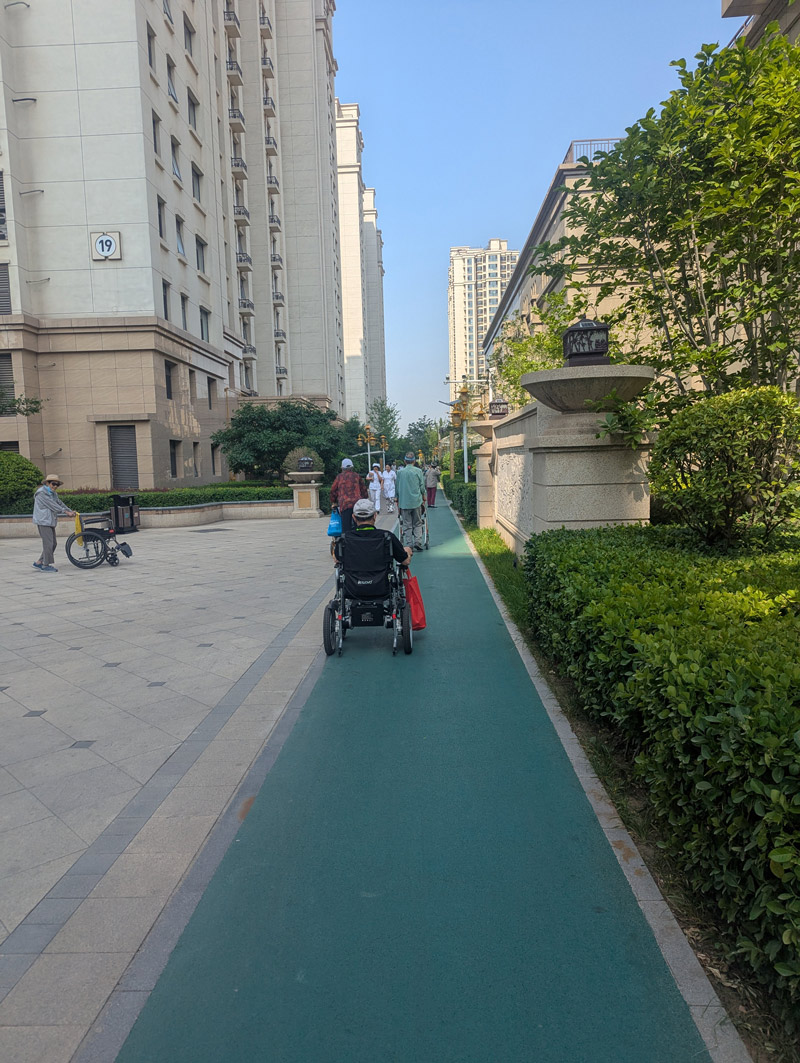
I did not know much about elderly care in China when we made our late-night arrival in Retirement City. The next morning, I immediately took to the strolling path that looped through Retirement City’s Subdivision Two, where we had rented an apartment not far from Laolao’s building. Luckily for us, Retirement City offers highly flexible short-term rentals for family visitors or elderly who wish to test-drive retired life before moving in permanently. Paved with the same rubbery material that used to line my high school running track, the path found an instant fan in my knees. At dawn and dusk, I dutifully followed it, taking every opportunity to carefully observe my fellow residents. I rarely saw married couples, and I quickly realised that couples who were lucky enough to grow old together and stay in relatively good health were the least likely to find their way to Retirement City. Among the single residents, women outnumbered men by a visible margin. And many retirees were accompanied by a personal attendant—mostly women—who were employed by Retirement City as hugong (护工, literally, ‘worker nurses’). Suffering from an advanced form of Parkinson’s, Laolao had her hugong on call in her apartment 24 hours a day. Most hugong, however, only worked day shifts and were always the first people I saw on the strolling path in the mornings.
The more time I spent in and around Retirement City, the more I came to understand how essential hugong were in the day-to-day lives of retirees. There were some 1,400 of these caregivers, with about half recruited from the surrounding community of Yanjiao. These locals first spend a few weeks at the Retirement City training centre, learning the skills they must master to properly take care of their charges: feeding, assisting with medication, physical care, and shepherding retirees to and from appointments and activities. The other half were sourced from vocational programs in and around Hebei, and Retirement City advertising boasted of the many partnerships with various schools to graduate trained hugong ready to serve the retirees. But while hugong were in my mind the most important workforce in Retirement City, they were perhaps simply the most ubiquitous. There was a full range of employment categories, each with official titles and uniforms. Hugong were dressed in short-sleeved grey polo shirts with black slacks. Nurses (护士), some of them stationed in the lobbies of the residential towers, wore all-white outfits. Administrators (行政) wore blue suits with crisp white shirts with oversized collars. Most of these workers at Retirement City receive a modest salary, but the work was steady and reliable. Like the rest of China, Retirement City was a gigantic enterprise, a well-oiled machine that relied on a huge workforce. Without inexpensive labour, Retirement City could never exist, let alone turn a profit.
Living the Retired Life
Still, living in Retirement City is not cheap. Folks can choose between five levels of apartment, with the most basic package starting at under RMB3,000 (US$420) a month. Laolao lived in a two-star apartment, at just over RMB6,000 (US$845) a month; she paid more for her hugong, but, at RMB9,200 (US$1,300) per month for full-time care, this was also a bargain. The most expensive option, a five-star apartment, topped out at more than RMB18,000 (US$2,500) a month. Residents in need of greater medical attention could opt to live in ‘hotel-style’ apartments that were further integrated into the hospital adjoining Retirement City. Always an attentive host, Laoye made sure we saw some of these apartments, which came with an ‘overhead transfer system’ that could hoist patients and carry them from their rooms to medical offices. While not cheap, every level of care was affordable compared with what we would find back home: the most expensive option, a five-star room in a ‘special needs’ hotel-style apartment, was still less than RMB20,000 (US$2,800) a month.
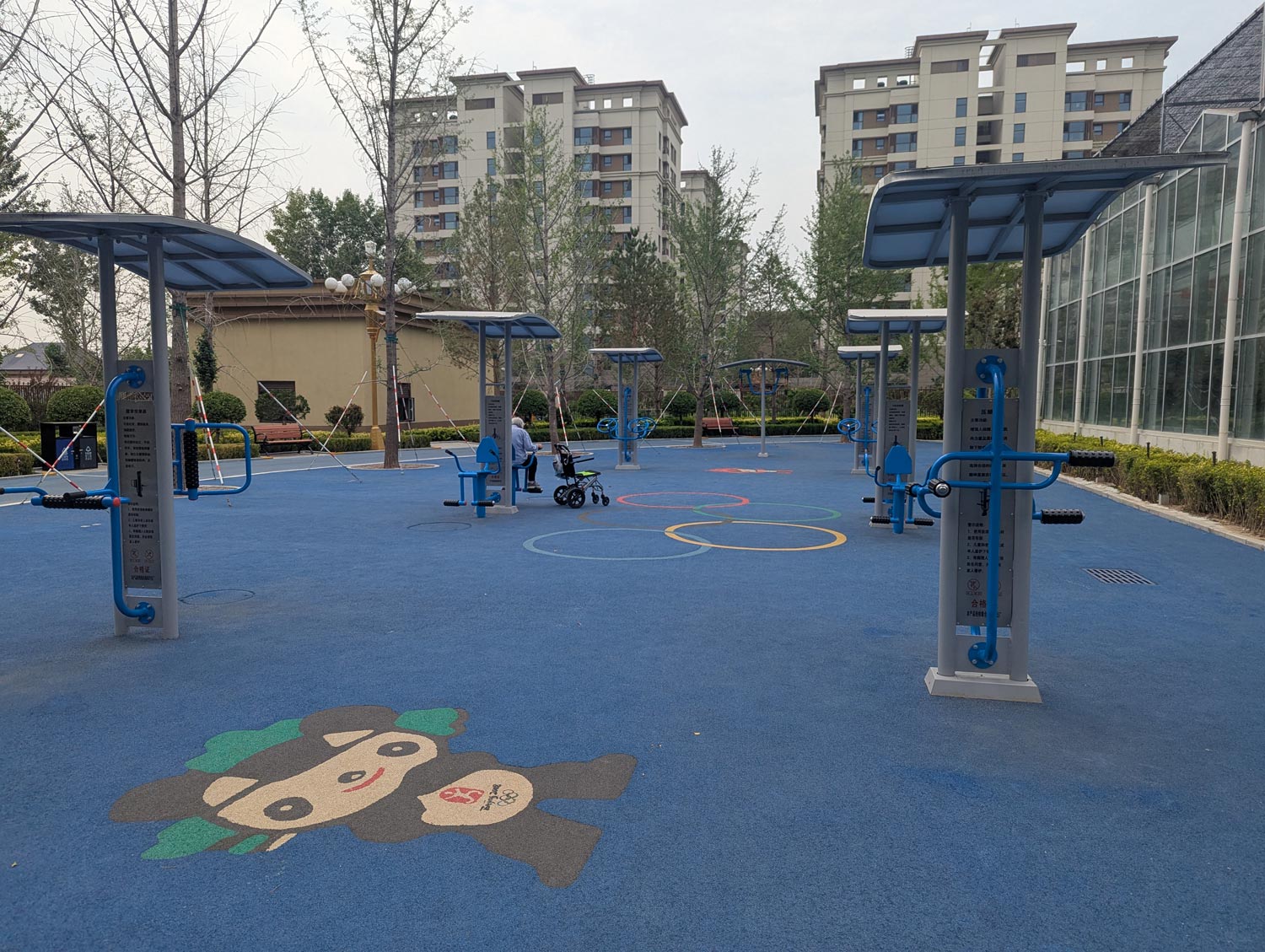
As I discovered, life in Retirement City costs a fraction of what we would have to pay for a similar community back in Louisiana. While affordable by Western standards, this was still a lot of money for these retirees. But they seemed to get their money’s worth. After struggling to care for Laolao by himself when they still lived in the suburbs of New Orleans, Laoye was clearly relieved to have her living in Retirement City under the watchful eye of her hugong. Still full of vigour, he insisted on showing us everything the place had to offer, and we spent multiple afternoons following him around the three subdivisions, each with recreation and fitness centres, supermarkets, and healthcare facilities. There were endless opportunities for activity and engagement, including an Elderly University (老人大学) where I thought about offering a guest lecture. We stopped by classrooms where seniors made handicrafts, practised calligraphy, and painted. Some of the amenities were surprising, none more so than the virtual reality driving range for elderly golf enthusiasts.
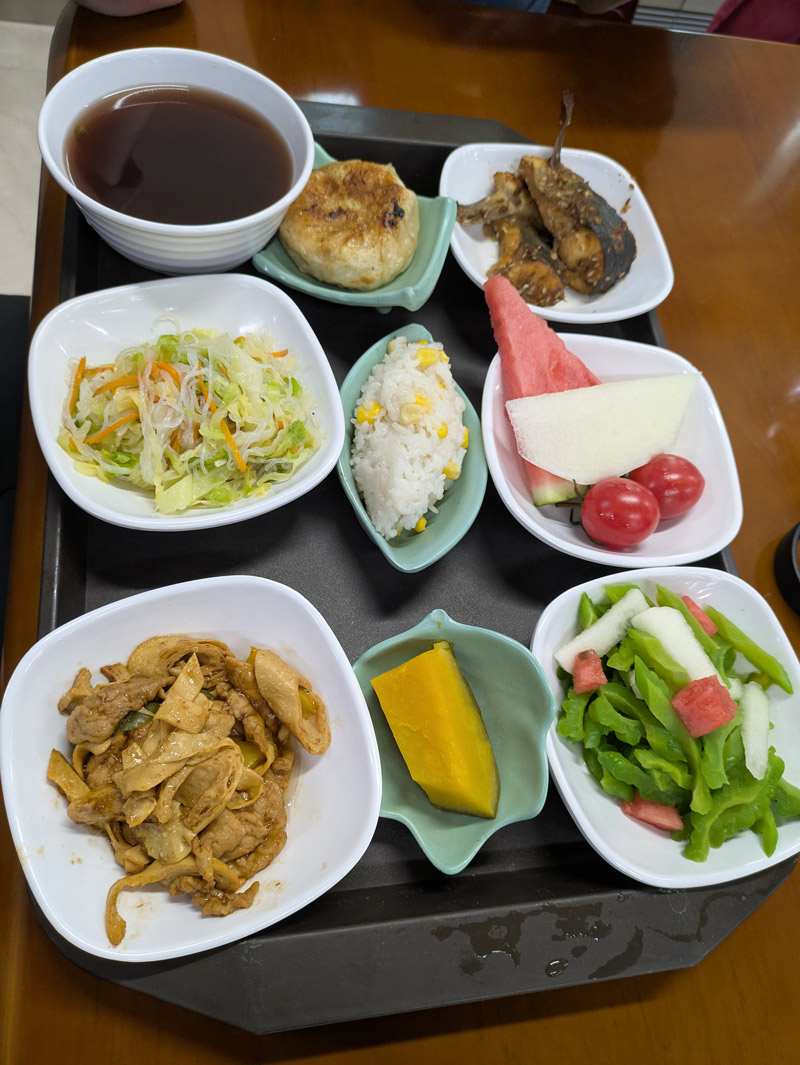
There were dozens of dining options scattered throughout the premises, and we sampled the full array, from simple cafeteria fare to showy dishes in private dining rooms. Despite the diversity, all the food vaguely tasted the same. Spicy dishes, the mainstay of my usual diet in China, were nowhere to be found. A single Western restaurant offered subpar burgers and the only coffee around.
There was always something to see. With my son in tow, we always drew a crowd, with retirees wondering whether this half-Chinese boy could understand what they were saying and reacting with excitement when he responded to their questions in Chinese. My son turned out to be the driving force in all aspects of community engagement. Not content to zone out and enjoy a month away from reality, he insisted that we visit the recreation centres, especially the three pools. The pool in Subdivision Two had six soaking hot-tubs, a few of which were treated with a herbal medicine whose purpose I could never ascertain. After every swim, we soaked for 15 minutes—the maximum time anyone was allowed to stay in the hot-tubs—discussing all the things we had seen that day.
Most of the regular swimmers were thriving in Retirement City. One proudly stood on one foot and lifted a raised fist to the sky as he announced in English that he was 92 years young. Seeing my grey beard, he asked me whether I was the child’s grandfather. I tried not to take offence and complimented him on his vitality. Over the weeks I saw the full range of life for the thousands of retirees. Some were doing great. I often saw the recreation centre full of laughter and even watched some retired grannies play an energetic foosball match. One woman I met lived alone but had a circle of close friends who gathered at her place to play mahjong. Her only complaint about Retirement City was the lack of opportunities to sing. Only the new recreation centre, in Subdivision Three, had a karaoke room, and it was always occupied and too far away. True, there was a singing club, but it was competitive, with only a few dozen members. A few days later, I spotted the club practising in one of the recreation centres and assumed they must be reminiscing by singing old favourites, but I later realised they were singing a modern ballad about growing old. To my ears, the song was oddly both cheesy and macabre, with lines such as ‘One day, when we can no longer walk, we will be together in another time and space’ (有一天, 我们走不动了, 另外一个时空在相守).
Not everyone was thriving. With enough time on the strolling path, you were bound to see an ambulance taking a resident to the hospital right outside Retirement City, which was a big draw for many residents. Back in Louisiana, Laolao and Laoye had been continually frustrated by all aspects of our local healthcare system, with the long wait for medical appointments a huge concern. But here medical care was on demand and, of course, there were nurses stationed in every residential building. As for Laolao, she was getting by. Her condition kept her from the fitness centres, but her hugong dutifully took her to group activities to keep her engaged in the community.
Like most retirees, Laolao’s physical therapy centred on massages more than exercise. Watching Chinese TV for the first time in a decade, I was struck by how much of the advertising targeted elderly folk, especially ads for huge full-body massage pods—that is, a reclining chair with built-in massage bars, vibration, and heat, all wrapped in a futuristic-looking capsule. Who would buy such a thing? But there in Laolao’s small living room, a good chunk of space was devoted to her own personal massage pod. Every day after lunch, Laolao’s hugong would assist her into her pod for a massage. We would visit later in the day, and my son always made a beeline for the pod, jumping in and testing out its various preset routines. Without fail, Laolao would look on with a smile on her face while her grandson oohed and ahhed from her massage pod.
Former Red Guards in Retirement City
My favourite stop was the Antiques and Old Objects Museum. It was not the only museum in Retirement City, which also boasted a multi-room display of ancient lanterns, some of them hundreds of years old. But the Antiques and Old Objects Museum was entirely populated with items borrowed from Retirement City residents, making it a fascinating tour of their lives. As the museum’s creators declared: ‘Here, you can not only tell your own story but also witness the pace of the country’s opening and reform.’ And, indeed, many objects on loan to the museum were tangible markers of China’s early climb to prosperity. Ms Liu, for example, lent the museum her boombox, a Chinese-made model from the 1990s, complete with a collection of cassette tapes. Most of her cassettes were from Taiwanese and Hong Kong pop singers, but I was happy to see she also had one by Mariah Carey.
Poking around the Antiques and Old Objects Museum, I realised that the story the retirees were telling about their lives was not limited to the post-Mao era of reform and opening. These retirees, like Laolao and Laoye, lived through the Maoist revolution. Most had served as Red Guards in their teenage years, and traces of the Cultural Revolution dotted the museum. Donated items from Mr Cai, for example, included his prized camera but also propaganda posters for The Legend of the Red Lantern (红灯记), a revolutionary opera that was wildly popular during the Cultural Revolution. His old phonograph was also behind a glass pane, complete with a rare recording of revolutionary classics as performed by a cultural troupe in the Liangshan Yi Autonomous Prefecture, with songs such as ‘The Socialist Road is the Brightest of All’ (社会主义道路最宽广) and ‘The Emancipation Melody of the Yi People’ (彝家翻身调). Sitting just above the phonograph was his father’s Valet razor, perhaps a century old and proudly marked ‘Made in England’.
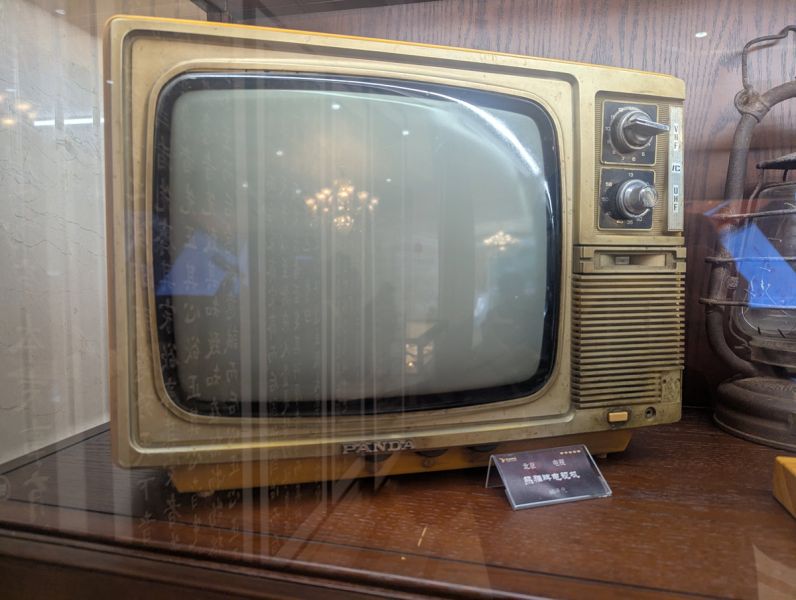
The other collections reflected Mr Cai’s approach to mixing objects from the revolutionary and reform eras. I saw an old Panda brand TV, watches, bulky mobile phones, pagers, and different models of cameras. I also saw Maoist texts, novels about land reform such as Zhou Libo’s The Hurricane (暴风骤雨), and translations of Soviet classics like Remembering Lenin (列宁回忆录). There were treasures to be found here. Under a collection of essays by Ba Jin, published in the late 1950s, I spotted a Cultural Revolution broadsheet. Only the header of the broadsheet was visible from under the book: ‘Highest Directive: Never Forget Class Struggle’ (最高指示: 千万不要忘记阶级斗争).
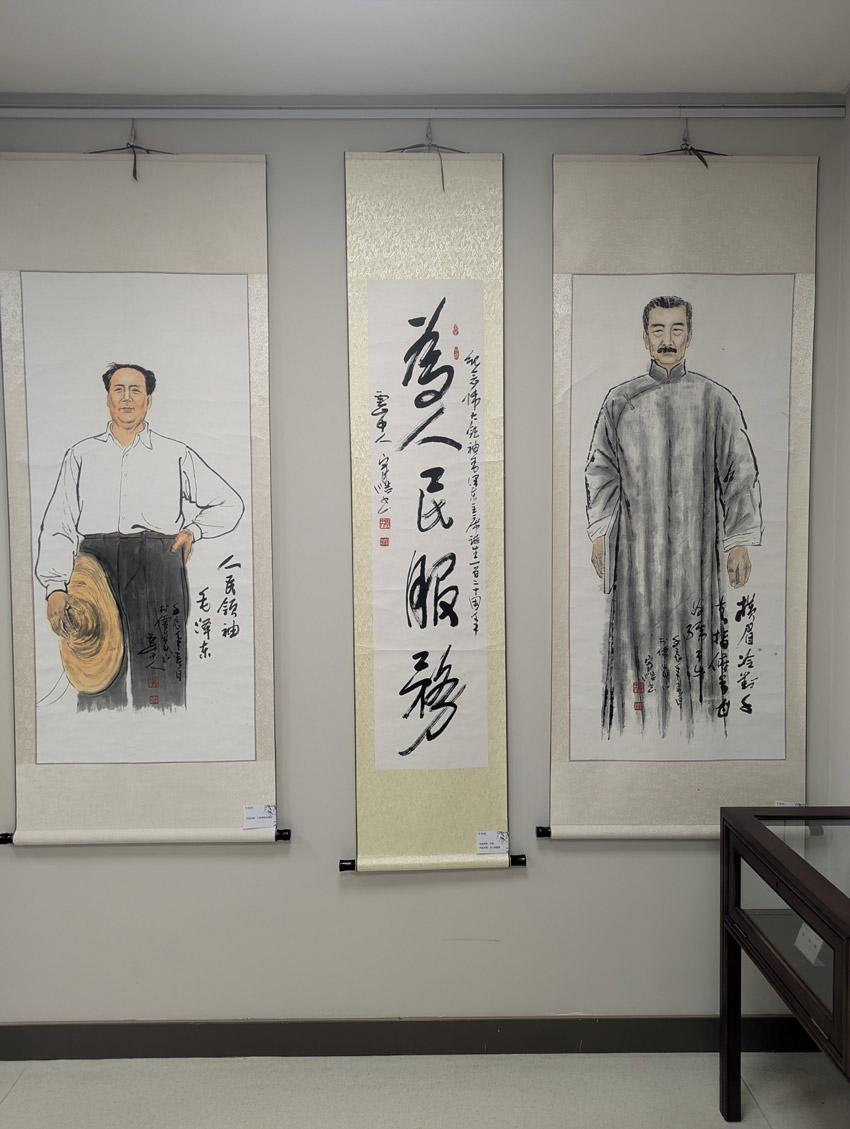
The residents of Retirement City were clearly patriotic and nostalgic. Adorning the walls of recreation centres were ample examples of their artwork, including ones with revolutionary or patriotic themes. Papercuts explicitly declared their love for their country alongside images of the Temple of Heaven or space shuttles. A few retirees painted portraits of Mao Zedong and Lu Xun. And one calligrapher had practised their art with one of Mao’s most famous sayings: ‘Serve the people’ (为人民服务). But these were sanitised representations of the past, unlike the call to ‘Never forget class struggle’ that was now safely behind glass.
I suspect I was one of the few people who spent so much time thinking about what this all meant. Whenever we went to the Antiques and Old Objects Museum, we were the only ones there. Having spent decades studying PRC history, I was like a kid in a candy store, delighting in the carefully curated displays. But few of the folks I met seemed interested in dwelling on the past. That was especially true for Laoye, who was always moving.
A Day Trip with Laoye to Tangshan
Laoye had found his own apartment outside Retirement City. On most days, before we could get out of bed, we invariably heard him knocking on our door—his first stop of the day. Plans would be made, and he would head to Laolao’s building, where he had lived until her hugong moved in full time.
Sometimes, when it was just the two of us, Laoye would regale me with his stories. He knew I was a historian and found in me an eager audience. He had much to say. Like other folks at Retirement City, he had grown up in the Maoist era and taken part in multiple revolutionary campaigns. But it wasn’t until I explicitly asked him that he confirmed that he had been a Red Guard during the Cultural Revolution. There were a lot of things he had not been talking about over the years. And even now as he finally found a perfect audience for his tales, there were some details he kept to himself.
Much of his family history, and all the worst of the stories, had taken place in Tangshan, a city a few hours’ drive from Beijing. Laoye eventually decided that we needed to see the place for ourselves, so one day we made the drive to Tangshan. Much had happened here. His father, one of China’s first experts on concrete, had been an engineer at the Tangshan factory that paved Tiananmen Square. He had survived fierce criticism during the Cultural Revolution only to tragically perish during the Tangshan Earthquake of 1976.
Laoye told that story again as we toured a Tangshan park built around an artificial lake—recent additions to the city. As he recalled, he had been in Tangshan the night before the earthquake, visiting his father and his grandmother. He got back to Beijing late at night, only to be jolted awake as aftershocks from the devastating earthquake rippled through the North China Plain. If he had stayed the night in Tangshan, he noted, he would not have seen the morning. My son interrupted Laoye’s story to double check this chain of events, fascinated by how contingent life can be. Another night in Tangshan, no Laoye, no Mama, no him.
Before we left Tangshan, we visited the old concrete factory. Never rebuilt after the earthquake, it had been turned into a museum celebrating its humble but truly concrete contribution to the industrialisation of China. Our final stop was the Tangshan Earthquake Monument Park, dominated by huge granite blocks inscribed with the names of the quarter of a million lives claimed by the disaster. Walking in the sweltering heat, Laoye looked up at one of the granite monuments and wondered where his father’s or grandmother’s name might be found. I know that there must have been other family members who died that night, but Laoye never talked about them.
Into the Silver-Hair Market
Back in Retirement City, I grew increasingly fascinated with the place. From my visits to the antiques museum, I knew that many residents had shared Laoye’s journey through the Mao years and beyond. They must all have stories, but did they also keep some of their personal histories private from their children? And, having once championed socialism and even commune living, what did they think about retiring in contemporary China, where capitalism had once again taken root? Watching constant TV ads for massage pods and laxatives, I realised that, in Retirement City, I had a front-row seat to the explosive growth of a new commercial market aimed at retirees such as Laolao and Laoye.
After hearing an offhand comment from me over breakfast about my newly found interest in what’s known as the ‘silver-hair market’ (银发市场), Laoye convinced Mr Wang, the salesperson who originally sold him on moving Laolao to Retirement City, to chat with me. I discovered Mr Wang was a relative newcomer to the industry. Out of work and investigating retirement options for his own family a few years ago, he had realised that this was the opportunity for which he had been longing. As he explained, the retirees I was seeing everywhere belonged to a generational sweet spot. They had survived the Maoist era just in time to take advantage of the opening and reform era, so, unlike earlier generations, they could afford to retire in style. And, because of the One-Child Policy’s strict enforcement in Beijing, they did not have multiple children to care for them.
This was just another reminder of what I came to view as the most fascinating wrinkle in the story of Retirement City: while these elderly folk were lucky enough to afford to retire in style, they once had railed against the ‘capitalist road’ back in their Red Guard days. You would never know it unless you noticed those Red artefacts in the Antiques and Old Objects Museum. Much more prominently displayed were the kinds of ‘feudal’ beliefs that had once drawn the ire of revolutionaries. That included huge God of Longevity statues and lavish depictions of the Twenty-Four Stories of Filial Piety (二十四孝). Each was an outlandish tale promising children great rewards for sacrificing themselves for their parents. I made sure to introduce my son to one of my favourite stories, centring on a filial boy about his age who dutifully sacrificed himself to swarms of bloodsucking mosquitoes every night so that his parents could sleep in peace. He was decidedly unimpressed.
I asked Mr Wang what former revolutionaries would think of all this, but he saw things from a different angle. According to him, these call-backs to traditional culture were really aimed at the adult children who might feel guilty about sending their ageing parents away instead of caring for them at home. The emphasis on filial piety was hardly limited to Retirement City. The messaging was also coming from the very heights of the Party-State: the government is not going to take care of your elders, so children must be filial and serve their parents. For the children who trekked out from Beijing on weekends to visit their parents at Retirement City, the signage was telling them that, with the help of the hugong and other workers at the facility, these overburdened only-children could rest assured that they were indeed filial.
Leaving Retirement City
Beneath the familial sentiments lay a cold, hard economic reality. Taking care of China’s massive and growing elderly population is a complicated and expensive task that is challenging state and society, and elderly care is developing in a decidedly capitalist manner. Back when she was in better health, Laolao and her sister once told me that they were sometimes nostalgic for the Mao days. As they put it, their family was poor, but so was everyone else. That is no longer the case and, while Laolao and Laoye never struck it rich, their employment as engineers in Beijing set them up for a comfortable life. Arriving in Retirement City, I had been mostly concerned with Laolao’s care. From my time working at that retirement home in Honolulu, I had seen old folks neglected. But Laolao had constant support from her hugong, regular access to health care, and even swimming pools that made her grandson a happy visitor.
Perhaps that is why, months after leaving Retirement City, my son and I regularly find ourselves reminiscing about our time sampling the retired life and wondering when we will go back. At the same time, I have had to remind myself that what we saw represents only a sliver of the Silver-Hair Market. Just as is the case in the United States, many retirees lack proper care, putting great strain on younger generations and family life. Talking with Mr Wang, I could sense he took great pride in the service he provided for retired folk and their families. He knew first hand the heavy responsibility of caring for elderly family members and seemed to believe that Retirement City could provide top-notch care for retirees and total peace of mind for their families.
Still, my conversation with Mr Wang also served to underscore how Retirement City needed to turn a profit. Decisions had to be made with the majority of the retirees in mind, so that might mean changes to the amenities as different generations moved in. Perhaps in the future there will be more exercise equipment and better food options, he mused. Not yet 50 years old, he was still far away from retirement himself. He was working nonstop, as most of his income was directly tied to closing sales. When I asked him about retirement, his response was quite honest. He had grown up in Yanjiao and had no desire to live his final years here. Instead, he would head south and do some travelling.
Laoye, listening in from the next table, bluntly interrupted our conversation. He pointedly explained that Mr Wang was making a common mistake, underestimating how important it was for retirees to be near medical care. Hadn’t Mr Wang just bragged about the hospital next-door and how seniors in need could have medical attention in a matter of minutes? Laoye advised him to stay in Retirement City.
References
Guo, Chen. 2025. Digital Media and the Daily Lives of China’s Senior Citizens. London: Routledge.
People’s Daily. 2024. ‘我国医养结合机构达7800多家 床位达200万张 [China Now Has Over 7,800 Integrated Medical–Retirement Facilities and Two Million Beds].’ 人民日报 [People’s Daily], 17 May.
Zhou, Y., Li X., and Ma L. 2021. ‘Medical and Old-Age Care Integration Model and Implementation of the Integrated Care of Older People (ICOPE) in China: Opportunities and Challenges.’ The Journal of Nutrition, Health and Aging 25(6): 720–23.