
Remaking the Earth, Exhausting the People
A Conversation with Micah Muscolino
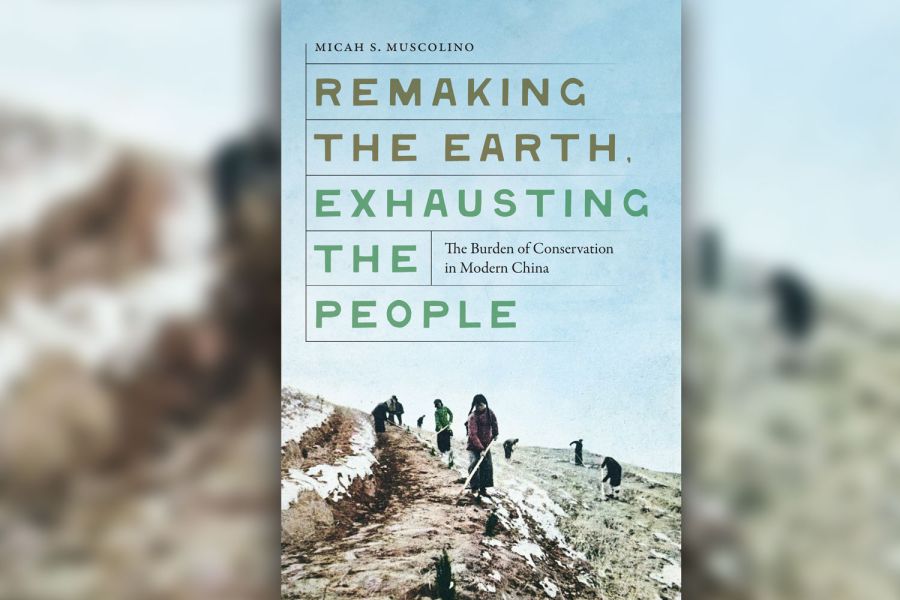
Environmental historians of modern China have often examined how states transformed landscapes in pursuit of economic development and ideological visions of remaking nature. In Remaking the Earth, Exhausting the People: The Burden of Conservation in Modern China (University of Washington Press, 2025), Micah Muscolino shifts the focus from the environmental outcomes of conservation to the people whose labour made those transformations possible. Centring on Gansu Province’s Tianshui Prefecture, Muscolino demonstrates that Mao-era conservation campaigns were not only projects of ecological engineering but also forms of political and economic mobilisation that imposed profound social and physical burdens on rural communities. Drawing on rich archival sources and oral histories, the book reveals conservation as an uneven process in which environmental benefits were inseparable from questions of power, labour, gender, and regional inequality. Read alongside Muscolino’s latest edited volume, Revolutionary Natures: Grassroots Environmental Histories of China’s Mao Era (University of Washington Press, 2026), the book also points to the growing importance of grassroots, social, and ecological perspectives in rethinking the environmental history of Mao-era China.
Yuan Gao: Remaking the Earth situates Gansu Province’s Tianshui Prefecture—an arid, resource-scarce northwestern frontier—as both a marginalised region and the site of some of the earliest large-scale conservation efforts in the People’s Republic of China (PRC). It shows that Mao-era conservation functioned as a kind of extraction and exploitation that intensified labour burdens. You end with a caution that environmental protection often comes at the expense of marginalised communities’ livelihoods. How should historians balance recognition of the ecological necessity of conservation with the social injustices it can produce?
Micah S. Muscolino: Historians should recognise, first and foremost, that conservation and environmental protection have different consequences for different groups of people. John McNeill, my former colleague and one of your graduate mentors at Georgetown University, observed in his 2000 book Something New Under the Sun that modern environmental writing, including environmental history, typically evaluates environmental changes as ‘good or bad’, but rarely specifies the criteria for those judgements. Environmental changes are usually, as McNeill (2000: xxv) notes, ‘good for some people and bad for others, and indeed good for some species and subspecies and bad for others’. For that reason, environmental historians need to carefully consider ‘for whom (or what) a given development was good or bad’ (McNeill 2000: xxv). The implication, then, is that when historians try to assess environmental changes linked to conservation, they must evaluate them from the perspective of different social groups and in terms of their interests rather than assuming the changes affect everyone the same way.
My book combines the methods of environmental and social history to consider who gained and who lost when state-led water and soil conservation (水土保持) programs undertaken during the Mao era (1949–76) remade the biophysical environment and people’s relations with it. Who benefited from these conservation programs? Who shouldered their costs? In answering those questions, I highlight the power relations that characterised conservation and the environmental inequalities that resulted from uneven distribution of its benefits and costs across social and spatial hierarchies.
The book’s main argument is that the water and soil conservation schemes that the PRC Party-State undertook after 1949, and the distribution of their costs and benefits, were inseparable from political and economic relations that marginalised and disadvantaged China’s rural populace. Beginning in the 1950s, the PRC’s development strategy depended on state accumulation through mandatory, unequal exchanges between the agrarian and industrial sectors. The state purchased grain and other agricultural products at depressed prices, kept the price of industrial goods high, and profited from the difference. The household registration (户口) system tied people classified as peasants to rural spaces, where they tilled collective fields. This development strategy channelled surpluses from the agrarian sector to fund rapid industrialisation but placed a heavy burden on rural people.
The history of Mao-era conservation cannot be understood in isolation from these patterns of state accumulation, uneven development, and rural–urban inequality. Campaigns to conserve water and soil imposed heavier workloads on rural people, while state grain procurements deprived them of control over the harvest. As a result, villagers who did the exhausting work of remaking the land received little in return for their exertions.
YG: Your book shows that rural people did not simply comply with conservation campaigns, but engaged in subtle, everyday forms of resistance, sometimes expressed through vivid or ironic language—a kind of ‘weapon of the weak’. Could you elaborate on how these everyday practices of resistance operated? What role did expressive forms such as complaints, satire, idioms, or local metaphors play in enabling people to critique conservation policies without overt confrontation? To what extent did these everyday forms of resistance merely mitigate the burdens of conservation versus meaningfully reshape how policies were implemented?
MM: Previous historical studies of the Mao era have clearly demonstrated that the PRC Party-State’s pursuit of its policy goals was fraught with conflict and tension. Conservation was no exception. Documents from local archives in Gansu that I visited while researching this book contain abundant evidence of rural people’s ambivalence and even outright opposition to state-led conservation. Although some villagers enthusiastically joined Mao-era conservation efforts and many more simply went along with them, others engaged in passive and active resistance that ranged from doing work in a perfunctory manner to verbally attacking local cadres.
Resistance resulted not from ignorance or innate conservatism among rural people, but from their anxieties about the potential effects that conservation might have on land, labour, and livelihoods. The ‘misgivings of the masses’ and examples of their passive and active resistance appear repeatedly in the archives. Quotes from ordinary villagers who frankly expressed their reservations and suspicions in coarse and colloquial language (sometimes including profanities) appear throughout the investigations, work reports, and other sources on which I drew for the book, providing glimpses of how people understood conservation and its consequences.
Often—as you have rightly observed—local people turned to complaints, satire, and other expressive forms to critique conservation policies without overt confrontation. To cite an example that appears a couple of times in the book, disgruntled rural residents compared water and soil conservation programs to the public works projects undertaken by the First Emperor of Qin (Qin Shihuang, 259–210 BCE) because they both ‘exhausted the people and drained the treasury’ (劳民伤财) without bringing real benefits. Other villagers criticised the extra effort required for water and soil conservation by saying that ‘this is like taking off your pants to fart—doing twice the work for one job’ (这是脱裤子放屁的, 一次做工两次花了). This kind of vivid and ironic language, of which the book contains many examples, captures the perspectives of rural people and makes it clear that they were in no way passive in the face of party-state policies and directives.
Local agents of the Party-State had to respond to these misgivings. Grassroots cadres and officials mediated between higher-level authorities, who expected them to meet conservation targets, and villagers, who were their neighbours, co-workers, and kin. Engaging in constant back-and-forth with other villagers, grassroots cadres and local officials modified work methods, carefully adjusted systems of evaluation and compensation, and took pains to align the timing of conservation projects with the seasonal cycle of farmwork so they did not interference with crop production. Everyday forms of resistance may not have been able to fundamentally alter the PRC Government’s overarching policy objectives, but they gave rural people enough agency to influence how conservation policies were implemented.
That said, everyday practices of resistance lost some of their effectiveness in mitigating the burdens of conservation after 1956, when rural households forfeited landholdings to higher-level agricultural cooperatives that paid them work-points in exchange for their labour and no longer had the right to withdraw. Under these circumstances, villagers who depended upon collectives for grain rations had little choice but to take part in conservation programs to earn work-points. Yet, the misgivings of the masses never fully disappeared, and state agents had to adjust policy implementation in response if conservation efforts were to succeed.
YG: One of the most striking aspects of the book is how conservation emerges not just as a policy or landscape transformation, but also as an embodied experience with its physical toll etched into the bodies of rural people, especially women. How does focusing on the bodily and gendered dimensions of conservation change the way we understand environmental governance in modern China?
MM: Focusing on the bodily dimensions of water and soil conservation during the Mao era is necessary because the environmental changes that it brought about were realised through backbreaking physical labour. Conservation depended on the muscle power of rural people who dug trenches, moved earth, planted trees, and tamped down embankments. The physical toil of conservation work, in turn, jeopardised the health and wellbeing of rural people and had lasting effects on their bodies.
My book’s emphasis on the embodied experiences of rural men and women aligns with other environmental histories that—inspired by Richard White’s classic 1995 essay ‘Are You an Environmentalist or Do You Work for a Living?’—call attention to the physicality of work as one of the primary ways that people know and experience the environment. Ruth Rogaski (2022), for example, has shown how the labour of young people sent to reclaim the ‘wastelands’ of northeastern China’s Sanjiang Plain during the Mao era translated into knowledge of nature. My book extends these insights by examining how not only the labour of production but also the gendered labour of social reproduction has shaped human encounters with the environment.
The embodied consequences of Mao-era conservation were not always negative. Since the gendered division of labour defined gathering fuel and fetching water as women’s work, tree-planting campaigns during the early 1950s that increased fuel availability and digging ponds and wells to alleviate water shortages lightened female villagers’ workload. With the full-scale collectivisation of agriculture after 1956, however, the physical burdens of conservation work came to weigh more heavily on all rural residents. Labour demands were most acute during the Great Leap Forward (1958–61), which in Tianshui and other parts of Gansu involved mass mobilisation to conserve water and soil through afforestation, terracing, and dam construction. The heaviest burdens fell on women, who had to balance the work of water and soil conservation and collective farming with childrearing, food acquisition and preparation, and other forms of reproductive labour.
The embodied and gendered dimensions of ecological change came across most clearly in the oral history interviews that I conducted with elderly men and women who participated in Mao-era conservation campaigns. While male villagers recalled the physical demands of conservation work and its impact on crop production, female villagers also spoke about how conservation work affected social reproduction—the work of giving birth, raising children, and feeding family members. Elderly women recalled how large-scale conservation campaigns during the Great Leap Forward and the famine they brought about by disrupting agricultural production threatened household subsistence, jeopardised social reproduction, and left enduring effects on their physical health and wellbeing.
During one especially poignant oral history interview, a woman who had her first son in 1960, when the famine was at its worst, recalled that she could not observe the postpartum custom of resting at home for a month (坐月子) because she had to go out to gather wild vegetables for her family to eat only seven or eight days after giving birth. Because of that experience, the woman explained, she now has severe leg pain that keeps her from being able to work. Her memories of ecological trauma were expressed in terms of gendered and embodied experiences of work, hunger, and affliction.
This example, along with others in the book, suggests that historians must examine the bodily and gendered effects of conservation and other forms of environmental governance to fully understand their complex and uneven consequences, whether good or bad, for different social groups.
YG: Your book vividly captures the militarised ethos of Mao-era conservation campaigns, in which efforts to ‘save’ nature often took the form of aggressively transforming it, from ‘splitting mountains’ to filling gullies. How should we understand this apparent contradiction between ecological intent and destructive practice? To what extent did the militarised, top-down, campaign-style approach to conservation shape not only how these projects were carried out, but also their unintended environmental and social consequences?
MM: A little bit of clarification might help to resolve that apparent contradiction. Water and soil conservation during the Mao era were not intended to ‘save’ nature. As the phrase ‘remaking the earth’ in my book’s title indicates, conservation sought to transform nature in ways that would limit water and soil loss and thereby advance the PRC’s larger goals of decreasing the Yellow River’s sediment load and increasing agricultural productivity.
To be sure, slogans associated with the conservation campaigns employed militarised rhetoric that called on people to struggle against nature, conquer nature, battle nature, and the like. But the advocates of Mao-era conservation campaigns—and many of the people who participated in them—understood this aggressive, militarised transformation of nature in terms of a narrative of improvement and progress. Victory over the existing environment promised to alleviate erosion, drought, resource shortages, and poverty. A verdant, irrigated, and flourishing rural landscape would come into existence as a result. In this framing, toil and self-sacrifice in the name of conservation became part of a heroic struggle to transform the environment and create a better future.
The militarisation of conservation reached its peak during the Great Leap Forward, which cast collective labour as a military operation that required devoting all resources to accomplishing miraculous feats of environmental and economic transformation. People’s communes organised their members into quasi-military units that marched in ranks to the fields and other worksites every morning, accompanied by gongs, drums, and banners. Militarised campaigns transferred the urgency, discipline, and heroism of wartime struggles to the task of remaking the land in peacetime. Armies of workers organised into columns and brigades went to war on hillsides and in gullies, moving earth, building terraces, and implementing other conservation measures to combat water and soil loss.
The militarised, campaign-style approach that defined water and soil conservation campaigns during the late 1950s shaped their environmental and social consequences by creating conditions in which speed, scale, and visible indicators of victory in the war against erosion mattered far more than carefully and deliberately adapting conservation measures to specific environmental conditions, maintaining agricultural production, and sustaining local livelihoods.
Making conservation the moral equivalent of war implied the need for mass mobilisation and large-scale commitment of labour to the task of remaking the land. During the Great Leap Forward, the scale of the war against erosion grew to encompass wider areas and larger populations. People’s communes deployed their members to ‘theatres of operation’, with thousands or tens of thousands of people from different locales ‘going to the front’ to ‘do battle’ on a particular project. Militarisation increased the scale and intensity of conservation work, as armies of labourers toiled over vast areas with little or no rest. Invoking military struggle and self-sacrifice thus served as a powerful way to justify the extreme labour intensification and backbreaking physical exertion required to remake the earth.
Militarisation also generated a heightened sense of urgency. Language that equates environmental transformation with warfare implies the existence of immediate and serious threats, against which people must take quick and forceful action. For this reason, militarised conservation campaigns compressed measures that might have succeeded if they had been carried out in a more deliberate manner into spectacular assaults that lasted mere days or weeks. Instead of a gradual process of building, maintaining, and improving environmental infrastructure to increase crop yields, make resources more available, and improve local livelihoods, conservation became an urgent struggle that had to yield immediate, visible, and dramatic results.
As conservation campaigns gained momentum during the Great Leap Forward, local cadres and officials mobilised rural people to make the land conform to an aesthetic ideal—hillsides covered with curving parallel terraces and reservoirs filled with water—that would garner recognition and praise from their superiors. As conservation increasingly focused on appearances (what contemporaries called ‘formalism’), grandiose battles to remake the earth pushed aside the mundane routines of farming. In some instances, villagers dug up fields that had crops growing in them to fill in gullies and construct terraces. The landscape’s well-ordered appearance became evidence that the war against water and soil loss was being won; speed and spectacle took priority over sustaining production. Communes enlisted the entire workforce to engage in this ‘great war’ to conserve water and soil—often without compensation—and neglected the harvest. Crop output collapsed but the state collected grain procurements based on exaggerated production reports, leading to ‘three hard years’ of catastrophic famine.
The urgency that came with militarisation also had unintended environmental consequences. During the Great Leap Forward, the temporality of conservation campaigns was dictated by political imperatives instead of careful consideration of how to align conservation with the intertwining rhythms of agriculture and the environment. Language that trumpeted the ability of militarised mass mobilisation to conquer nature and remake the land obscured the fact that heavy seasonal rainstorms could cause poorly designed and hastily built terraces and dams to wash out and collapse, unleashing stored water in channelled deluges that could end up intensifying erosion and causing severe flood damage. To be effective, conservation had to respond and adapt to the dispersed agencies of nature; militarised campaigns were not conducive to that task.
YG: The contemporary Chinese State promotes ‘ecological civilisation’ (生态文明) as a guiding framework for environmental governance, combining sustainability goals with strong centralised authority. China is also actively (maybe even aggressively) planting trees in its arid northwestern and northern frontiers. How does your analysis of Mao-era conservation reshape how we interpret present-day environmental governance in China? Do you see continuities between earlier conservation campaigns and what some scholars call ‘environmental authoritarianism’? Or does it represent a departure from how environmental responsibility and social costs are framed?
MM: The book offers a reminder that, even with the far-reaching changes witnessed since the 1980s, certain features of Mao-era conservation characterise contemporary environmental governance in China, and the cost of conservation still tends to fall on poor and disadvantaged populations. The PRC’s policy of ‘returning farmland to forest’ (退耕还林, commonly known as ‘Grain-for-Green’) exemplifies these continuities.
By the late 1990s, China’s central government leaders came to see steeply inclined farmland that had come under cultivation to increase grain production during the Mao era as marginal for agriculture and highly susceptible to runoff and erosion. To address environmental damage caused by agricultural expansion between the 1950s and 1980s, the PRC piloted Grain-for-Green in Gansu, Shaanxi, and Sichuan in 1999 before starting the program in other provinces the next year.
By retiring sloping land from farming and planting trees on it, the Grain-for-Green program aimed to control erosion and flooding. Regardless of the marginal land’s low productivity, inclined fields still generated income for rural households, who needed at least temporary compensation if they could no longer farm them. For this reason, the Grain-for-Green program paid farmers to take their land out of cultivation and plant trees on it, offering annual subsidies for a fixed number of years to compensate for their lost income.
Participation in Grain-for-Green was technically voluntary; but, as with state-led conservation campaigns during the Mao era, it often did not respect that principle in practice. Many households felt they had little or no choice about whether to take part. As in the Mao era, rural people continued to shoulder the burden of conservation, as payments for removing land from cultivation did not offset the cost of participation. Rural households that converted farmland to forests depended on state subsidies for their income. During the early stages of the process, however, households that retired inclined land from cultivation had to invest labour and capital in planting trees, and subsidies did not cover those expenses. Because the costs to farmers tended to be higher than the amount of state compensation, households incurred economic losses. Rural people had little choice about whether to take part in Grain-for-Green, in other words, and incurred most of its costs.
To meet targets for returning farmland to forests and ensure the delivery of state subsidies, local governments tended to over-report survival rates for the trees that were planted or had households replant trees on land where they had not taken root before upper-level inspections. In Gansu and other parts of northwestern China, even after trees were replanted, many did not grow due to lack of water. Low survival rates and frequent replanting reduced the program’s effectiveness and increased its costs. Even when saplings survived, tree planting often had unintended consequences. Fast-growing trees need more water than grass or shrubs, so large-scale afforestation can hamper the soil’s ability to preserve water, limit the regeneration of other plant species, decrease biodiversity, and damage native ecosystems.
To boost their income, some rural households planted crops such as wheat, maize, flax, and rapeseed among the trees on land that had supposedly been converted to forest and did not leave enough space for saplings to grow. Immature trees withered as crops robbed them of water and fertiliser. Once state subsidy payments ended, many households converted land on which trees had been planted back to agricultural cultivation. Ineffective monitoring and supervision by county-level authorities did nothing to prevent these practices.
These recent efforts to turn farmland into forests share obvious similarities with Mao-era campaigns to conserve water and soil. Whether in the 1950s or the twenty-first century, local cadres and officials seeking to impress their superiors with highly visible, short-term achievements that bolster their performance evaluations have paid insufficient attention to the quality of work, leading to poor results. Rural dwellers with little choice about whether to participate in top-down environmental governance programs shoulder the costs.
References
McNeill, J.R. 2000. Something New Under the Sun: An Environmental History of the Twentieth-Century World. New York, NY: W.W. Norton.
Rogaski, Ruth. 2022. Knowing Manchuria: Environments, the Senses, and Natural Knowledge on An Asian Borderland. Chicago, IL: University of Chicago Press.
White, Richard. 1996. ‘Are You an Environmentalist or Do You Work for a Living?’ In Uncommon Ground: Rethinking the Human Place in Nature, edited by William Cronon. New York, NY: W.W. Norton.