

Monroe Doctrine Redux
New Americanism and the Echoes of Empire in China and Japan
The United States will once again consider itself a growing nation—one that increases our wealth, expands our territory, builds our cities, raises our expectations, and carries our flag into new and beautiful horizons. And we will pursue our manifest destiny into the stars, launching American astronauts to plant the Stars and Stripes on the planet Mars.
—Donald Trump’s inauguration speech, January 2025
In the early twentieth century, Japanese, Chinese, and other Asian intellectuals called for a united Asia to combat the imperialist West. While these ideas were often framed in terms of common nation, race, and civilisation, they were also buttressed by a desire for regional hegemony. The Asianist discourses that preceded and accompanied the violence of World War II have been thoroughly researched in recent years, including by myself (see, for instance, Saga 2020; Smith 2021; Murthy 2023). However, the influence on these currents of American assertions of regional power—the so-called pan-Americanism—has been largely ignored or relegated to the margins of historical debates.
Now that the US Government has turned to military conquest to control Venezuela, reiterated its claims over Greenland, and menacingly commented on Canada and Mexico, it is more important than ever to understand the discursive connections between Asian and American regional hegemony. While caution is warranted in linking early twentieth-century Asianism and pan-Americanism to present political contexts (Smith 2022), in this piece, I argue that pan-Americanism and early writings on the Monroe Doctrine directly and indirectly influenced justifications for hegemonic regionalism in twentieth-century Asianism. I show how discourses on regionalism flow in both directions across the Pacific during periods of imperialist expansion, not only echoing but also reinforcing each other.
What Does New Americanism Have to Do with Asianism?
The dynamics of twenty-first-century imperialism, as well as the economic and social conditions of today’s two superpowers, have changed considerably over the past few years.
Since the mid-2010s, China has been experiencing an economic slowdown, entering what officials have been calling ‘the new normal’ (新常態). The situation has worsened on the heels of a trade war with the United States and the Covid-19 pandemic—a difficult period made worse by the near collapse of real estate markets and the skyrocketing of youth unemployment. However, despite these domestic troubles, China has remained committed to expanding its economic and political footprint through trade, investment, and aid across the region and around the world. The contrast with the United States, especially since Donald Trump regained power in early 2025, could not be starker. The US Government has drastically reduced once generous international aid and effectively ended the economic globalisation it once led by establishing a regime of protective tariffs, while also aggressively laying claim to the territory of neighbouring countries.
It is under the second Trump administration that a new form of hegemonic regionalism that we can call ‘New Americanism’ has taken root. In a reassertion of nineteenth-century concepts and discourses, soon after taking power at the beginning of 2025, Trump began making claims over Canada, Greenland, and Panama, triggering alarm and public outrage on a global scale. Pro-Trump news sources such as Breitbart did not shy away from framing these New Americanist ambitions as ‘Manifest Destiny’ (Gilbertson 2025), a religious concept from the nineteenth century that justified the appropriation of indigenous lands and imperialist expansion. Manifest Destiny was the religious expression of a more political concept that underlined imperialist pan-American thinking: the Monroe Doctrine. This term refers to the 1823 declaration that asserted the Western Hemisphere was an exclusive sphere of US influence, warned European powers against intervention, and naturalised American dominance as defensive rather than imperialist. While formally articulated as a doctrine of non-interference, it functioned in practice as a legitimating framework for US regional hegemony.
Both the United States and Japan—and, to a more limited extent, China—have historically drawn on the Monroe Doctrine to legitimise their hegemonic ambitions. In the United States, the Monroist slogan ‘America for the Americans’ condensed the doctrine’s claim to hemispheric authority into a populist formula that nationalists widely interpreted as ‘the Americas for the United States’ (undoubtedly, much the same way in which they read the ‘Gulf of America’ shenanigans). In early twentieth-century Japan, the Asianist rallying cry ‘Asia for the Asiatics’ functioned as a direct analogue, translating an American logic of regional exclusion and leadership into an Asian imperialist idiom. In China, as we will see, the story was more complicated.
Translating Regional Hegemony
It is important to understand how this translation occurred. In the nineteenth and early twentieth centuries, interest in the Monroe Doctrine and what was then known as pan-Americanism surged in the United States, where many viewed it as a means of defending against an anticipated global war or ‘race war’. In the 1910s, Chinese and Japanese intellectuals also began to take regionalism seriously, partly due to their shock at the collapse of Europe under the tides of nationalism that preceded and accompanied World War I.

This was part of a more general reckoning with these ideas that was taking place all over the world, especially in those countries that were being directly affected by the vagaries of US foreign policy. In those years, the most widely circulated book on American regionalism was Pan-Americanism, an academic account written by Roland G. Usher, a professor of history at Washington University in St Louis, published in March 1915, while the United States was still watching World War I from the sidelines. Usher saw the unity of the Americas as a necessity to defend not only against whoever won the war, but also against a Japan-led Asia. In this sense, the then growing calls for Asianism—unity against the imperialist West—played a role in prompting Usher’s pan-Americanism. However, despite his vision for the importance of the Monroe Doctrine in America’s future, he understood that, while pan-Americanism represented anti-imperialism to some, it was simply American imperialism to others:
To some, Pan-Americanism is the Utopia of peace, a demonstration of the superior morality of the Western over the Eastern Hemisphere, of the New World and its Christianity over the Old. To some it is a dream of the monopolization of South American trade by the United States; to others, the Monroe Doctrine and our chivalrous protection of the weak against aggression; to others, a vision of empire in the Western Hemisphere. (Usher 1915: 203)
Pan-Americanism was widely experienced as a form of hegemonic regionalism by ‘weaker’ nations, particularly those who depended on the United States for what was often framed as ‘chivalrous protection’. While many in the Americas initially welcomed the Monroe Doctrine’s rejection of European imperialism in the early nineteenth century, by the century’s end, the United States itself had emerged as the imperial power with which to reckon. South American objections to the doctrine’s hegemonic implications in the late nineteenth and early twentieth centuries were largely misunderstood or ignored by US observers, who tended to view American actions as inherently benign. As one US academic paternalistically wrote in 1926: ‘One difficulty in the understanding of the Monroe Doctrine from the Latin American viewpoint is, that there is a confusion in the Latin American mind, between the Monroe Doctrine and the imperialism of the United States’ (Hanaway 1926: 113).

Mexican perspectives were particularly negative, as the country had already lost more than half its territory to US imperialist ambitions over the preceding 60 years. Mexican public intellectual Carlos Pereya offered perhaps the most scathing academic critique in his 1916 book El Mito de Monroe (The Myth of Monroe), in which he accused the Americans of using the doctrine to justify imperialist and interventionist activities. However, the politicians were no less forgiving than the intellectuals: Mexican president Venustiano Carranza, in office from 1917 to 1920, vehemently rejected the doctrine (Riguzzi 2023: 798).
Latin American objections to the Monroe Doctrine were largely unknown in East Asia at the time, and even critics of regionalist hegemony in Asia often accepted US claims that the doctrine enjoyed broad support beyond the United States. This reflected the constraints shaping East Asian intellectual world views, which were frequently mediated through American perspectives, publications, and, later, television and film. Under these conditions, sympathy for or understanding of Latin American experiences of US hegemony was difficult to sustain. As a result, both Chinese and Japanese intellectuals tended to view the Monroe Doctrine and pan-Americanism in largely positive terms.
For instance, in an article published in 1916, popular Japanese intellectual Ōyama Ikuo explained the Monroe Doctrine as a proposition that ‘garners enthusiastic support from people across all stratums of societies in the various countries of the Americas’ (p. 16). Despite this misunderstanding of the Monroe Doctrine’s reception, Ōyama was writing in opposition to Usher’s Pan-Americanism and Japanese politician Kodera Kenkichi’s calls to apply this approach to Japan’s foreign policy. As Japan was still a conduit for Chinese knowledge about the West at this time, the Japanese perspective had great influence in China. Ōyama’s criticism of Japanese regional hegemony, along with his comments on the Monroe Doctrine, was translated and published in the Eastern Miscellany, China’s most popular journal, later that year.
In China, while there was no lack of critical voices—for instance, in 1914 the colourful Wu Tingfang, former Qing ambassador to the United States, quoted T.S. Sutton’s criticism of ‘America for the Americans’ as ‘the most asinine whine in the world’ in his own critique of the slogan as both illogical and immoral (Wu 1914: 178)—some Chinese intellectuals also held a positive view of pan-Americanism. For instance, in 1920, a writer called Ma Jingxing wrote very positively about the Monroe Doctrine, claiming that ‘as imperialism is so aggressive, it inevitably provokes a counterforce. This counterforce is Pan-Continentalism, including Pan-Asianism or Pan-Americanism.’ Ma accepted that pan-Americanism was connected to US president Woodrow Wilson’s ‘Fourteen Points’ and the spread of democracy and concluded: ‘I must voice my ardent support for this’ (Ma 1920: 28).
Ultimately, detached from its concrete operation in the Americas and recast as a general principle of regional guardianship, the Monroe Doctrine came to be adapted as a justification for Japanese leadership and, eventually, imperial expansion. Japanese writers such as Tokutomi Sohō and Kodera Kenkichi wrote books and articles supporting the idea of an Asian Monroe Doctrine during World War I, establishing the discursive justifications that would become crucial for Japan’s invasion of northeast China in the 1930s (Swale 2011: 281). Significantly, not only were these ideas shaped by propaganda in support of American hegemony; on at least one occasion, they also were directly suggested to the Japanese political elite by members of the American elite. In 1905, when Theodore Roosevelt met with his old friend Kaneko Kentarō (1853–1942) and the Japanese delegation to the Portsmouth Peace Conference, he told them that Japan should declare an ‘Asian Monroe Doctrine’ (Kimitada 2007: 26).
Li Dazhao’s Critique
As Japan’s imperial star was on the rise, Chinese intellectuals begged to differ on who should exert regional hegemony. While they still believed in the general principles of the Monroe Doctrine, they were less sympathetic to the idea of Japanese leadership. As Ma Jingxing wrote:
This unprecedented so-called ‘Asian Monroe Doctrine’, while taking the name of a grand ideal, is in fact little more than a tactic to clearly demarcate spheres of influence. It remains fundamentally different from the real Monroe Doctrine of the Americas. (Ma 1920: 28)
In this context, some Chinese intellectuals went as far as to declare that the role of regional hegemonic power should fall on China. One of the most influential Chinese intellectuals to make this argument was Li Dazhao, who only a few years later would play a significant role in establishing the Chinese Communist Party.
In a 1917 article titled ‘New Chinese Nationalism’ (新中华民族主义), he discussed the pan-continental movements that were beginning to take hold across the world, connecting the Monroe Doctrine to Asianism and indicating that China must rise to be the leader of Asia (Li 2006a). Only two days later, he published another article, complaining that Japan’s ‘Far-Eastern Monroe Doctrine’ was a pale imitation of the American version, which Li saw as protecting the Americas from European imperialism (Li 2006b). Another two months later, he reaffirmed this belief, arguing that attempts to make ‘Asia for the Asiatics’ had made a mistake with the question of leadership:
[China] can represent the power of all of Asia and its civilisation can represent the civilisation of all of Asia. This is not some self-praise but is a fact recognised by the world … [T]hose Japanese who advocate Pan-Asianism must see the revival of China as the crucial key. If the Japanese people truly hold this ideal of establishing Greater Asianism as an ideal, they must first recognise China as the cornerstone of Asia. (Li Dazhao 2006c: 155)
By the end of World War I, after Japan had steadily increased pressure on China from the ‘21 Demands’ to the Treaty of Versailles, Li Dazhao started looking at the issue from a different perspective. Rather than focusing on the question of who should exert hegemony, he became extremely critical of Japanese discussions of the Asian Monroe Doctrine, now seeing it as ‘a doctrine of imperialist conquest’ and ‘a euphemism for the annexation of China’ (Li 2006e: 380). He blamed pan-Germanism for the war in Europe and felt that all such movements would also inevitably lead to war (Li 2006d).
However, it was the leadership of pan movements that he opposed, not the movements themselves. In fact, he maintained the belief that all nations would move towards pan-continental governments before advancing into a global federation. Therefore, he proposed an Asianism based on democracy and national self-determination:
We Asians should propose a New Asianism that will supersede the Great Asianism advocated by certain Japanese factions … We insist on national liberation as the foundation and call for a radical transformation. Every Asian nation that has been annexed by another power must be liberated, carry out national self-determination, and then unite in a great federation. (Li 2006e: 380)
This vision stands in opposition to the efforts towards hegemonic regionalism we are again witnessing in both East Asia and the Americas.
A Coercive Core
In the twentieth century, the desire to expand empire in the name of countering ever-present external threats was a central ingredient of Asianism, as it was of other forms of regionalism. Today’s ‘New Americanism’ is no exception, nor are its contemporary counterparts in East Asia. In the early twentieth century, East Asian intellectuals, especially among the Japanese elite, framed hegemonic regionalism as a necessary response to Western imperialism, which at the time posed a tangible threat to the political and territorial survival of many countries in the region. In 2025, Donald Trump justified calls for a potential pan-Americanist annexation of Canada, Greenland, and the Panama Canal by invoking alleged external threats to US supremacy, including those posed by Russia, China, and transnational actors involved in the smuggling of illicit drugs such as fentanyl (McCarthy 2025). At the same time, Russia and China have been using similar arguments about external threats to justify their own territorial claims, becoming more confident in their ambitions to control Ukraine, Taiwan, and Okinawa.
This history suggests that hegemonic regionalism is rarely an innocent response to external threat. Whether articulated as pan-Americanism, Asianism, or today’s New Americanism, claims to meta-geographic unity have repeatedly served to naturalise hierarchy, obscure domination, and recast expansion as protection. The circulation and adaptation of the Monroe Doctrine across the Pacific demonstrate how doctrines forged in one imperial context can acquire new meanings while retaining their coercive core. Excavating these entangled histories does not imply a simple equivalence between past and present, but it does underscore a persistent danger. When regional leadership is framed as destiny, guardianship, or as a civilisational centre, it becomes increasingly easier to obfuscate the difference between benevolence and hegemony. In the twentieth century, East Asia learned the dangers of hegemonic regionalism, and the re-emergence of such discourse today should remind us of the potential cost of allowing such power to grow.
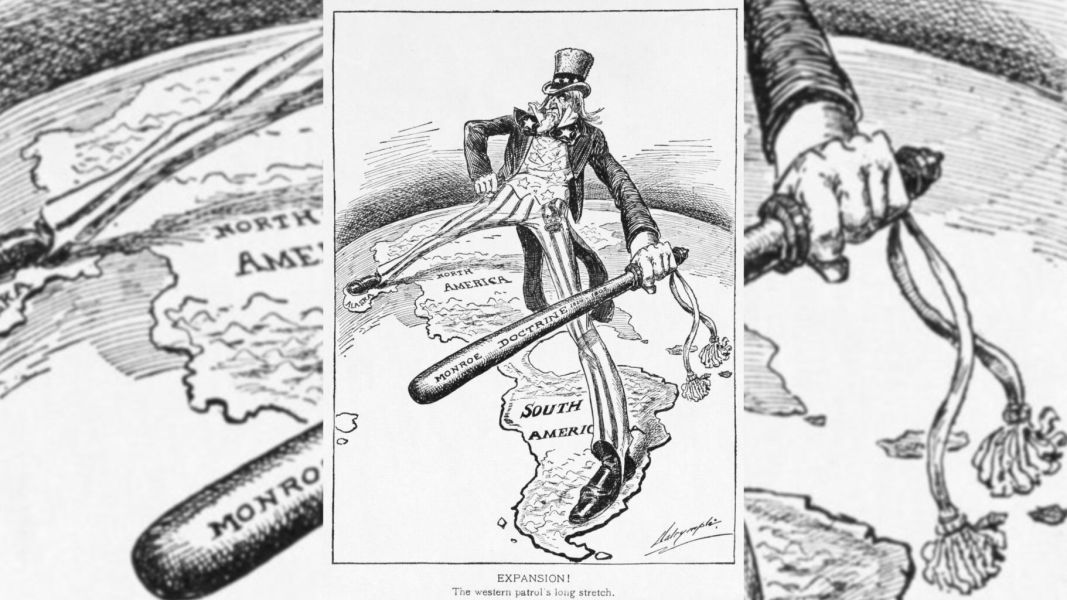
Featured Image: Satirical cartoon on US expansionism in the Pacific: Uncle Sam strides across the Americas wielding a large stick, a metaphor for American military power, bearing the inscription ‘Monroe Doctrine 1824–1905.’
References
Gilbertson, Nick. 2025. ‘Manifest Destiny: Donald Trump Jr. Visits Greenland as His Father Considers Purchasing Arctic Landmass.’ Breitbart, 7 January. www.breitbart.com/politics/2025/01/07/manifest-destiny-donald-trump-jr-visits-greenland-as-his-father-considers-purchasing-arctic-landmass-usa.
Hanaway, Roy Clark. 1926. ‘Latin American Opinion of the Monroe Doctrine.’ Social Science 1(2): 113–21.
Kimitada, Miwa. 2007. ‘Pan-Asianism in Modern Japan: Nationalism, Regionalism and Universalism.’ In Pan-Asianism in Modern Japanese History: Colonialism, Regionalism and Borders, edited by Sven Saaler and J. Victor Koschmann, 21–33. London: Routledge.
Li, Dazhao 李大钊. 1917 [2006a]. ‘新中华民族主义 [New Chinese Nationalism].’ In 李大钊全集 [Complete Works of Li Dazhao], vol. 1, pp. 284–86. Beijing: Renmin Chubanshe.
Li, Dazhao 李大钊. 1917 [2006b]. ‘极东们罗主义 [The Far East Monroe Doctrine].’ In 李大钊全集 [Complete Works of Li Dazhao], vol. 1, pp. 290–91. Beijing: Renmin Chubanshe.
Li, Dazhao 李大钊. 1917 [2006c]. ‘大亚细亚主义 [Great Asianism].’ In 李大钊全集 [Complete Works of Li Dazhao], vol. 2, pp. 154–56. Beijing: Renmin Chubanshe.
Li, Dazhao 李大钊. 1918 [2006d]. ‘Pan … ism之失败与Democracy之胜利 [The Failure of Pan … ism and the Victory of Democracy].’ In 李大钊全集 [Complete Works of Li Dazhao], vol. 2, pp. 344–47. Beijing: Renmin Chubanshe.
Li, Dazhao 李大钊. 1919 [2006e]. ‘大亚细亚主义与新亚细亚主义 [Great Asianism and New Asianism].’ In 李大钊全集 [Complete Works of Li Dazhao], vol. 2, pp. 379–82. Beijing: Renmin Chubanshe.
Ma, Jingxing 馬景行. 1920. ‘大美洲主義與大亞洲主義 [Pan-Americanism and Pan-Asianism].’ 青年進步 [Advancing Youth], no. 30: 17–28.
McCarthy, Simone. 2025. ‘Trump Says the US Needs to Protect Greenland from China. Are His Fears Overblown?’ CNN, 6 May. edition.cnn.com/2025/05/06/china/china-greenland-footprint-us-suspicion-intl-hnk.
Murthy, Viren. 2023. Pan-Asianism and the Legacy of the Chinese Revolution. Chicago, IL: University of Chicago Press.
Ōyama Ikuo 大山郁夫. 1916. ‘大亞細亞主義之運命 [The Fate of Pan-Asianism].’ Translated by Zhang Xichen 章錫琛. 東方雜誌 [Eastern Miscellany] 13(5), Section 2: 17.
Pereya, Carlos. 1916. El Mito de Monroe [The Myth of Monroe]. Madrid: Editorial-América.
Riguzzi, Paolo. 2023. ‘Mexico and the Monroe Doctrines, 1863–1920: From Appropriation to Rejection.’ Diplomatic History 47(5): 781–801.
Saga, Takashi 嵯峨隆. 2020. アジア主義全史 [A Complete History of Pan-Asianism]. Tokyo: Chikuma Shobo.
Smith, Craig A. 2021. Chinese Asianism: 1894–1945. Cambridge, MA: Harvard University Asia Center.
Smith, Craig A. 2022. ‘The Ghost of Asianism in China’s Diplomatic Slogans.’ The Asia-Pacific Journal (Japan Focus) 20(8), issue 17.
Swale, Alistair. 2011. ‘Tokutomi Sohō and the “Asiatic Monroe Doctrine,” 1917.’ In PanAsianism: A Documentary History. Volume 1, 1850–1920, edited by Sven Saaler and Christopher W.A. Szpilman, 279–86. Lanham, MD: Rowman & Littlefield.
Trump, Donald. 2025. ‘The Inaugural Address.’ Transcript, 20 January. Washington, DC: The White House. www.whitehouse.gov/remarks/2025/01/the-inaugural-address.
Usher, Roland G. 1915. Pan-Americanism: A Forecast of the Inevitable Clash between the United States and Europe’s Victor. New York, NY: Century.
Wu, Tingfang. 1914. America and the Americans from a Chinese Point of View. London: Duckworth.