
The Curious Case of the Cyber-Based ‘New Federal State of China’
Guo is the first citizen in Chinese history who dares to claim his personal right and benefit while fighting against an appalling state apparatus.
—Ha Jin (2017)
Bannon is a propaganda artist because he has proven capable of both organising infrastructure and shaping a dominant narrative.
—Jonas Staal (2018)
The ‘New Federal State of China’ (NFSC) is a diaspora movement founded in 2020 by former Trump strategist Steve Bannon and Guo Wengui, Bannon’s flamboyant Chinese-exile ally, often portrayed as operating under his supervision, who has since been convicted in the United States for defrauding his followers. Styled as a ‘government-in-waiting’ for a democratic China, the NFSC relies on livestream theatrics and digital mobilisation. Within the global rise of platform populism, the NFSC performs revolution as franchise. Its followers are neither simple victims nor fanatics, but participants in what might be called a diasporic fantasy of sovereignty—a dream of reclaiming agency through digital capital, spectacle, and moral renewal. Belief in the NFSC is inseparable from faith in visibility: to appear, to be seen, to matter.

This essay, therefore, seeks not to verify Bannon’s and Guo’s claims but to explore the conditions of belief that make their performance convincing, particularly for segments of the Chinese diaspora for whom ‘China’ has become an object of longing, grievance, and contested futurity. Using digital ethnography, I trace how allegiance was cultivated and dissent was contained across the project’s online ‘farms’ on Telegram, Discord, GTV, and Gettr, many of which are now defunct. By examining the NFSC’s underground organisational practices—its hierarchies, rituals, and disciplinary mechanisms—I show how a network that began as ‘whistleblowing’ has evolved into a hybrid formation of cult, corporation, and community.
What emerges is a portrait of how the language of Chinese dissent is reshaped when routed through the infrastructure of social media, and how revolutionary longing is transmuted into livestream content, hashtags, and digital tokens. In this sense, the NFSC project illuminates a broader shift in global China politics: ideological struggle moving into the domain of networked populism, where belief becomes both the product and the currency. It is here that the project stands as both parody and prophecy—a reminder that, in the platform age, even very dangerous rebellion can be optimised, monetised, and theatrical.
Theatre of Charisma
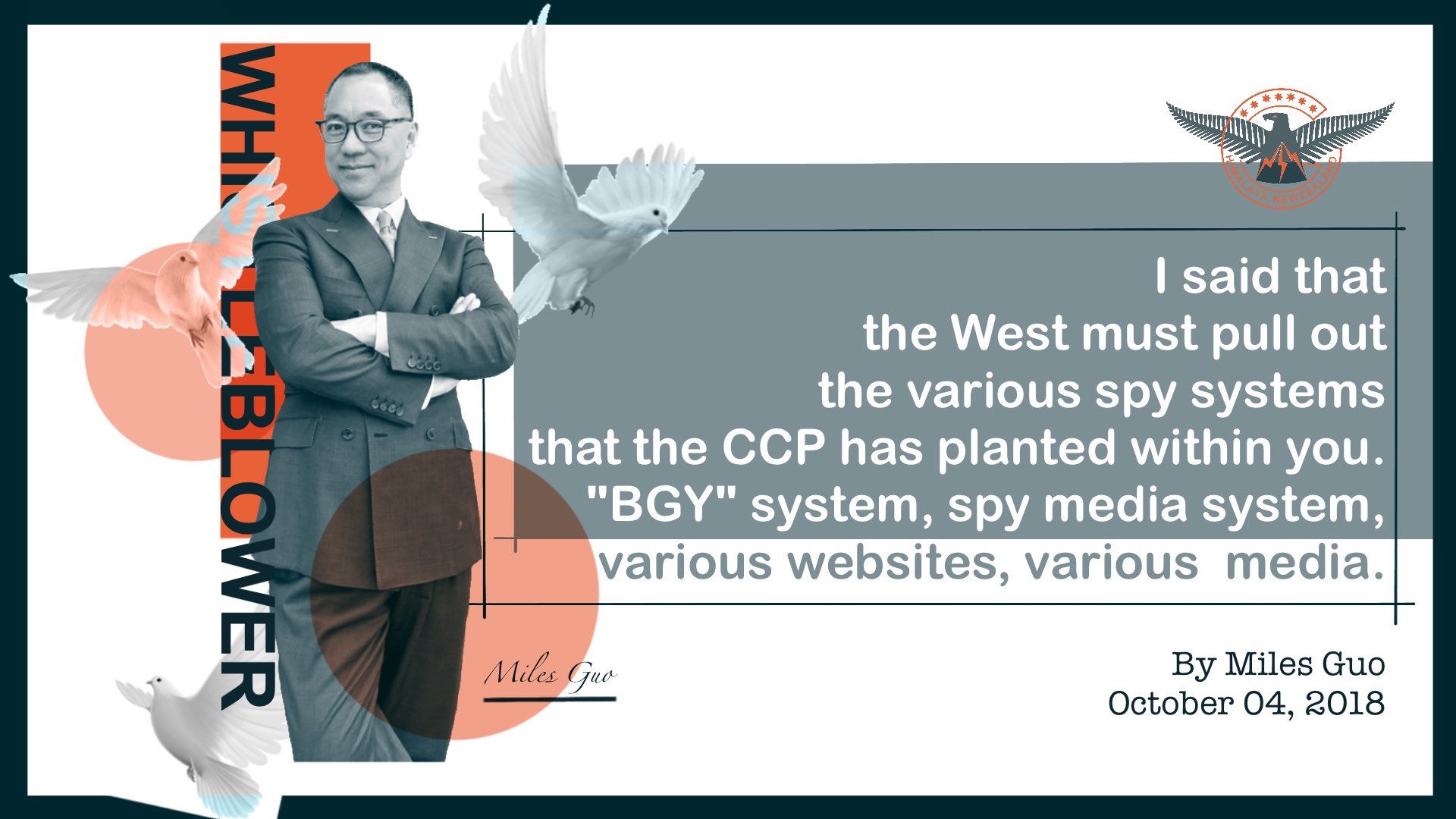
I first encountered Guo Wengui’s voice in 2017, when he began to surface in the public sphere. Around that time, he was still courting prodemocracy exiles through interviews and livestreams, before exclusively aligning himself with Bannon. On YouTube, his marathon monologues and finger-pointing lectures laid bare the alleged private sins of China’s elite—their hidden wealth, offshore villas, and dynastic privileges—delivered with the conviction of a prophet rather than a fugitive. ‘Yes, you can call me a “criminal”,’ Guo proclaimed, ‘but can’t a criminal expose those even greater criminals?’ The line stayed with me, not for its logic, but for its seductive reversal of morality—a vision in which controversy and transgression become truth-telling and criminal revelation.
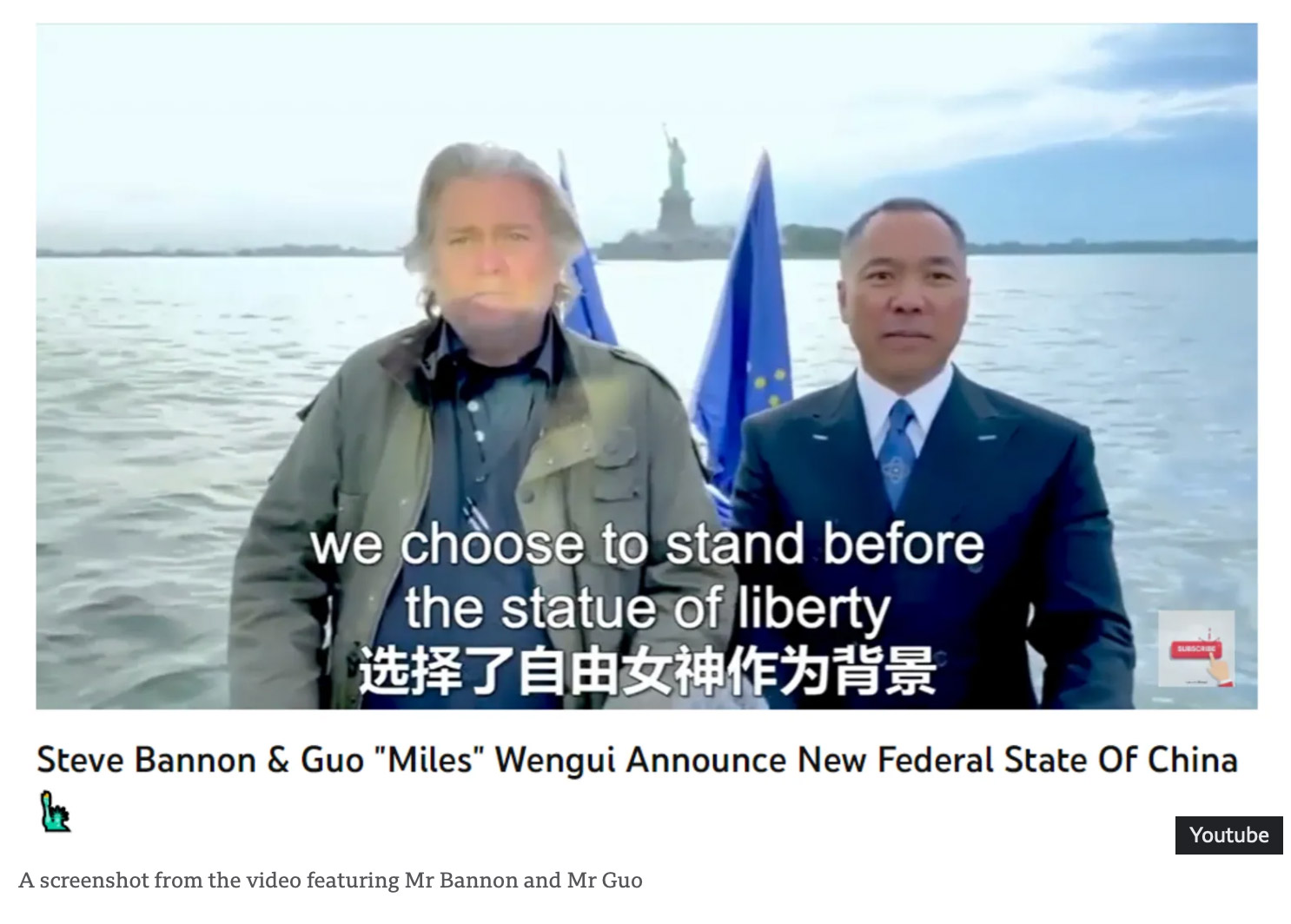
On 4 June 2020, the thirty-first anniversary of the 1989 Tiananmen massacre, and amid the Covid-19 pandemic, Guo and Bannon announced the ‘New Federal State of China’ (NFSC 2024). The launch took place not in the centre of Beijing, but on a luxury yacht bobbing in front of New York’s Statue of Liberty. ‘We Chinese cannot live in a dream anymore! Stop dreaming!’ Guo thundered, while Bannon, poker-faced, recited the English manifesto of the movement, tweaking ‘terrorist’ into the more marketable ‘criminal’ when referring to the Chinese Communist Party (CCP). Even Bannon, connoisseur of political theatre, seemed caught off-guard when Guo bit his own finger until it bled and stamped the manifesto with a bloody seal—proof of revolutionary sincerity, or perhaps a casting call for a horror film about feudalist China. At that moment, a bolt of lightning split the New York sky, which Guo improvised as ‘God’s reply’ and ‘a sign from Tiananmen’s departed souls’.
The next morning, Guo was alone on deck, pressing his palms together, facing Lady Liberty as though auditioning for a devotional music video. He knelt, he kowtowed, he prayed for China’s freedom. A self-styled Buddhist, Guo soon recast his NFSC project as simultaneously a ‘government-in-exile’, the ‘Himalaya Supervisory Organisation’ (an opaque oversight body named after the mountain range as a symbolic site of spiritual authority and geopolitical distance from China), a global franchise of diasporic ‘Himalaya Farms’ marketed as self-sufficient economic nodes, and—why not—a total artwork. In private art circles, he was even jokingly referred to as ‘China’s most unhinged yet avant-garde artist’—one who had already surpassed anything the country’s radical artists had ever dared to imagine. In mid-June, Guo livestreamed himself making grand promises to collaborate with the Dalai Lama; soon, the Tibetan Parliament-in-Exile repaid his enthusiasm with a stinging rejection, condemning his group for presumption and disrespect (Tenchoe 2020). Guo even declared that he would recruit a seasoned politician to lead the project, naming former UK prime minister Tony Blair as his ideal candidate. Predictably, no reply ever came.
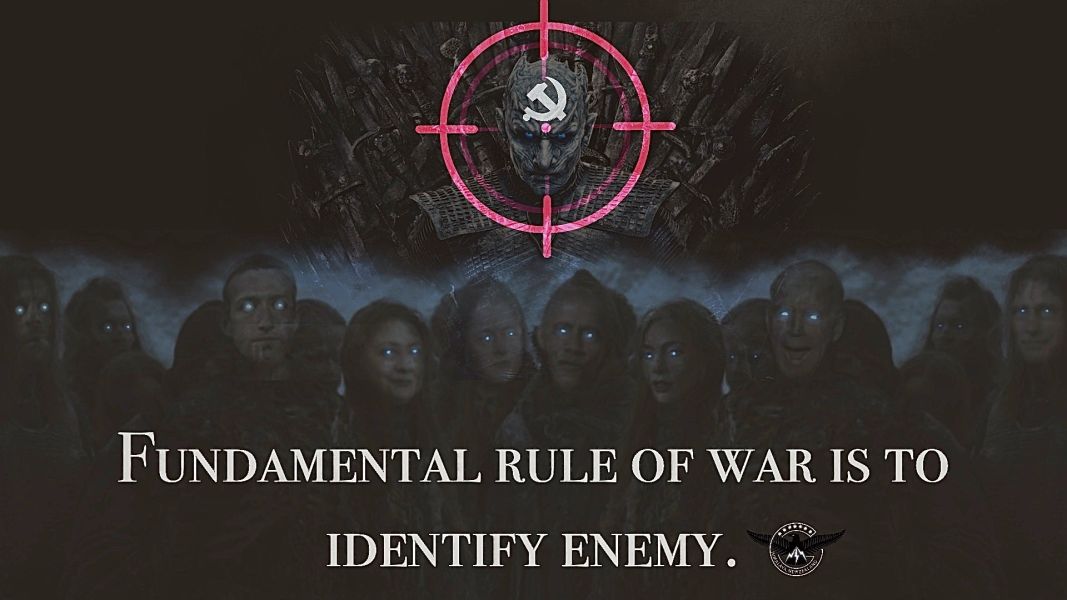
Since 2017, Guo had cultivated a whistleblower persona on social media, orchestrating a cyber network dubbed ‘ants in a web’ (Graphika Report 2021) that churned out rumours, conspiracies, accusations, and, of course, unverified ‘facts’. These ranged from lurid claims about CCP elites’ secret affairs with celebrities to exposés of senior cadres’ vast overseas fortunes and even alleged ‘gene-engineering’ schemes to proliferate their bloodlines abroad; rumours of covert influence operations and, finally, sweeping accusations that Beijing operated a global ‘BGY’ infiltration program targeting Western institutions. Together, such narratives formed a heady cocktail for a hungry diaspora and dissidents in hiding back home. His luxury apartments, gym routines, and gaudy livestreams served as proof, at least in his own script, that he possessed both the means and the stamina to ‘fight to the end’. The result was less The Communist Manifesto than Keeping Up with the Kardashians: Beijing Edition. Since his broadcasts were indeed censored globally, any Western writer or journalist sceptical of his crusade was conveniently recast as being on Beijing’s payroll. So, the spectacle dragged on—half-espionage thriller, half-reality TV, its punchline perpetually deferred, until US federal authorities abruptly arrested him on fraud and money-laundering charges in early 2023, just in time for the presidential election season.
In Max Weber’s (1978: 241–45) sense, ‘charismatic authority’ typically arises in times of crisis, when followers seek salvation in figures believed to possess extraordinary qualities. Guo’s rise as a ‘saviour’ during a period of disillusionment and political paralysis among the Chinese diaspora exemplifies this dynamic: his supposed insider knowledge and personal wealth lent his charisma an aura of authenticity and power. In the machinery of digital influence, the NFSC project merges political rhetoric with celebrity branding and speculative enterprise. As Jodi Dean (2005; 2010: 4–6) notes, ‘communicative capitalism’ turns participation into a stand-in for transformation, converting expression into circulation that sustains the system. Guo’s network also embodies this logic: followers ‘resist’ by liking, reposting, donating, and investing—gestures that generate visibility while simulating agency. What emerged was not simply an organisation, but an affective infrastructure held together by belief and aspiration: volunteers performing patriotism to ‘save’ those in China, then extending their ‘mission’ to warn the West, while enforcing discipline and financing a virtual polity. Their unpaid emotional labour collapses the divide between activism and digital capitalism. Guo’s charisma—amplified through his media apparatus and shaped, perhaps, by Bannon’s influence—transforms trauma into belonging and speculation into solidarity, revealing a deeper mutation of dissent: from moral protest to monetised spectacle, from conviction to faith.
Rule of Organisation

To enter the cyber-based diasporic ‘Himalaya Farms’, one must first cross a digital border. Applicants navigate layers of gatekeeping, each farm enforcing its own ritual of initiation. For those inside China, the first act of allegiance is to fan qiang (翻墙)—that is, to scale the state’s Great Firewall through a reliable virtual private network (VPN). The act is both technical and symbolic: a miniature performance of exile—a rite that converts connectivity into liberation. Each click affirms what Morris et al. (2023) have called the ‘digital sovereignty of diaspora’. The access itself reshapes the imaginaries of Chineseness, which are anchored less in cultural continuity than in precarious and performative forms of political belonging, contingent loyalty, and digitally enforced discipline.
At the branch I joined, prospective members were asked to submit a cover letter narrating their suffering under the CCP regime—an exercise in confessional authenticity that blurred political commitment with affective exhibition. Admission also required a donation to Guo’s Rule of Law Foundation—reportedly founded with an initial investment of US$100 million in 2018 (NFSC 2024)—with no fixed amount. Faith, not sum, was the true currency. Once admitted, members would encounter a ‘brave new world’ both regimented and strangely playful, a mix of the outspoken and the permanently silent—all cloaked in anonymity or pseudonyms, numbering in the hundreds (and some insisted it had once swelled beyond 2,000). Since the organisation was essentially cyber-based, offline activities were minimal; the primary task for most members was to disseminate its content on social media to counter the CCP’s overseas propaganda. In effect, it became a campaign of ‘propaganda versus propaganda’. Many were further mobilised to police and suppress counter-ideological voices on Gettr, the platform developed by Guo himself, like Donald Trump’s Truth Social. ‘Counter-ideological’ posts included anything that questioned Guo’s claims, criticised the NFSC’s tactics, or even opposed Trump. These dissenting users were often targeted through coordinated trolling and mass reporting, which buried their posts or led to temporary suspensions and, in some cases, account removal—the very same methods the group claimed had been used against them on mainstream platforms such as X (Twitter) and YouTube.
Discord and Telegram servers were subdivided into quasi-ministerial departments—finance, media, education, architecture, arts, recreation, etcetera—mimicking the structure of a state or institution. This bureaucratic theatre was sustained by volunteers who contributed their time, skills, and emotions without material reward. Their labour was affective in the strict sense: it produced enthusiasm, solidarity, and the illusion of purpose. In principle, this structured establishment could have served as an effective mechanism for the organisation to identify and retain talent. In practice, however, productivity was measured in metrics such as posts, shares, and meeting attendance, so that numerical visibility replaced substantive participation. The result was an economy of devotion in which quantity masqueraded as virtue, with numerical tallies directly determining eligibility for investment—most notably, the chance to buy NFSC financial products, such as the crypto G-Coin, a digital currency advertised as gold-backed, at the lowest possible price. Many capable young members were said to circulate across the global ‘farms’, continually seeking a more advantageous placement.
Yet, the community’s fervour was shadowed by fear. Since anyone could be a CCP informant, trust was fragile and contingent. Allegiance demanded constant performance: unceasing praise for Guo, Bannon, and figures such as virologist Yan Limeng (who fled China alleging Covid-19 was engineered as a CCP bioweapon before later breaking with Guo), ritualised slogan-chanting, denunciations of sceptics, and absolute obedience to ‘farm’ leaders. Followers who raised questions or simply showed signs of emotional exhaustion were swiftly branded imposters (伪类) and expelled, forfeiting not only their digital rank but also their financial stakes. These ‘stakes’ took various forms: donations framed as patriotic contributions; purchases of NFSC-linked financial products such as G-Coin or GTV equity; and, for some, the expectation that loyal service would yield privileged access or material reward once the ‘new state’ came into being. Expulsion thus meant the symbolic and economic erasure of whatever one had already put in: time, status, and money. Association with the punished invited suspicion and exclusion, turning fear itself into a demonstration of loyalty.
In this circuit of surveillance and confession, the ‘farms’ replicated the authoritarian logic they claimed to oppose. What set them apart from the CCP regime they condemned was not discipline but desire—the craving to belong, to believe, to feel morally cleansed through collective struggle (Dean 2016). When rivals were recast as traitors, their expulsions became livestreamed ‘executions’ that reaffirmed internal authority.
A Revolt of Chinese Elites
Although framed as voluntary and fraternal, the global chain of organisations operated in a distinctly hierarchical fashion. The internal hierarchies mirrored the class structure of China’s power elites. Those who had entered Guo’s orbit early, revealed their personal identities (including their families’), or donated and invested large sums were undoubtedly elevated to leadership. Their proximity to Guo was an index of holiness: intimacy with the prophet conferred symbolic capital. For many, this hierarchy echoed familiar forms of advancement in both China and the United States—unequal societies in which loyalty, access, and patronage often matter more than merit or credentials. The NFSC replicated this structure, offering not so much a fantasy as an exaggerated mirror of existing pathways to mobility, recast through devotional politics.
Although often framed as an offshoot of the Western populist wave led by Bannon, Guo’s movement was, in substance, a revolt of Chinese elites. Those self-styled diaspora ‘farm’ leaders—individuals whom followers widely believed and whom internal chatter frequently alleged to be ‘red princelings’, former cadres, businessmen, celebrities, or intellectuals—were themselves major stakeholders in the NFSC. In some cases, these identifications were based on Guo’s teasing remarks and leaders’ own hints about their backgrounds; in others, they circulated as presumptions within the community, reinforced by the leaders’ accents, mannerisms, or claims of past access to China’s political or economic spheres. Over time, Guo’s promises of future wealth transformed the network from a moral crusade into a speculative economy. The NFSC did not simply demand loyalty; it commodified it. Participation was elevated to devotion, and devotion was measured by financial contributions, turning money into the currency of virtue.
Guo, by contrast, distinguished himself from earlier exiles and dissidents—from Democracy Wall veterans and Tiananmen student leaders to Falun Gong activists, human rights lawyers, and non-Han advocates—through his rare position as an insider among China’s ruling class: a billionaire financing his own ‘revolution’. He repeatedly claimed that many others from this privileged stratum would eventually rally to his cause—an assertion that also served as its most effective advertisement. Yet, as Weber (1978: 1121) noted, charisma must be ‘routinised’ and translated into enduring structures of control. As participation in the NFSC expanded, Guo’s charisma became increasingly bureaucratised, converting belief into the very obedience his followers professed to reject. His rupture with other exiles stemmed less from ideology than from the logic of platform sovereignty—that is, the drive to monopolise ‘truth’ itself through control of data, attention, and narrative, however unverifiable that ‘truth’ might be.
Competition among ‘farm’ leaders was livestreamed, with Guo rewarding the most zealous and criticising those who fell short. These public performances resembled corporate reality television: affective labour rendered spectacular. Fragmentation soon followed: national networks splintering into rival factions named after new cities and symbols. The Australian ‘farm’, for instance, was split into Sydney and Melbourne branches, each led by one of Guo’s self-styled ‘female warriors’ whose devotion oscillated between personal adoration and political conviction. Such scenes illustrate what Ico Maly (2018) calls ‘algorithmic populism’: the translation of charismatic power into data-driven visibility and networked competition. Most conspicuously, eager to prove their worth, leaders mobilised volunteers to assault Guo’s ‘enemies’—dissidents who openly defied his authority online—and broadcast these confrontations live on G-TV. The spectacles were seldom spontaneous; some were meticulously staged, with a hired local lawyer calculating precisely how far the attacks could go. Conveniently, the targets were denounced as CCP operatives abroad—a label that justified aggression and further entrenched Guo’s mythology of embattled righteousness.
From afar, Guo, ensconced in his Fifth Avenue penthouse, appeared as an absent sovereign presiding over an empire of belief. His followers, meanwhile, were both agents and captives of their own affective investment. The rituals of devotion—daily meetings, livestream pledges, donations, and even expulsions—functioned not merely as social activity but also as a complete apparatus of governance: transforming loneliness into solidarity, alienation into purpose, and digital clicks into tokens of salvation. The followers’ commitment was sustained by visionary promises and an incessant stream of insider tales and unverified ‘facts’. In this sense, the movement epitomises the postmodern fusion of exploitation and enthusiasm, in which voluntary participation masks systemic coercion and faith itself becomes a form of labour.
Very Deliverable

What, then, compels so many people to risk following Guo?
Beyond his visible fortune and theatrical bravado, Guo’s appeal lies in his ability to fuse entrepreneurial confidence with populist grievance—a formula perfectly attuned to the attention economy. As Paolo Gerbaudo (2019) notes, digital populism thrives by turning affective identification into a form of micro-mobilisation, in which followers experience empowerment through proximity to ‘charismatic authority’. Guo performs this role: a billionaire-messiah who appears to champion fraternity and equal access, inviting anyone to contact him directly through his Telegram number, while promising redemption through investment, participation, and faith. His alliance with Bannon and other icons of the American right-wing—Rudy Giuliani, Michael Flynn, Peter Navarro, and Jason Miller, all of whom appeared at Guo’s events and broadcasts (Osnos 2023)—only magnified his aura of access to real power. For members of the Chinese diaspora, long treated as invisible or politically marginal, this recognition from powerful white elites offered not merely validation but also transcendence—a sense of being seen and of mattering.
The economic dimension of the faith was equally crucial. The NFSC’s manifesto promised universal health care, education, property rights, freedom of speech, and so on (NFSC 2020). Yet, Guo’s livestreams clarified that the leadership would remain permanently abroad, supervising China’s future from exile. In this vision, the NFSC is not a threat to those governing within China. Guo himself, weary of ‘ugly politics’, professed a desire for a reclusive life, in contact only with a few trusted allies—a sentiment perhaps understandable for one who has long been consumed by danger and political spectacle.
So, instead, it projects an image of citizens as wealthy and globally mobile—a fantasy of elite cosmopolitanism that reassures rather than destabilises existing power. Liberation was not collective but financial: success meant joining a transnational class of investors, the self-styled ‘aristocrats’ of a miniature ‘free’ China. G-Coin, the so-called ever-appreciating digital currency, would be mediating their imagined sovereignty. Faith became fungible; utopia acquired a price tag. This conversion of belief into speculative capital exposed the movement’s paradoxical structure: a ‘revolution’ that reproduces the neoliberal fantasy it claims to resist. Followers donated not simply out of trust, but also to buy symbolic equity in the coming freedom. Exploitation and enthusiasm fused seamlessly. Members framed their losses not as victimhood but as sacrifice—proof of loyalty and moral worth. Failure itself became performative, part of the collective narrative of struggle.
For Guo and Bannon, this configuration was remarkably deliverable. The system required no army and no territory, only connectivity and conviction. Each volunteer’s labour—spreading messages, converting others, defending the course online—expanded the movement’s data empire. The very precarity that defined the followers’ diasporic existence supplied the emotional energy that kept the system alive. What emerged was less a political organisation than a ‘populist start-up’: scalable, modular, self-exploiting, and self-sustaining. Guo’s empire of visibility thus stands as a mirror of our digital age: a theatre where exploitation feels like empowerment and loyalty itself becomes the ultimate commodity.
Despite its grandiose name, the ‘New Federal State’ was a pragmatic venture, less about building a nation than about expanding the early stage ‘revolution’. Its architecture chiefly benefited the already affluent, those eager to emulate Guo, while enticing ordinary followers with the promise of buying original shares at token prices and, with luck, securing a modest escape from a possibly impoverished future. What remains perplexing is how a supposedly seasoned entrepreneur could launch such an ambitious transnational enterprise without assembling a competent team to run it. Guo, meanwhile, frequently appeared in livestreams in a state of near despair: ‘My dear brothers and sisters, please focus on our great goal—stop the endless, chirping quarrels over trivial nonsense!’ The entire project unfolded as a dark cyber-comedy of faith, greed, and mismanagement.
The Curtain Falls?

Around the time of the 2020 US election, Guo claimed that President Trump would soon recognise the NFSC as a legitimate ‘state’—if only he secured a second term in 2021. Perhaps this holds the key to understanding why Guo’s media machinery plunged into the first Biden–Trump contest, and why he ended up in jail before the second. In March 2023, the curtain seemed to fall. Guo was arrested in New York on federal charges of fraud, money-laundering, and conspiracy. On the same day, a fire broke out on the eighteenth floor of his Manhattan residence (NFSC 2023). News of the arrest flooded social media, accompanied by images of his confiscated possessions—cash, art, luxury cars, a 26-room apartment overlooking Central Park. The scene was almost too theatrical: the self-proclaimed ‘saviour’ of China brought down by the very machinery he had sought to command. For many, the episode confirmed what critics had long suspected: that Guo’s movement was a scam, a moral farce. Yet, within hours of the news breaking, NFSC channels flared to life before quickly falling quiet again. Followers refused to believe the charges. Some called it ‘the second arrest of Christ’, others insisted that Guo had orchestrated his own detention to ‘expose the deep state’.
Guo’s arrest cast an abrupt shadow over a movement already stretched between devotion and disbelief. It also sharpened a question that had long lingered at the edges of the NFSC spectacle: how could a self-styled revolutionary of total opposition end up aligned with America’s alt-right? The contradiction is less an anomaly than a hallmark of what Gerbaudo (2019) calls ‘post-ideological populism’—a formation that collapses conventional political categories by fusing resentment, moral certainty, and media spectacle. Guo’s movement thrives on this fluidity. His rhetoric swings between nationalist grievance and libertarian fantasy, spiritual redemption and capitalist promise. What holds these contradictions together is not doctrine but affect—the sense of collective persecution and moral clarity produced through participation itself. Guo’s partnership with Bannon and other Trump-era figures exemplifies this logic. To many, it signified access to ‘real’ power; to others, a betrayal of democratic ideals. Yet, such tension never fractured the movement because belief was measured not by ideological consistency but by visibility. In this networked populism, to be seen taking a side mattered more than which side it was.

In a livestream around the launch of the NFSC, Guo was filmed in one night sitting by a bonfire, drinking alone, and paying tribute to Liu Xiaobo, the writer and Nobel laureate who died in Chinese state custody. In the eyes of many, Liu embodied a form of ‘moral endurance’ and ‘ethical martyrdom’ (Sørensen 2013). In the same broadcast, Guo declared that one must confront a ‘gangster’ only as another ‘gangster’, never as a ‘gentleman’—a rationale that, on the surface at least, appears difficult to dispute. Guo’s ‘gangster versus gangster’ strategy reflected what Rey Chow (2002: 9–12) calls ‘coercive mimeticism’: the compulsion of marginalised subjects to reproduce the very forms of power that oppress them to be recognised within global hierarchies. The struggle against authoritarianism thus mirrored the same logic of charisma and control it opposed. The NFSC project was hardly about China’s political future—that question was far too vast to answer; it was about the management of belief in a disenchanted world. In an economy in which visibility equals existence, Guo’s ‘downfall’ only reaffirmed his power: the more he was persecuted, the more meaningful became his belief. His followers’ refusal to accept the narrative of their possible failure reflects what Dean (2016: 23–27) calls ‘reflexive passivity’—the circulation of passion and outrage that substitute emotional intensity for political transformation.
If the ‘farms’ once promised a digital utopia—an imagined community freed from state control—they now embody a more unsettling truth about contemporary populism: that participation can itself become a form of capture. For me, as a specialist in visual art, watching these digital pageants was like witnessing the strange afterlife of the Chinese avant-garde. The ethos of radical autonomy once celebrated by artists has been reborn in perverse form: not as critique, but as charisma; not as subversion, but as strategy. The dissident—once an icon of moral courage—now survives as an influencer persona, a brand of authenticity traded across various platforms. The figure of Guo—part-messiah, part-meme—marks the endpoint of this transformation, in which avant-garde rebellion and entrepreneurial selfhood converge into the same performance of deliverability. The unfolding ‘fall’ of Guo, then, is not merely the failure of one man’s delusion but the exhaustion of a certain political imagination—the fantasy that sincerity, exposure, or spectacle might still deliver liberation. What remains, perhaps, is a quieter kind of awareness: that belief, too, demands critical vigilance rather than an excess of disdain and insult; that freedom, pursued through visibility, risks becoming another form of captivity. To investigate the curious case of the NFSC is therefore not to romanticise it, but to recognise, in its absurd reality, a mirror of our own condition, where every act of dissent is instantly folded back into the circuits of attention and the theatre of politics continues long after the curtain falls.
Acknowledgements
I am grateful to the editors of the Made in China Journal for their generous and incisive editorial suggestions, which helped me navigate the complexities of this chaotic and controversial case, and to Jeffrey Wasserstrom for his early encouragement to pursue this topic.
References:
Chow, Rey. 2002. The Protestant Ethnic and the Spirit of Capitalism. New York, NY: Columbia University Press.
Dean, Jodi. 2005. ‘Communicative Capitalism: Circulation and the Foreclosure of Politics.’ Cultural Politics 1(1): 51–74.
Dean, Jodi. 2010. Blog Theory: Feedback and Capture in the Circuits of Drive. Cambridge, UK: Polity Press.
Dean, Jodi. 2016. Crowds and Party. London: Verso.
Gerbaudo, Paolo. 2019. The Digital Party: Political Organisation and Online Democracy. London: Pluto Press.
Graphika Report. 2021. Ants in a Web. 17 May. graphika.com/reports/ants-in-a-web#download-form.
Ha, Jin. 2017. ‘哈金访谈: 郭文贵是一位“战将”, 很了不起 [Ha Jin Interview: “Guo Wengui is a ‘warrior’, very great”]!’ 自由亚洲电台 [Radio Free Asia], 2 October. www.rfa.org/mandarin/duomeiti/guandian/POV-HJ1-10022017154916.html
Maly, Ico. 2018. Populism as a Mediatized Communicative Relation: The Birth of Algorithmic Populism. Tilburg Papers in Culture Studies, No. 213. Tilburg, Netherlands: Tilburg University.
Morris, Carwyn, Andy Hanlun Li, and Lotus Ruan. 2023. ‘Covid Origins, Nationalism, and Diasporic Heterogeneity: China, Chineseness and Covid-19.’ In Covid Conspiracy Theories in Global Perspective, edited by Michael Butter and Peter Knight, 43–57. London: Routledge.
New Federal State of China (NFSC). 2020. ‘The Declaration of the New Federal State of China.’ Website. New York, NY: NFSC. nfsc.press/our-mission/.
New Federal State of China (NFSC). 2023. ‘Court Case Documents.’ News release, 22 April. New York, NY: NFSC. nfsc.press/2023/04/22/court-case-documents/.
New Federal State of China (NFSC). 2024. ‘NFSC Official Timeline.’ Website. New York, NY: NFSC. nfsc.press/timeline-nfsc/.
Osnos, Evan. 2023. ‘What Secrets Does the “Donald Trump of Beijing” Know? The Case Against Guo Wengui Could Expose More About America’s Politics Than China’s.’ The New Yorker, 16 March. www.newyorker.com/news/daily-comment/what-secrets-does-the-donald-trump-of-beijing-know.
Sørensen, Henrik Hjort. 2013. ‘The Politics of Suffering: Liu Xiaobo and the Moral Aesthetics of Dissent.’ China Information 27(2): 133–36.
Staal, Jonas. 2018. Steve Bannon: A Propaganda Retrospective. Rotterdam, Netherlands: Het Nieuwe Instituut and Studio Jonas Staal.
Tenchoe, Lobsang. 2020. ‘Speaker Pema Jungney disapproves, Rejects Guo Wengui’s “New Federal State of China”.’ The Tibet Express, [Dharamshala, India], 6 July. tibetexpress.net/12526/speaker-puma-jugney-disapproves-rejects-guo-wenguis-new-federal-state-of-china/.
Weber, Max. 1978. Economy and Society: An Outline of Interpretive Sociology. Edited by Guenther Roth and Claus Wittich. Berkeley, CA: University of California Press.