
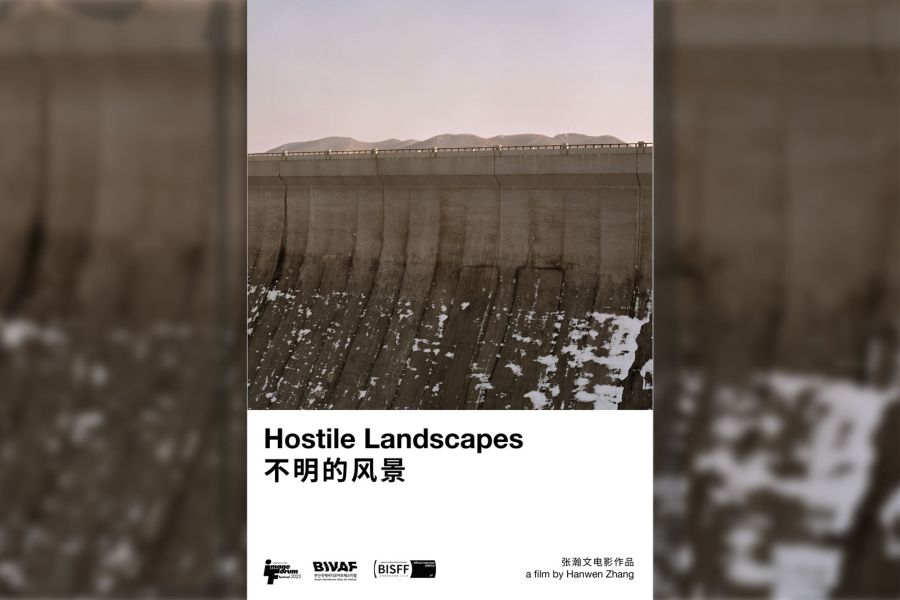
Hostile Landscapes: A Conversation with Zhang Hanwen
In October 2021, Ju Hyeongeon (朱贤健), a North Korean defector held in Jilin Prison in Northeast China, broke out of the facility and spent 40 days on the run before he was caught near the Fengman Dam, a site with a long history of Japanese colonial engineering. Artist Zhang Hanwen (张瀚文) retraces this journey in Hostile Landscapes (不明的风景, 2025), a two-channel film that moves through Ju’s confirmed and suspected hideouts, allowing the camera to linger on terrain that has absorbed the stories of many border crossers besides him. The film does not reconstruct Ju’s escape as a single narrative thread. Instead, it layers his path between other histories of flight and displacement across East Asia, treating the landscape as an unstable archive that holds traces of empire and clandestine movement that it does not give up easily. Hostile Landscapes won the Grand Prize and Audience Prize at the 2025 Tokyo Image Forum Festival and the Jury Prize at the 2025 Busan International Video Art Festival.
In this conversation, Zhang speaks with historian Dayton Lekner about what happens when artistic and historiographical methods are pointed at the same fugitive and the same terrain. At stake is how to represent a story that resists confirmation and what it means to build a claim of truth from landscapes that keep their secrets.
Dayton Lekner: Your film resonated with me in several unexpected ways. While the work is framed within the narrative arc of a man on the run through the landscape of Jilin, it is also a work of history, which led me to think about how artists and historians approach the past. What is history to you and why did you turn to the history of Jilin and Jilin Prison as you traced the steps of a contemporary fugitive?
Zhang Hanwen: ‘What is history’ sounds like a complicated ontological question, but I will try to give a plain answer. To me, (hi)story, as the word literally suggests, is first and fundamentally narrative, grounded partly in reality. This reminds me of when I started learning German and was surprised to find that ‘history’ and ‘story’ are the same word, Geschichte. I see history as the result of a repetitive, accumulative process of constructing what happened in the past and sometimes what is still happening in the present. My work is one tiny part of this process.
In the case of Hostile Landscapes, this meant constructing and telling a recent story—of a North Korean defector’s brief life on the run after escaping prison—and setting it within a somewhat broader frame of local history. I brought in the histories of Jilin, Jilin Prison, and Fengman Dam because the landscape in which they sit is like a stage that has only taken its present form because of its colonial past. In hindsight, though, this historical dimension wasn’t what I was focused on while filming. Recording video and audio onsite in front of the dam, for instance, I didn’t know it would become a prominent thread of the film. The details and connections to local history only came to me during editing—which, I suppose, proves the point I made above that history is an accumulation of constructions.
DL: I like this way of thinking about history: the layering of stories. Hostile Landscapes does this in a very effective way by mixing the dramatic narrative arc of a fugitive with a historical telling of the land he runs across. The regional history is dramatically sharpened as we view the landscape through the eyes of someone who is hunted. At the same time, the fugitive’s story is more deeply embedded in the regional landscape and history than that of Andrew Davis’s iconic film The Fugitive (1993). But there’s another layer here. We have a man on the run. We have the landscape, and its history, through which he runs. And we have a man with a camera and a microphone—that is, you. How did you come to the story of Ju Hyeongeon and how did your vision for the film develop?
ZH: Ju’s story was a local headline when he escaped from prison in October 2021. News about him was everywhere, both in the news media and on social media, so it was hard to miss. I remember people talking about it a lot; jailbreaks are quite rare in contemporary China—remember, it is assumed to have the world’s most advanced and sophisticated police surveillance system. This ‘surprise’ was compounded by the news that authorities had raised the bounty on Ju several times, to an incredibly high amount, and that it took 40 days to capture him. While all this was happening, I was in Shanghai and I sensed intuitively that I might do something with it in the future. Fast forward to 2022, the third year of the Zero-Covid policy, and the Shanghai lockdown began. I had the full experience of that lockdown and reflected a lot during that time. Jilin, where my parents live, was under a similar lockdown. The events of that period motivated me to return to my hometown and get my hands on Ju’s story. So, in October, I packed my filming gear and travelled back, both to check on my parents and to start filming.
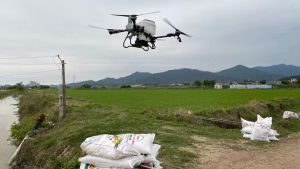
The audiovisual aesthetics of the piece were decided before filming began. Since I knew it would be impossible to get access to Ju in person, it was, again, an intuitive early decision to focus on the negative space: his absence in the landscape. With that essential ‘strategy’ in mind, I left the rest of the creative decisions to the field. Before setting out, I did some initial research and marked several spots on the map that were Ju’s confirmed or suspected hideouts, according to news reports or rumours. Although the beginning and end of his life on the run are known, no-one except Ju knows exactly where he hid in between. That void left me plenty of space with which to work, which I was quite excited about.
That reminds me of our conversation in Venice on Chai Jing’s (2025: 3:48) YouTube channel episode featuring Gao Hua, the late historian of Nanjing University well known for his work on early People’s Republic of China and Chinese Communist Party history. Chai said that Gao Hua ‘read’ many things that were never written, or the silences where the text suddenly stops, and that guessing at them is a skill historians hone early. Sometimes historians’ guesses come closer to the truth than the existing records, since, for topics such as the Cultural Revolution, it’s common to have huge gaps in archives and records and historians must fill these as factually as they can based on what remains.
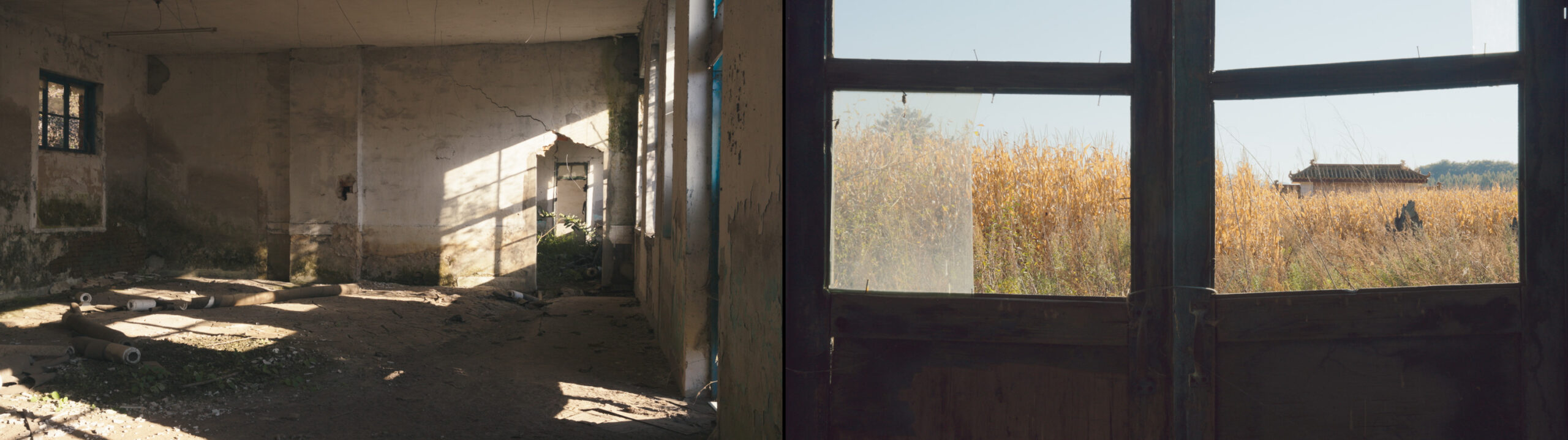
DL: I’ve been thinking a lot about the relationship between history and creativity, particularly as I consider new projects and what form they might take. As a historian, I’m comfortable with the idea, as Chai Jing suggests, that my craft is to some extent creative. Hayden White’s (1973) challenge that history writing is a fictive endeavour never struck me as a critique of history so much as a celebration of what is true in fiction. A few nights ago, I listened to an interview with Juan Gabriel Márquez, whose book Retrospective blends historical research (archives, diaries, interviews) with the novelist’s practice of creating, or re-creating, dialogue and private moments he could never be quite sure happened and certainly did not happen precisely as they appear in the novel (Arana 2019). Márquez makes the point that fiction can reach truths that formal historical writing cannot.
I want to push further into this question of how an artist and a historian differ in their approach to the past. If I imagine writing a history of Ju Hyeongeon, I imagine carrying out as much textual research as possible and then travelling to Jilin in the hope of interviewing those who heard of the escape, knew of the ever-growing bounty, and had some response to the idea of a fugitive at large in their landscape. I feel that our crafts diverge here: I couldn’t really tell the story from Ju’s perspective without taking more creative licence than I would be comfortable with or that peer reviewers would tolerate. I don’t know what kind of story would have emerged, but I imagine it would be a reflection on how we all respond to a sense of danger in the landscape around us. In your work, however, we stay with Ju’s personal perspective and what is hostile in the landscape is not a single person but the possibility of capture and the loss of freedom.
I also have no idea how I might relate Ju’s flight to the colonial history of the land. Watching Hostile Landscapes, and digesting it afterward, I had a strong sense that the two are related. Of course, individual stories and regional or even national histories are entwined, but the connection your film lets us feel would elude an academic historical account. That’s part of why I enjoyed the film so much: it did something I would love to do but can’t.
Let me stop harassing you about history and ask a different kind of question. In Hostile Landscapes, you include conversations between yourself and people you encounter while filming. Your film crew also appears at least once. Why did you include yourself in the film and can you say something, without spoiling it, about the final conversation, in which you become the focus of someone else’s questions?
ZH: I agree with Márquez. This notion that fiction can approach truths more closely than non-fiction can apply not only to historical writing but also to the essence of film and art more broadly. It’s a notion that has been explored by countless directors and artists.
When it comes to documentaries, filmmakers, critics, and viewers are usually concerned about the moral issues connected to every aspect of how the film (re)constructs reality: the filming process, the presence and gaze of the camera, questions of representation, and so on. Fictional films, by contrast, are relatively exempt from these moral burdens and might even have more potential, as a result, to grapple with reality or reveal ‘truth’.
That leads me to you imagining yourself working on Ju’s story. Most of my creative process followed the imaginary one you describe. I did textual research on Ju throughout the filming and editing, which led to the texts in the film on the current situation of North Korean defectors in China. But I didn’t try to stay objective. The film is also a personal reflection on the landscape around me—in this case, my hometown.
That brings me to your question about showing the film crew and including the conversation at the end. Both reveal that the piece is not, or at least not limited to being, a journalist’s ‘documentary’ on Ju, but a reflexive film about him and me at the same time. This became clear early in production, after collecting and watching the first batch of footage and discussing it with artist peers, since Ju would never appear in the frame. In the end, it would always be my point of view, no matter how hard I imagined myself into his position—something that was later confirmed by conversations I had with locals. The more details I heard about the local authorities’ manhunt, the more I felt it was impossible to replicate Ju’s view, because he was literally running for his life in an extremely precarious situation, against the whole violent apparatus of a powerful regime. And this wasn’t even the first time he had been in that situation, since, before China, he was fleeing North Korea.
Still, filming out in the wild pushed me to my limits and put me in other intense situations, including the final scene, which captures a conversation that took place right after I filmed the opening sequence at Jilin Prison. These situations can’t be compared with what Ju personally went through, but they gave me a hint of what he, and other marginalised people like him, face in everyday life and how, in a sense, we all share a vulnerability that most people in contemporary China would rather ignore.
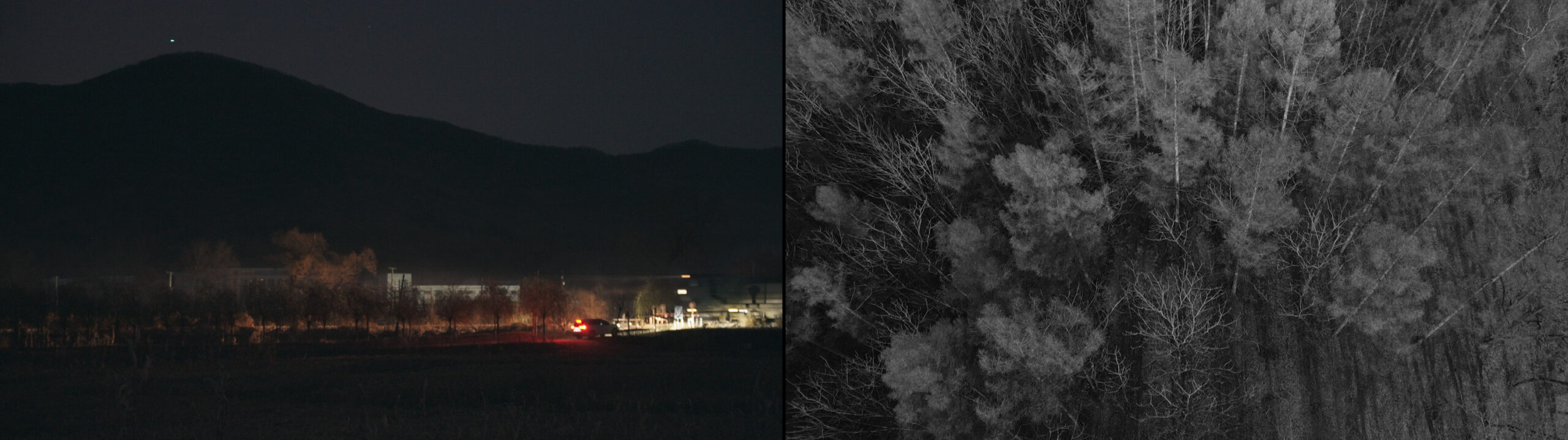
I also chose to keep my own onsite recorded sound in the film: breathing, sniffling, footsteps. Within the frame of Ju’s visual absence, I hope my audible presence reminds viewers that I never intended to be objective in this piece. What matters is that Ju might have been there and that I was there, too.
DL: Now I am trying to work out what is the historian’s equivalent of audible breathing. I try to do something similar by writing in a way that reflects my subject, trying not only to tell the reader a historical story, but also to draw them into a moment in time and give them an experience in some way like that of the people about whom they’re reading—to put them in the space, in the way you describe.
Let’s close with something I feel you probably don’t want to talk about: politics. I get the sense from Hostile Landscapes, as well as your other works such as Snowy Day Studio Visit and We Spin Around the Night Consumed by the Fire (我们盘桓在夜色里被烈火吞噬), that you’re drawn to prominent political issues and, at the same time, want to approach them somewhat obliquely, to show another, often overlooked, side of these questions. Watching your films, I get the sense of talking with a friend about potentially divisive topics while walking through an enchanting landscape. Sure, I might feel strongly about repressive national security measures or Taiwanese self-determination, but look at how the wind moves through the grass, look at how the snow gathers on the roof of that building. It’s a very effective juxtaposition of feelings. What kind of engagement with the political, if any, are you attempting?
ZH: I like how you describe your writing approach. It reminds me of the filmmaker-artist Trinh T. Minh-ha and a line from her work that I will borrow here to answer your question.
In Trinh’s first film, Reassemblage (1982), there’s a line that has since been frequently quoted to grasp her cinema: ‘I do not intend to speak about; just speak nearby.’ The context is that she filmed a community in Senegal as a visual ethnographer. The line presents her position as an unauthoritative narrator and obliquely criticises the Western canon of ethnographic research. Trinh has influenced my work, too. Though I’m not an external intruder, I also feel like a stranger and often question whether I’m qualified to address certain subjects and how to do so appropriately.
‘Speaking about’ the politics of or in China through art is always tricky, especially when the artist and the piece are placed in different cultural, political, and ideological contexts. In general, radical political artwork that strongly opposes a specific agenda can be easily hijacked, altered, or co-opted for other purposes, since interpretation of a work is always beyond the artist’s control. Yet, it’s unlikely that artists today could claim to conduct pure formal or aesthetic experiments without touching politics. In this sense, I agree with Trinh and think ‘speaking nearby’ can be an appropriate approach when dealing with complicated subjects, such as China’s multifaceted political reality. This doesn’t mean finding a middle point, but it opens an alternative space. And, while it sometimes means artwork avoids making clear statements on certain issues, hopefully it can still stimulate viewers to ask questions and feel confusion, rather than land on simple answers.
DL: That’s exactly how I felt after seeing your work: stimulated, confused, but also inspired. Hanwen, thank you so much for taking the time. I’m looking forward to meeting again and to seeing more of your work.