
Borne Back Ceaselessly into the Past: Reactionary Politics in China
When the libertarian looks upon society, he does not see isolated individuals; he sees private, often hierarchical, groups, where a father governs his family and an owner his employees.
—Corey Robin (2011: 16)
What is reactionary politics? The global resurgence of the reactionary right in recent years has attracted considerable scholarly attention. Yet, despite this growing body of research, a clear and consistent definition of the concept remains elusive. The existing literature disagrees on how reactionism relates to other ideologies: some equate it with populism (Capelos and Katsanidou 2018; Zhang 2020), others treat it as a form of conservatism (Robin 2011), and still others interpret it through the lens of nationalism (Zhang 2026) or traditionalism (Sullivan 1992). Some argue, meanwhile, that reaction should be studied on its own terms (Shorten 2022). Scholars have also identified different manifestations of reaction, characterising it as anti-egalitarian (Robin 2011), anti-progress (Shorten 2022), anti-change (MacKay and Laroche 2018), anti-Western (Sullivan 1992; Thompson 2019; Zhang 2020), or anti-left (Zhang 2026). Taken together, these studies suggest that reactionary politics is complex and multilayered, operating differently across contexts.
Despite these divergences over how to conceptualise reactionism, there is some convergence in understanding reactionary politics as grounded in a particular understanding of the past in relation to the present. The past is imagined as a hierarchical order—both socially and globally, at the interstate level—and idealised as superior to current conditions. The present, by contrast, is a state of frustration and anxiety, marked by perceived loss of privilege and identity, status threat, and a sense of being ‘left behind’. Consequently, reactionaries seek either a straightforward return to this supposedly better past (Capelos and Katsanidou 2018) or a reconfiguration of it to make it more vital and popular (Robin 2011). Either way, they aim to reverse social, political, and cultural change to restore those hierarchies and reclaim the privilege, identity, and status they believe have been lost. Capelos and Katsanidou (2018: 1274) describe this dynamic as ‘reactionary nostalgia’—an ‘evocation of a glorious imagined past’.
Adopting this analytical lens, this essay examines reactionary politics in contemporary China. Through a study of two popular online time-travel novels, we argue that reactionary forces in China are rooted in reactionary nostalgia, through which individuals seek to restore social hierarchies and project hierarchical world views. What makes the Chinese case particularly instructive is that these reactionary imaginaries do not simply stand in opposition to the state. Some resonate with and reinforce official narratives; others cut against the grain of state ideology. Examining this dynamic allows us to move beyond accounts that treat reactionism as a purely oppositional force and to consider how authoritarian governance both enables and constrains reactionary expression.
Online Literature and Time Travelling
Today, online Chinese literature is no longer a subculture. Rather, it has become part of the mainstream and is a rapidly growing cultural and commercial industry. Over the past 10 years, the number of registered online authors has increased from 4.19 million to 22.78 million, while the number of works has grown from 8 million to more than 32 million (Xinhua News Agency 2023). According to China’s National Press and Publication Administration (NPPA 2025), in 2024 China had 575 million online literature readers, accounting for 51.9 per cent of all Chinese netizens, making it the most popular and widely accessible form of literature. By the end of 2024, the revenue of China’s online literature market had reached 43.06 billion RMB (about 5.97 billion USD).
Our research focuses on historical time-travel novels (历史穿越小说), identified by the China Writers Association (2025) as one of the four most popular genres of Chinese online literature. In these stories, a modern person travels back in time to a past era, often through an accident, death and reincarnation, a magical event, or a scientific experiment. Sometimes the time travellers arrive in historical periods that truly existed (the most popular include the Qin, Han, Tang, Ming, and Qing dynasties); sometimes they arrive in an imagined period that did not exist in Chinese history but the cultural and social contexts of which resemble those of a particular era (People’s Daily 2013). The genre often explores how an individual uses modern knowledge and values to survive in, adapt to, and eventually succeed in the past. Common themes include romance, encounters between traditional and modern cultures, imperial court politics and power struggles, and military strategy. The time travellers often find themselves living in imperial courts or with access to political institutions; they eventually rise to political power and shape, or even change, the course of history. Many of these novels have been adapted into television dramas and films, expanding their reach to an even wider audience.
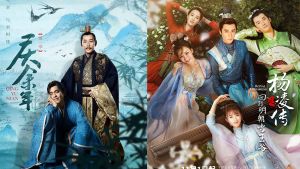
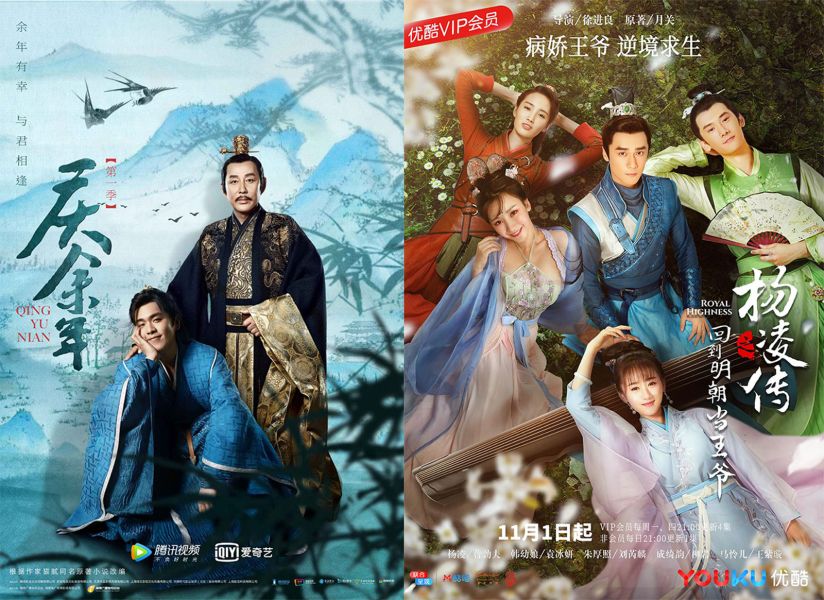
In this essay we examine two of the most popular historical time-travel novels published on qidian.com, one of the largest online literature websites in China, with a monthly readership of 18.3 million (He and Jin 2023). Joy of Life (庆余年) was serialised between 2007 and 2009, accumulating 19,146,970 total views, and, in 2025, ranked among the ‘Top 20 Prestigious’ online novels. In 2019, it was adapted into a TV drama of the same name, attracting 5.1 billion views (Keji Zaixian 2020). Returning to the Ming Dynasty to Be a Prince (回到明朝当王爷) was serialised between 2006 and 2008, receiving 5.17 million reader recommendations on its hosting platform (Yueguan 2006–08). In 2018, it was adapted into a TV series titled Royal Highness (回到明朝当王爷: 杨凌传), which aired on the popular streaming platform Youku.
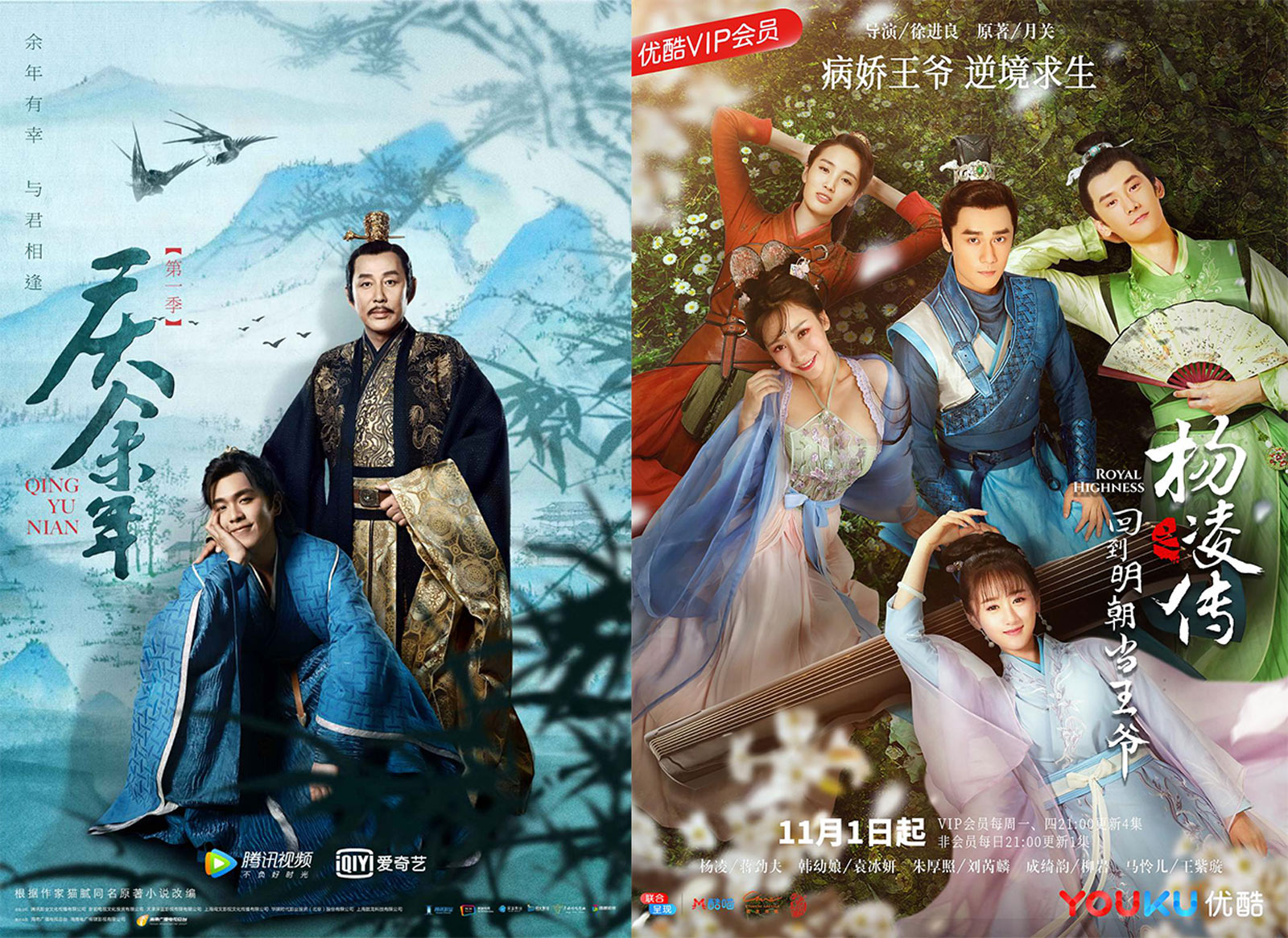
Both novels centre on a male protagonist who time-travels from the present to the past. One arrives in an entirely fictional historical period; the other returns to the Ming Dynasty. Despite their different historical settings, these modern men become aristocrats with wealth and privilege, rise steadily up the political hierarchy, and ultimately achieve substantial governing power by the end of the story. Both narratives also feature a protagonist in multiple romantic relationships, each practising polygyny. Indeed, sexuality and power are core thematic concerns not only in these two stories but also across the genre of historical time-travel novels more generally. These narratives share an underlying logic of hierarchical social order, which is central to the reactionary world view. The following sections examine this reactionary reimagining of the past.
Reasserting Domestic Hierarchy
In his book The Reactionary Mind, Corey Robin (2011) argues that reactionaries and libertarians are closer than they appear, as they share the same commitment to social hierarchy, with themselves positioned at its apex. In the private sphere, both the reactionary and the libertarian envision themselves as the dominant father; in the workplace, as the dominant boss. Historical time-travel novels vividly reproduce this ‘father and boss’ mentality. For example, one of the numerous love affairs engaged in by the protagonist in Joy of Life, Fan Xian—in this case, with an empress of a neighbouring kingdom—unfolds as follows:
‘You are an extraordinary woman—but in the end, still just a woman.’
… He let out a self-mocking laugh. ‘I’ve poured too much effort into this, so I won’t allow you to destroy it.’
‘I am not someone who yields to threats,’ the young empress said coldly, thinking Fan Xian was returning to the original dispute.
‘I never threaten my own woman.’ Fan Xian suddenly reached out and gently lifted the three strands of fringe on her forehead, speaking softly: ‘But my woman must obey me.’
Earlier, when the young empress woke from her intoxicated daze, the first words she spoke pierced directly into Fan Xian’s heart—My kingdom is your kingdom.
… Since it was his kingdom, of course it had to be under his control. Even the emperor of Northern Qi must submit to his will. Conquering a monarch—that seemed like something forever impossible. But conquering a woman, especially one who loved him—no matter how strong her will or how powerful her position—there would always be a chance. In the end, this empress finally had all her armour shattered by him, becoming a true woman. (Maoni 2007–09: vol. 2, ch. 42)
The language reflects a highly patriarchal and hierarchical view of gender relations. It naturalises male dominance through expressions such as ‘my woman must obey me’ and ‘my kingdom is your kingdom’. While conquering the political authority of a country is regarded as ‘something forever impossible’, conquering its female leader is framed as an achievable target and, by so doing, he appropriates her political authority. This reduces a powerful and autonomous woman to a subject to be taken and subdued. The conquest of her independence and agency is described as ‘her armour being shattered by him’. Only once she is fully under the man’s control and dominance does she become ‘a true woman’, validating a social order in which men hold power and authority in both the private and the public spheres.
In these stories, Fan Xian has a wife and a concubine and engages in romantic relationships with three additional women, while Yang Ling in Returning to the Ming Dynasty to Be a Prince has 12 wives and concubines. These polygynous arrangements do not grant women equal sexual autonomy. Rather, women are expected not only to remain faithful and loyal to their husbands but also to be supportive and understanding when those husbands pursue other romantic or sexual partners. This dynamic is exemplified in the scene in which Yang Ling announces to his wife, Han Youniang, that he plans to bring a concubine into the household:
When Han Youniang first heard the news, she truly felt a bit sad. But then she thought about her husband’s personality—he really wasn’t the sort of man who indulged in promiscuity. What high-ranking official didn’t have several wives and concubines? According to custom, if he wanted to take a concubine, he didn’t need her consent at all. Now he was being so cautious, afraid she would be unhappy—she ought to be content. (Yueguan 2006–08: vol. 2, ch. 50)
This passage further naturalises the hierarchical gender relations featured in these novels, in which a man does not need his wife’s consent to take a concubine. Similarly, Joy of Life describes the private life of the Chief Minister, the highest-ranking official under the Emperor, as follows: ‘In any powerful aristocratic family, it is perfectly normal for the family head to have several concubines. If you only have one wife? Sorry, it would be too embarrassing for you to show up at social gatherings’ (Maoni 2007–09: vol. 2, ch. 4). Embedded within this gender hierarchy is a clear class hierarchy: polygyny is presented as a commonly accepted practice for high-ranking officials, implying that men of lower social status are not entitled to the same.
These stories sometimes portray the time-travelling protagonists as advocates of egalitarian values within highly stratified social contexts. For example, Fan Xian teaches his younger sister in his reincarnated family to be kinder to servants, because ‘respecting others is not only good for them; it is also good for you’ (Maoni 2007–09: vol. 1, ch. 60). Yet, when challenged by an arrogant steward, he does not hesitate to reassert his authority and restore the household’s hierarchical order through physical punishment. Fan Xian slaps the steward in public, declaring: ‘I don’t abuse servants, but I’m happy to let you know how aristocratic playboys behave’ (Maoni 2007–09: vol. 1, ch. 60). Indeed, these protagonists are firmly positioned at the top of the social hierarchy, enjoying support, loyalty, and even self-sacrifice from their subordinates. Their subordinates’ obedience is framed as virtuous and voluntary, while the protagonists’ dominance is entitled and deserved. This reflects what Robin (2011: 29) describes as the core principle of reactionary politics—‘that some are fit, and thus ought, to rule others’.
Reimagining a Hierarchical World Order
Such a hierarchical world view extends from the domestic sphere to the geopolitical arena. The recurrent choice of the Qin, Han, Tang, Ming, and Qing dynasties as historical settings for time-travel novels is significant, because these periods are widely regarded as imperial ‘golden ages’ characterised by centralised rule, territorial expansion, cultural achievement, and heightened regional influence. Set in such contexts, the protagonists’ rise to political power is directly linked to the strengthening and expansion of the Chinese Empire, enabling the reactionary vision of a hierarchical world order. Sometimes the stories reinforce existing historical narratives by confirming the legitimacy of China’s traditional great-power status in the region; sometimes they present an alternative historical pathway to imagined imperial dominance.
Returning to the Ming Dynasty to Be a Prince, for example, reproduces the history of the Chinese tribute system in a highly positive light. In the story, Yang Ling manages relations with two tributary states, the Ryukyu Kingdom and the Malacca Sultanate, on behalf of the Ming imperial court. Under him, the court opens trade with Ryukyu and commits to defending it against attacks by Japanese pirates. He leads the imperial navy to defeat the Portuguese and liberates Malacca from Portuguese colonial occupation. Such actions are enthusiastically welcomed by both countries. In the story, the Prince of Ryukyu begs Yang Ling for the Ming Court’s support, saying:
Honoured Imperial Envoy, the Kingdom of Ryukyu has always been the most loyal vassal of the Great Ming. We offer tribute every year and make annual visits to the court, faithfully fulfilling our duties as subjects of the empire. Each time a new king ascends the throne, he personally requests investiture from the Great Ming emperor, the Son of Heaven. Now our country faces the threat of invasion by pirates. We earnestly ask that, in recognition of our loyalty to the Celestial Empire, you petition His Majesty the Emperor of the Great Ming to dispatch heavenly troops to help us. (Yueguan 2006–08: ch. 252)
When Yang Ling agrees to his request, the Prince is ‘moved to tears and prepared a generous gift, seeing Yang Ling off with profuse gratitude’ (Yueguan 2006–08: ch. 252).
Similarly, the Malaccan people express strong gratitude towards and trust in the Ming imperial court:
Exactly one hundred years earlier, the great fleet of the eunuch-admiral Zheng He had arrived here. On that occasion, he presented the local people with porcelain, tea, silk, and friendly smiles. Yet when the people of Malacca first saw Zheng He’s vast, mobile ‘kingdom on the sea’, they could not help feeling a tremor of fear. This time, Yang Ling brought cannons, muskets, bows and spears, and an army clad in full armour, exuding an aura of lethal force. And yet the people of Malacca sang and danced in celebration, cheering with joy—because with the help of this powerful army, they had restored their kingdom. (Yueguan 2006–08: ch. 252)
Apart from its favourable representation of a past in which the benevolent Chinese Empire brings peace and economic prosperity to the tributary countries, the story also fabricates a history of Chinese expansion. The novel concludes with Yang Ling being appointed a feudal prince, tasked with expanding the empire’s territory into Siberia. To persuade the Emperor of the significance of this appointment, Yang presents his rationale as follows:
The territory of Siberia is comparable in size to the land currently possessed by our Heavenly Dynasty … If the Great Ming becomes more powerful and its territory expands further north, then the grasslands beyond the current borders will be nothing more than the Emperor’s garden for autumn hunting on horseback. Why would Your Majesty, with the dignity of the Son of Heaven, need to personally defend the gates of the realm?’ (Yueguan 2006–08: ch. 469)
The Emperor responds to this proposal by saying: ‘One is no hero until the Great Wall is torn down; only by riding to the North Sea can one claim true domination!’ (Yueguan 2006–08: ch. 469)
Together, these narratives construct an imagined past characterised by hierarchical order both domestically and internationally. To understand why they resonate so well with contemporary audiences, it is necessary to situate them within the social and economic conditions of present-day China.
Contextualising Reactionaries in Contemporary China
The popularity of historical time-travel novels is closely linked to social and economic changes in China. Rapid economic growth over the past decades has made China one of the most unequal societies in the world and, in recent years, the economic slowdown has contributed to rising unemployment and falling house prices, further exacerbating income inequality. Against this backdrop, readers who perceive themselves as having been marginalised by economic development may develop a nostalgia for an imagined past, rooted in unfulfilled aspirations in the present. This corresponds to what Robin (2011: 58) calls ‘a feeling of loss’ or, more specifically, to what Capelos and Katsanidou (2018: 1276) describe as the sentiment to which reactionism appeals: ‘[T]he realization that one is not able to keep up with contemporary social and economic complexity.’
On Zhihu, the Chinese equivalent of Quora, one user asks: ‘Why are there so many people who like historical time-travel and reincarnation novels and TV dramas?’ One response reads:
People today are dissatisfied with the present, and so they long to create a new world. Time-travel novels fulfil this kind of fantasy, while reincarnation novels satisfy the desire to live life over again. That’s all there is to it. (Zhihu user 2024)
The author of Joy of Life explains the novel’s popularity by saying that
for readers, there are two ways to identify with the story: one is to step into the shoes of an underdog and follow the protagonist’s rise to success; the other is to identify with someone like Fan Xian—how thrilling it is to be a young nobleman, living in luxury and power! (Beijing Youth Daily 2019)
Commenting on Returning to the Ming Dynasty to Be a Prince, one reader posted that ‘those who love this book will read it over and over again whenever they feel disappointed or discouraged’ (Bilibili user 2021). In both cases, the novels offer their audiences an escape from the frustrations of reality, allowing them to bask in imagined power and privilege.
In addition to dissatisfaction with the present, such reactionary nostalgia also reflects the rise of popular nationalism in China (Smith et al. 2025). Historical time-travel novels align with the nationalist discourse of the China Dream—the great rejuvenation of the Chinese nation—by presenting visions of China’s glorious past, and such sentiments are often echoed by the audience. One reader, commenting on Returning to the Ming Dynasty to Be a Prince, writes:
If, as the author fantasises, China had been spared the ravages of warfare in its modern history and the painful ruptures of its culture, it could have become a great and flourishing nation centuries earlier—and that would indeed be exhilarating. (Dedao user 2024)
Unlike Parker and Lavine’s (2025) argument that the state is a battleground of reactionary politics or a target for reactionary distrust and capture, the Chinese case suggests that the interactions between the state and reactionaries can take different forms. The conservative gender hierarchy represented in historical time-travel novels is mirrored by the state’s crackdown on feminist movements and its emphasis on traditional family values and women’s domestic roles. Narratives of a strong Chinese nation in these novels have not only emerged indirectly, as the outcome of 30 years of state-led patriotic education, but also been actively promoted by authors and online literature platforms as a direct response to the state’s call to ‘inherit the traditional culture of the Chinese nation’ (CSSN 2024). Thus, the state functions not merely as a background context but as an active enabler of reactionary imagination.
It is worth noting that some forms of this reactionary imagination run counter to official ideology. Class hierarchy contradicts the egalitarian communist ideal, while imperial conquest and territorial expansion sit at odds with the state’s discourse of China’s peaceful rise and its self-projection as a defender of the international order. Yet, such contradictions have not led to censorship or suppression, likely because historical time-travel novels serve a ‘pressure valve’ function, providing a space for the expression of frustration, desire, and nationalist fantasy without posing a direct political threat.
The rise of reactionism in China should be understood as part of a global resurgence of reactionary politics; in this sense, it is one instance of wider transnational value shifts. Certain elements of Chinese reactionary trends echo Western alt-right and populist movements in their critique of egalitarian norms and liberal internationalism. Yet, reactionism in China is also a distinctive case. Unlike many Western contexts, where such movements are largely oppositional, reactionary tendencies in China must operate within state-sanctioned boundaries and can serve governance goals.
This essay is developed from a paper first presented at the ‘Asia’s Security Futures: A Multidimensional Approach’ workshop at the Australian National University, 3–4 December 2025, supported by grants from the Academy of the Social Sciences in Australia and the Australian Research Council.
References
Beijing Youth Daily 北京青年报. 2019. ‘《庆余年》: “金庸大法”已然练成 [“Joy of Life”: The “Jin Yong Grand Method” Has Been Mastered].’ 人民网 [People.cn], 6 December. media.people.com.cn/n1/2019/1206/c40606-31493220.html.
Bilibili user. 2021. [Reader comment on Returning to the Ming Dynasty to Be a Prince]. Bilibili. www.bilibili.com/opus/485577053891539285.
Capelos, Tereza, and Alexia Katsanidou. 2018. ‘Reactionary Politics: Explaining the Psychological Roots of Anti Preferences in European Integration and Immigration Debates.’ Political Psychology 39(6): 1271–88.
China Writers Association 中国作家协会. 2025. ‘中国作协网络文学中心发布《2024中国网络文学蓝皮书》 [China Writers Association Online Literature Centre Releases the 2024 China Online Literature Blue Paper].’ 中国作家网 [China Writers’ Net], 30 June. www.chinawriter.com.cn/n1/2025/0630/c404023-40511500.html.
Chinese Social Sciences Net 中国社会科学网 (CSSN). 2024. 2023年中国网络文学发展研究报告 [2023 China Online Literature Development Research Report]. 26 February. Beijing: Chinese Social Sciences Net. www.cssn.cn/wx/wx_ttxw/202402/t20240226_5734785.shtml.
Dedao user. 2024. [Reader Note on Returning to the Ming Dynasty to Be a Prince]. 得到 [Dedao]. www.dedao.cn/knowledge/note/detail?id=ZPy0b7x3684G3EO2ZD4Ekn4RgNJwVo.
He, Shuyao 何书瑶, and Jin Tianyi 金天意. 2023. ‘越来越“下沉”的网文小说, 靠什么吸引5亿中国人 [What Attracts 500 Million Chinese Readers to Increasingly “Down-Market” Online Fiction]?’ 上观新闻 [Shangguan News], 29 December. www.jfdaily.com/wx/detail.do?id=698668.
Keji Zaixian [TechOnline] 科技在线. 2020. ‘《庆余年》第一季点播收官 战绩创2019年度爆款佳作 [The First Season of “Joy of Life” Concluded Its On-Demand Viewing Run, Becoming a Blockbuster Hit of 2019].’ Sohu, 2 January. www.sohu.com/a/364362992_120248784.
MacKay, Joseph, and Christopher David Laroche. 2018. ‘Why Is There No Reactionary International Theory?’ International Studies Quarterly 62(2): 234–44.
Maoni 猫腻. 2007–09. 庆余年 [Joy of Life]. Serialised on Qidian.com. www.qidian.com/book/114559.
National Press and Publication Administration 国家新闻出版署 (NPPA). 2025. ‘网络文学用户规模达5.75亿人 [Online Literature Users Reach 575 Million].’ Press release, 19 June. Beijing: National Press and Publication Administration of the People’s Republic of China. www.nppa.gov.cn/xxfb/ywdt/202506/t20250619_900890.html.
Parker, Christopher Sebastian, and Howard Lavine. 2025. ‘Status Threat: The Core of Reactionary Politics.’ Advances in Political Psychology 46(S1): 80–104.
People’s Daily 人民日报. 2013. ‘网络穿越小说的文学价值 [The Literary Value of Online Time-Travel Novels].’ 人民日报 [People’s Daily], 22 October. politics.people.com.cn/n/2013/1022/c70731-23283652.html.
Robin, Corey. 2011. The Reactionary Mind: Conservatism from Edmund Burke to Sarah Palin. Oxford, UK: Oxford University Press.
Shorten, Richard. 2022. The Ideology of Political Reactionaries. London: Routledge.
Smith, David T., Minglu Chen, and Jingdong Yuan. 2025. ‘Panda Diplomacy Revisited: State Interests and Public Emotions.’ The Pacific Review, online first: 1–29.
Sullivan, Laurence R. 1992. ‘Reactionary Modernism in China: Cultural Conservatism and Technical Economism in Communist Ideology and Policy Since June 1989.’ In The Aftermath of the 1989 Tiananmen Crisis in Mainland China, edited by Bih-jaw Lin with Maria Hsia Chang, George P. Chen, John F. Coper, Michael C. Davis, Barry Naughton, W. Gary Vause, and Margaret Y. K. Woo, 15–38. London: Routledge.
Thompson, Mark T. 2019. Authoritarian Modernism in East Asia. London: Palgrave Macmillan.
Xinhua News Agency. 2023. ‘用户从二点三亿增长到四点九亿: 网络文学, 向广阔处生长 [From 230 Million to 490 Million Users: Online Literature Grows Toward Broader Horizons].’ 新华社 [Xinhua News Agency], 31 March. www.news.cn/2023-03/31/c_1129481795.htm.
Yueguan 月关. 2006–08. 回到明朝当王爷 [Returning to the Ming Dynasty to Be a Prince]. Serialised on Qidian.com. www.qidian.com/book/84024.
Zhang, Chenchen. 2020. ‘Right-Wing Populism with Chinese Characteristics? Identity, Otherness and Global Imaginaries in Debating World Politics Online.’ European Journal of International Relations 26(1): 88–115.
Zhang, Chenchen. 2026. ‘Race, Gender and Occidentalism in Global Reactionary Discourses.’ Review of International Studies 52(3): 469–91.
Zhihu user. 2024. [Response to ‘Why are there so many people who like historical time-travel and reincarnation novels and TV dramas?’]. 知乎 [Zhihu]. www.zhihu.com/question/5903049045.