
In Praise of Hardship, or the Labour-Schooling Poetics of Chinese Youth
In January 2025, I was chatting online with a few friends about the ongoing controversy surrounding the construction of a factory for Chinese carmaker BYD in Brazil, which had just come under scrutiny after the country’s Public Labour Prosecution Office accused it of ‘slavery’, following an investigation into the working conditions of Chinese labourers at the site (Ministério Público do Trabalho 2024). The report noted that workers’ passports were being held by BYD’s outsourced construction company. Featuring two striking images of worker dormitories, it described ‘workers sleeping in beds without mattresses’, ‘filthy living and dining conditions’, ‘no lockers for personal belongings’, ‘one bathroom for every 31 workers’, and ‘workers having to wake up at 4 am to form a line and start working at 5:30 am’.

These descriptions struck an uncanny chord with us. While we condemned the miserable working conditions at BYD’s construction site, the details and images echoed our own high school experiences in China. As one friend remarked: ‘It’s just like my dorm.’
My friend was referring to the cramped living conditions typical of Chinese high school dormitories in the late 2000s and early 2010s. Bathrooms were scarce—often requiring strategic early wakeups to secure access. The metal bunk beds shown in the report were the national standard in Chinese school dormitories, from high schools to colleges.
Beyond the spatial similarities, the BYD construction site in Brazil also mirrored the rigid temporal rhythms of Chinese high schools. Hengshui High School—renowned for its intense focus on university entrance exam performance—is infamous for having students wake at 5.30 am and carry small notebooks while queuing for meals.
Hengshui is far from unique. An online survey conducted during the 2024–25 academic year collected more than 4,600 student complaints about excessive school hours (611Study.ICU 2025). At least 1,168 schools required students to begin classes before 6 am and nearly all (4,421) started before 8 am—despite the Ministry of Education’s recommendation that secondary schools begin no earlier than 8 am (Ministry of Education 2021). Students also expressed frustration with dormitory and canteen conditions, citing, for example, ‘14 people living in a dorm with one bathroom’ and ‘insects in the meals’.
As young Chinese like my friends and I—shaped by these spatial-temporal hardships—condemned the harsh treatment of Chinese workers in Brazil, it was unsettling to realise that what Brazilian labour authorities now labelled as ‘slavery’ had been, in many ways, normalised in our own schooling experiences.
BYD has a troubling track record when it comes to labour practices. On 28 September 2024, just two months before the controversy at its Brazilian site, a 55-year-old worker at BYD’s Xi’an factory died from overwork. That month alone, he had clocked 260 hours before his death (China Labour Bulletin 2024). During the Covid-19 pandemic, BYD was among several companies that implemented ‘closed-loop management’—a policy designed to maintain production by confining workers within a sealed loop between factory floors and dormitories. This system imposed severe hardships: excessive working hours, no time for rest, and harsh treatment of those who tested positive for Covid-19.
Closed-loop management began to unravel in late 2022, most visibly at Foxconn’s massive plant in Zhengzhou. In October of that year, during a Covid outbreak, Foxconn tightened restrictions on its 300,000 workers, sparking mass panic and an unprecedented worker exodus—one of the most dramatic episodes of labour unrest during China’s pandemic era (Li 2022). In response, the company launched a rapid hiring campaign in November of that year, recruiting 100,000 new workers amid widespread economic desperation. These recruits, however, were soon met with forced quarantines, withheld wages, and gruelling conditions, culminating in one of the fiercest worker revolts in recent memory (China Labour Bulletin 2022).
My friends and I had long sympathised with labour struggles, from BYD to Foxconn. We were certainly critical of closed-loop management and the harsh discipline imposed on students. Yet the remark, ‘It’s just like my dorm’, lingered. Were we also ‘enslaved’? Probably not; we were merely hardworking students. But were we, in some way, normalising hardship and, by extension, exploitation? Or was this remark a radical eureka moment that revealed a deeper continuum—one that stretches from Chinese factories overseas to the dormitories of Chinese high schools?
With these questions in mind, this essay explores the evolving meanings and politics of hardship, tracing its contours from classrooms to factory floors, in China and beyond.
In Praise of Hardship
The most deeply ingrained moral sentiment about hardship among Chinese students and workers is a celebratory attitude—one that embraces rather than avoids difficulty. This ethos is encapsulated in terms such as ‘hard work’ (努力), ‘striving’ (奋斗), ‘eating bitterness’ (吃苦), and ‘engraving bitterness’ (刻苦)—all of which emphasise both effort exerted and hardship endured (see also Loyalka 2012). These phrases reflect a positive, even honourable, stance towards suffering, framing it as something to be overcome through perseverance and moral dedication. In this essay, I use the term ‘the praise of hardship’ to capture this constellation of expressions and the broader discourse they represent.
The praise of hardship operates through different logics in different contexts. One of its canonical roots—still influential today—comes from Chinese philosopher Mencius (2009: 143):
Mencius said, ‘Shun emerged from the fields; Fu Yue was elevated from among the boards and earthworks; Jiao Ge from the fish and salt; Guan Yiwu from the hands of the jailer; Sunshu Ao from the seacoast; and Boli Xi from the marketplace. When Heaven intends to confer a great responsibility upon a person, it first visits his mind and will with suffering, toils his sinews and bones, subjects his body to hunger, exposes him to poverty, and confounds his projects. Through this, his mind is stimulated, his nature strengthened, and his inadequacies repaired.’
In this passage, Mencius cites a series of ancient sages, foregrounding their humble origins—as builders, fishers, and prison officers—and the immense hardship they endured, from physical toil and hunger to deprivation and mental strain. For Mencius, such suffering is not incidental but formative—a moral training necessary to cultivate the fortitude required for virtuous leadership in society and politics.
This passage remains part of the mandatory curriculum for Chinese junior middle school students (Wen 2017) and is frequently invoked by teachers as moral instruction on the importance of hard study. Other well-known sayings circulate widely, such as: ‘Only those who endure the hardest hardships can rise above the rest’ (吃得苦中苦, 方为人上人), a maxim dating back to imperial-era exam candidates; and ‘Heaven will not disappoint those who persevere; like the King of Yue who, after years of bitter endurance, led 3,000 warriors to conquer the State of Wu’ (苦心人天不负, 卧薪尝胆三千越甲可吞吴), a poetic rendering of a famous revenge story from the Spring and Autumn period (see Xin 2013).
These expressions stem from distinct historical moments and reflect varied logics of hardship: hardship as moral cultivation, hardship as a ladder for social mobility, and hardship as a vehicle for revenge. All three logics shaped my own schooling. Some of my classmates genuinely viewed hardship as a virtue to be embraced for life. Others rationalised the extreme demands of high school as the necessary cost of success in the college entrance exam—the defining gateway to stratified tiers of education and employment. And some, in a gesture of cathartic rebellion, burned their textbooks after the exam was over.
Importantly, the praise of hardship is not always celebratory. More often, it functions as a defence—a way to make sense of deeply embodied suffering. Criticism of hardship can even have the opposite effect, provoking a backlash that further entrenches its moral justification.
Hengshui High School has been a frequent focus of public debate since the early 2000s, largely due to its ‘fully enclosed’ (全封闭) schooling model, which is marked by long study hours, strict surveillance, and consistent top rankings in the national college entrance exam. Despite sustained criticism from education experts and media outlets, the school has continued to assert its own counternarrative with considerable force.
In 2014, for instance, Hengshui’s official WeChat account published an article titled ‘If Your Child Had Gone to School at Hengshui’ (Hebei Hengshui High School 2014), directly responding to public critiques of its rigid disciplinary regime. The piece adopts an internal perspective, highlighting the agency and commitment of its students and teachers, while pushing back against charges that its success relies solely on ‘inhuman’ methods:
If your child had ever studied at Hengshui High School, you wouldn’t say that its success comes just from admitting top students. We wake up at 5:30 every morning and race to the track, just to make use of a few precious minutes before morning exercises to memorize a few words or poems. We hold small notebooks in our hands while waiting in line for meals, just so we don’t waste a single second … The achievements of Hengshui students are built not just on a little bit of intelligence, but on countless drops of sweat. (Hebei Hengshui High School 2014)
By 2021, this narrative had grown even more assertive. Zhang Xifeng, a top-performing Hengshui graduate, delivered a televised speech presenting his experience of hardship not as coercion but as a subaltern struggle—one that, he argued, was misunderstood by elite critics (Zhang 2021). His speech ends with a powerful rebuttal:
To those who slander us without reason—
Have you ever seen what Hengshui High looks like at 5:30 in the morning during senior year?
Do you think we run to the track before dawn every day, shouting as we go, just for show?
Is it pretend? Is it performance?
No—we’re doing it to change our fate.
The students of Hengshui, the students of Hebei—we’re children from ordinary families, carrying the hopes of generations on our shoulders.
We’re not machines built for the college entrance exam.
We’re just a group of kids from poor families who want to become our parents’ pride, who want the people we love to live better, brighter lives.
Hengshui is in Hebei, a province historically associated with heavy industry—coal, steel, and cement—and long ranked near the bottom among China’s 31 provinces in terms of GDP per capita. The defiant tone of Zhang’s speech is grounded in this broader context of structural inequality. For students emerging from marginalised regions and working-class families, the path of intense self-discipline is not only morally defensible but also a form of pride—a defence against the condescension of external observers whose critiques fail to reckon with the lived realities of subaltern hardship.
Hardship Beyond Schooling and Beyond China
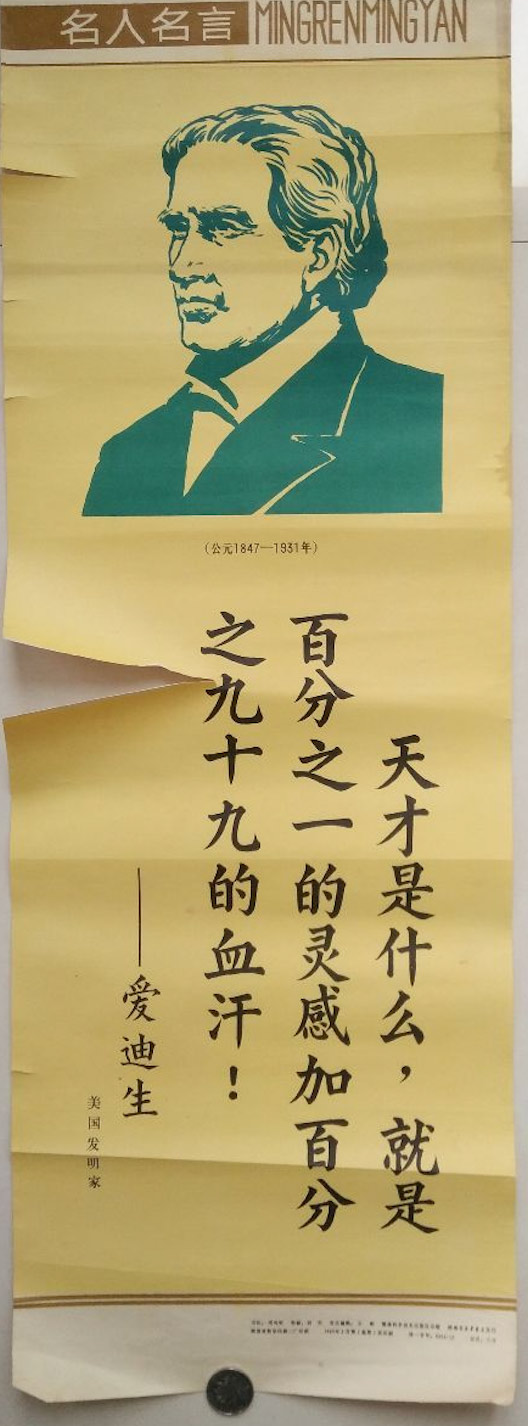
What I had been taught only minimally—and came to understand much later—was the continuity between the hardship of schooling and the hardship of the workplace. The examples Mencius cited were drawn mostly from sages who began their lives in manual labour. Similarly, the quote used by Hengshui High School to justify its success—‘a little bit of intelligence, but countless drops of sweat’ (一点点聪明和无数的汗水)—is a clear paraphrasing of Thomas Edison’s famous dictum: ‘Genius is 1 per cent inspiration and 99 per cent perspiration.’ This quote, along with Edison’s portrait, is among the most prominently displayed in Chinese classrooms.
What is often lost in translation, however, is the original context of Edison’s statement: a work ethic rooted in productivity and profit—a vision of hardship oriented towards commercial invention. Edison’s fame owed less to innate genius than to his role as a patent entrepreneur (Stross 2007). And the ‘perspiration’ behind his achievements was not his alone, but also that of the many workers in the Menlo Park Laboratory who contributed to his inventions.
Hardship in the workplace, therefore, operates differently from hardship in school; it is intrinsically tied to labour rights and wages. Yet, the discourse of the praise of hardship often blurs or erases these distinctions. As the widespread celebration of Edison’s quote suggests, moral narratives of perseverance can obscure the material and political dimensions of labour.
Similar forms of praise for hardship also pervade Chinese workplaces. For instance, Ren Zhengfei, CEO of Huawei, has emphasised that the company’s core spirit lies in ‘working diligently through hardships’ (艰苦奋斗). This ethos is vividly embodied in what has come to be known as ‘Mat Culture’ (垫子文化)—a legacy of hardship dating back to Huawei’s early years, when employees often worked around the clock, briefly resting on floor mats before returning to their tasks (Qu 2012: 2):
In the early days of our venture, our R&D [research and development] department started with just five or six developers. Despite having no funding and no favourable conditions, we upheld the spirit of hardship and perseverance embodied by the ‘Two Bombs, One Satellite’ initiative of the 1960s. Inspired by the older generation of scientists who worked selflessly and with relentless dedication, we made up for our lack of resources with sheer diligence. We tackled challenges head-on, delved into technical solutions by seizing the day and night, developing, verifying, and testing our products and equipment.
There were no holidays or weekends, no distinction between day and night. When we were exhausted, we’d sleep on floor mats for a while, then get right back to work once we woke up. This is the origin of Huawei’s ‘Mat Culture’.
Indeed, ‘Mat Culture’ offers relatively better sleeping conditions than those of the construction workers at BYD’s Brazilian factory, who were reportedly not even provided mattresses. Yet, it also lays the material foundation for further hardship. At Huawei, every employee is issued a mattress—not as a gesture of care, but as part of an implicit expectation to work overtime and, when necessary, sleep at the company. ‘Mat Culture’ has thus come to symbolise Huawei’s notorious culture of overwork. Often referred to as ‘996’, this schedule requires employees to work from 9 am to 9 pm six days a week.
This form of hardship is framed as a spirit of ‘seizing the day and night’ (夜以继日) to overcome problems—a mode of labour that, in both ethos and structure, is not far removed from the intense routines of schooling. In this, it once again echoes Edison’s dictum enunciating the ideal of relentless effort over inspiration. In the logic of corporate management, this ethic is enforced through performance metrics such as key performance indicators (KPIs) and objectives and key results (OKRs), which assign specific targets with strict deadlines—generating intense peer pressure and ever-rising expectations to work harder and longer (Liang 2019).
Moreover, by invoking the revolutionary trope of the ‘Two Bombs, One Satellite’ initiative of the 1960s, Huawei channels a grander version of the subaltern glorification of hardship that also underpins the narratives of Zhang Xifeng and Hengshui High School. The ‘Two Bombs, One Satellite’ story follows a specific nationalist arc in China: after the Sino-Soviet split, the country found itself caught between the imperialist hostilities of both the Soviet Union and the United States. In this context, the independent development of nuclear weapons and a satellite was framed as an urgent revolutionary task. A generation of scientists sacrificed time, family, and even their lives to fulfil this mission, ultimately securing China’s techno-military independence from foreign powers.
Following this narrative arc, Huawei’s rise since the 1990s has been cast as a struggle to break through the technological dominance of Western telecommunications firms. The hardships endured by Huawei’s employees are thus positioned as parallel to a national—and even global—revolutionary effort to catch up with and surpass the West (赶英超美).
BYD has similarly taken up this nationalist mantle in its efforts to compete with Western firms in the global electric vehicle market. Its current managerial ethos is encapsulated in the slogan ‘compete, learn, help, rush, surpass’ (比学帮赶超) (Qin and Xiong 2024: 360), which structures performance-based competition and public rankings among workers. Both the slogan and its operational techniques are strikingly reminiscent of disciplinary practices in Chinese high schools. Yet, at BYD, this ethos of hardship is scaled up and projected onto the national stage, as reflected in one of CEO Wang Chuanfu’s frequently quoted remarks:
The Chinese people are intelligent and hardworking. For an entrepreneur, to be in a country like China—with a nation like ours behind you—what challenge could possibly be insurmountable? And then, consider the sheer size of this market. Deep down, I’ve always believed in the ability of the Chinese people. Give us the opportunity, and we’ll build world-class companies. Not just one but many. (Qin and Xiong 2024: 390)
Wang Chuanfu’s ambition to build world-class companies aligns with shifts in the global political economy and the ascendant role of China. Under the banner of the Belt and Road Initiative, Chinese capital is not merely displacing Western companies; it is also advancing a form of post-revolutionary internationalism—one that promises to support countries in the Global South through investment rather than ideological aid. BYD’s factory in Brazil exemplifies this narrative. Once completed, it will be BYD’s first overseas manufacturing plant, symbolising the broader geopolitical transition from Western industrial capitalism to Chinese tech-driven capital. Its location in Camaçari, a city in Brazil’s industrial heartland, adds further symbolic weight: the site previously housed a Ford Motor Company plant that shut in 2021, resulting in the layoff of about 5,000 workers. In contrast, BYD has pledged to create 20,000 new jobs, reinforcing China’s image as an economic saviour in a post-Western industrial order.
Beneath this grand narrative of surpassing the West, and beneath the workplace ethos of ‘compete, learn, help, rush, surpass’, lies the enduring praise of hardship. This moral economy is especially resonant in relation to engineers and scientists, who are idealised as tireless problem-solvers in the service of progress. A clear example is BYD’s internal slogan, ‘the spirit of the engineer’ (工程师之魂). This ideal echoes Huawei’s R&D culture, the revolutionary legacy of the ‘Two Bombs, One Satellite’ scientists, the global mythos of Thomas Edison, and the lived experiences of Chinese students who endure gruelling academic pressure in pursuit of success.
Yet, the controversy surrounding the construction of BYD’s factory in Brazil exposes the limits of this ideal. What was once celebrated as virtuous perseverance is now being condemned as forced labour by the Brazilian labour authority.
In this context, the praise of hardship has morphed into a vulgar anthropological justification—one that deflects labour violations by framing them as mere ‘cultural differences’ (文化差异). On 25 December 2024, Jinjiang, the construction firm affiliated with BYD, issued a public response to the allegations. In its statement, the company claimed:
Due to cultural differences, the leading nature of the questioning, and misunderstandings caused by language translation, many of the statements released by the labour department’s press conference were inaccurate—especially the claims that the goldsmith employees were ‘enslaved’ and ‘rescued’, which were completely inconsistent with the facts. (Jinjiang Group Brazil Branch 2024)
Following this logic, a viral WeChat article published in defence of BYD invoked a crude form of cultural relativism. While acknowledging that ‘slavery’ is a particularly sensitive term in Brazil, the author dismissed the controversy as a mere case of ‘cultural conflict’ (文化冲突), even citing the nineteenth-century missionary ethnography Chinese Characteristics to argue for the exceptional hardworking nature of Chinese people (Chen 2025).
This kind of vulgar anthropology fails to account for the specific sociopolitical context of Brazil, where ‘slavery’ is not just a metaphor; it is a legal and historical reality with enduring resonance. As the last country in the Americas to abolish slavery, Brazil still bears fresh scars of that legacy. Forced labour remains a deeply charged issue in both the legal and the public spheres. Uniquely among global labour institutions, the Brazilian Public Labour Prosecution Office does not merely adjudicate workplace disputes and injury claims; it also actively investigates labour violations in the public interest, with a key mandate to identify and prosecute slavery-like practices (Lara and da Silva 2020). In this setting, the rhetoric of hardship runs into the muzzle of the gun.
Yet, the binary framing of the ‘hardworking’ Chinese worker versus foreign labour environments that allegedly ‘do not value hardship’ persists in both popular and academic narratives surrounding Chinese capital abroad. In Tales of Hope, Tastes of Bitterness (2019), anthropologist Miriam Driessen documents Chinese workers’ narratives of ‘speaking bitterness’ in Ethiopia. Many of these workers, serving as foremen on road construction projects, contrasted their own endurance with what they perceived as the ‘indolence’ of Ethiopian workers (see also Lee 2017).
However, as Driessen’s ethnography makes clear, the hardship experienced by Chinese workers is neither the result of an essentialised national character—as implied by vulgar anthropological accounts—nor the embodiment of a heroic ‘spirit of the engineer’ working towards national or global missions. Rather, their suffering stems from the mundane and isolating realities of life abroad: separation from family and friends, a lack of leisure time, and substandard living conditions. These challenges are particularly acute for the cohort of young workers—recent graduates from universities or vocational schools—who are the primary focus of Driessen’s study. For many, the decision to endure hardship in Africa was driven by the promise of comparatively high wages. This was especially appealing to those from modest backgrounds who had long internalised the necessity of working hard—first, in school, then in the workplace (Driessen 2019: 164–74).
These workers often compared themselves with their local colleagues, not just in terms of productivity but also in terms of affect—their own suffering versus the joy, satisfaction, or relative ease they perceived in others. In these comparisons, what emerges is not a triumphant praise of virtue, but rather a quiet sigh of resignation (Driessen 2019: 38).
The Poetics of Hardship of Chinese Youths
The sigh of hardship rhymes with the earlier remark: ‘It’s just like my dorm.’ It is critical of hardship, yet suffused with a familiar sense of pessimistic fatalism, which has been deeply internalised by students and workers in China. People work hard because they must, especially those whose roots lie in modest soil. This argument of necessity also underpins the defence, if not the praise, of hardship voiced by figures such as Zhang Xifeng and the students of Hengshui High School. Yet, what follows is a vicious cycle. The logic of necessity only intensifies competition, raising the threshold of what constitutes socially acceptable hardship, and in turn reinforcing the very logic that justifies it. It becomes a sad hamster wheel.
Before proceeding to the final discussion, it is necessary to clarify this essay’s methodological stance. Comparing the changing meanings of hardship as they resonate between workers and students is not meant to blur their distinct political and economic conditions. Behind workers’ sigh of hardship is their outright exploitation. Students, though often future workers themselves, currently occupy a position framed by the promise of social mobility. Their hardships are embedded in different political economies and oriented towards different trajectories. Yet, the ways in which these divergent situations may rhyme through shared experiences of hardship are crucial, for they shape the possibilities of solidarity, or apathy, between students and workers. The remainder of this essay explores this poetics of hardship by examining the diverse efforts of contemporary Chinese youth to forge connections between the hardships of schooling and working.
Coming back to the pessimistic recognition of hardship, it is most revealing in the widespread discourse about ‘involution’ (内卷). Originally a piece of Chinese internet slang popular among young people, ‘involution’ describes a zero-sum situation in which everyone is working harder and harder just to compete with one another, but no-one is gaining anything. Like ‘eating bitterness’, involution applies to both school and workplace settings. It recognises the reality of suffering yet disavows its telos. Hardship is no longer a virtuous effort or effective strategy as once taught, but an endless, repetitive grind. Like a hamster spinning on a wheel, this labour yields no reward, only the deterioration of health and spirit.
A more active response to this condition was the emergence of the 996.ICU movement, launched on GitHub on 26 March 2019 by an anonymous Chinese programmer. The project’s title encapsulates the brutal logic of overwork: the ‘996’ schedule—9 am to 9 pm six days a week—leads, in reality and in sarcasm, to the ICU (intensive care unit). The movement’s initial demand was simple: enforcement of China’s existing Labour Law, which mandates an eight-hour workday. Hosted as a crowdsourced database, the GitHub repository allowed users to publicly report companies that violated these provisions. The project gained immediate traction. By April 2019, it had received more than 240,000 stars and had sparked widespread public sympathy for the working conditions of tech employees (Li 2019).
Soon, the movement’s focus expanded beyond legal enforcement to a more fundamental critique of the praise of hardship itself. Just two weeks after its launch, tech magnate Jack Ma, then China’s richest man, publicly defended Alibaba’s 996 regime, calling it ‘a huge blessing’ and insisting that only the truly fortunate had the chance to dedicate themselves so completely to their work (Ma 2019). This ‘blessing’ theory of hardship backfired, fuelling even more intense backlash and public debate.
In retrospect, although 996.ICU was not initiated by any formal labour authority, it functioned as a large-scale grassroots labour investigation, which, in many ways, mirrors the role played by the Brazilian Public Labour Prosecution Office. The movement began by documenting the lived realities of overwork (996) and quickly escalated into a critique of its moral justification. Even without invoking legal terms such as ‘slavery’, the provocative aesthetics of ‘ICU’ redefined the meaning of hardship. No longer a taken-for-granted virtue, hardship became a vicious causality between overexploited labour time and workers’ health.
In 2025, another online movement ignited around a similar theme, centred not on the workplace, but on schooling. Named 611Study.ICU, the campaign was launched by Teacher Li, a Twitter-based activist who rose to prominence during the 2022 White Paper Movement. He has since continued to collect and circulate anonymous grievances from within China. The 611Study.ICU emerged in response to a flood of complaints submitted during the winter vacation—a period increasingly used by schools to extend academic instruction and erode students’ rest time.
The name 611Study.ICU clearly echoes its predecessor: ‘611’ refers to a now-normalised school schedule stretching from 6 am to 11 pm. The posts under this hashtag quickly multiplied. By April 2025, more than 4,600 complaints had been submitted, documenting daily study routines, excessive weekly hours, infrequent breaks, and even reports of suicide.
Like 996.ICU, 611Study.ICU centres its critique on the politics of time. Unlike 996.ICU, which anchored its demands in the Labour Law, participants in 611Study.ICU rarely cite legal or policy frameworks regulating over-schooling. Yet, it also forms a critical causality between enforced excess study time and students’ health.
The parallel between 996.ICU and 611Study.ICU arguably stems from the career continuity between students and tech workers. Many employees at 996 companies such as Huawei and Alibaba are graduates of top-notch Chinese universities, having endured years of intense academic hardship to be accepted. Their experience of studying hard grounds their experience of hardship working in tech companies: both are facilitated by solving problems under time pressure. Yet, this parallel has a significant blind spot. It overlooks the hardship experience of manual labour, which is largely excluded from the pathway to academic success.
There are also youth voices which draw critical resonances between the hardships of schooling and those of the manual workplace. One notable example is the Bilibili account This Is a Bewildering Planet (这是个令人疑惑的星球 Zheshige lingren yihuode xingqiu). Its creator, a recent college graduate, produces what he describes as ‘fieldwork report’ videos that document both the labour conditions of Chinese workers and the educational experiences of students. These two ends of hardship resonate throughout his work, as captured in one video:
Under the dim streetlights at 5:40 am, when we were required to raise our textbooks above our heads and recite aloud, I would sometimes enter a kind of transcendental state. In the grip of overwhelming exhaustion and sleep deprivation, the mind begins to detach. You experience a kind of out-of-body sensation—it’s as if you can observe yourself from a third-person view, watching the posture, the movement of your own body, but feeling no ownership over it. Your body no longer belongs to you.
I felt this same disembodiment again later, working the factory line, or during night shifts sorting packages as a temp. I once tried describing this to my co-workers. They all said I captured it perfectly. (This Is a Bewildering Planet 2025a)
To make sense of factory labour through the lens of his own schooling experience, the author develops what can be described as a critical phenomenology of disembodiment and alienation. Rather than simply listing the excessive demands on time, he renders the laborious hardship through situational feelings and the embodied tactics workers use to cope with it. Reflecting on another video documenting delivery riders’ long working hours, he remarks:
One could say that a delivery rider enters a certain state—a state of ‘immersion’. In this immersive mode, you become fully absorbed in the act of riding, picking up orders, delivering them. Your attention is streamlined, your efficiency increases. But this kind of so-called focus doesn’t bring a sense of progress.
It’s not like studying for an exam, where effort leads to new knowledge and the joy of intellectual growth. It’s not like scientific research, where deep concentration moves you closer to discovery. This is a purely physical form of immersion. And what it yields—beyond the dozen or so yuan for two or three extra deliveries—is nothing that benefits your body or your mind in any meaningful way. (This Is a Bewildering Planet 2025b)
While acknowledging a shared embodied sense of immersion, this reflection also makes a crucial distinction between delivery labour and the experience of schooling: the absence of intellectual growth. It is precisely this critical synthesis of sympathy and differentiation between studying and working that defines his ‘fieldwork report’–style videos. This Is a Bewildering Planet has struck a resounding social chord, with view counts ranging from 200,000 to more than 1 million and hundreds of comments under each video. Historically and globally, the united voices of students and workers have often formed a powerful symphony of social progress. Today, in the shared experience of hardship, and in the shifting tones and diverse poetics through which hardship is narrated, those voices once again resonate in China.
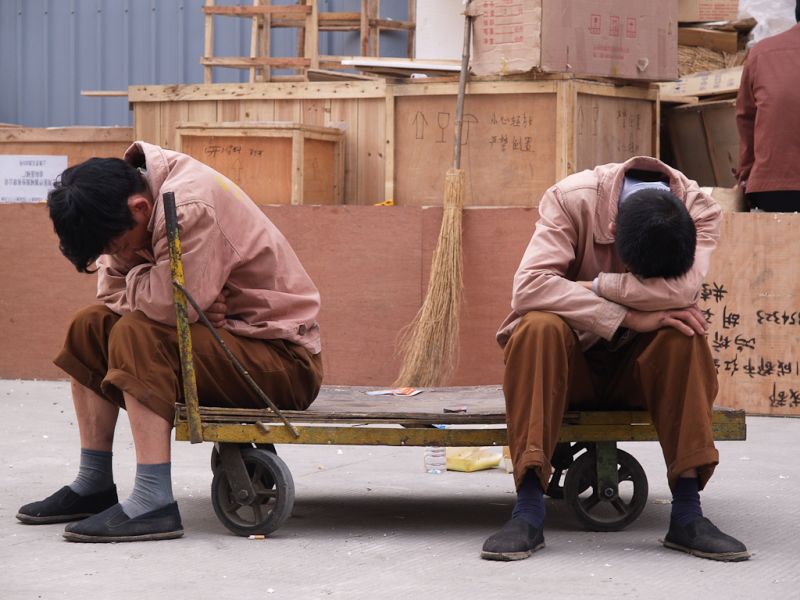
Featured Image: Chinese Workers in Chengdu, 2005. Source: Bosse Hultgren (CC), Flickr.com.
References
611Study.ICU. 2025. ‘全国小初高中超时学习学校耻辱名单 [National Shame List of Schools (Primary, Middle, High) with Excessive Overtime Study Practices].’ Website project, 20 April. docs.google.com/spreadsheets/d/1P48quxwMv9XsYQhXjLOvTRRq8tt3ahJnkbXo4VCxjLc.
Chen, Guo George 陈果. 2025. ‘比亚迪巴西事件后续 | 中国管理模式的全球化挑战 [Follow-Up on the BYD Brazil Incident: The Globalisation Challenges of the Chinese Management Model].’ 陈果 George WeChat account, 10 March. mp.weixin.qq.com/s/spcGtlGpJ4jfP4aqAfvnKA.
China Labour Bulletin. 2022. ‘Worker Protests at Zhengzhou Foxconn Highlight Labour–Capital Problems in Global Supply Chain.’ China Labour Bulletin, 25 November. clb.org.hk/en/content/worker-protests-zhengzhou-foxconn-highlight-labour-capital-problems-global-supply-chain.
China Labour Bulletin. 2024. ‘西安比亚迪工厂一名55岁工人过劳死亡-企业应正视厂内违法加班状况 [A 55-Year-Old Worker Dies from Overwork at BYD’s Xi’an Factory—The Company Must Address Illegal Overtime Practices Inside the Plant].’ China Labour Bulletin, 14 October. clb.org.hk/zh-hans/content/西安比亚迪工厂一名55岁工人过劳死亡-企业应正视厂内违法加班状况.
Driessen, Miriam. 2019. Tales of Hope, Tastes of Bitterness: Chinese Road Builders in Ethiopia. Hong Kong: Hong Kong University Press.
Hebei Hengshui High School 河北衡水中学. 2014 ‘如果你的孩⼦在衡中上过学 [If Your Child Had Gone to School at Hengshui].’ Hebei Hengshui High School WeChat account, 8 October. mp.weixin.qq.com/s/d5h5pFKZM0C-rXtT6g3buQ.
Jinjiang Group Brazil Branch 金匠集团巴西分公司. 2024. Post on Weibo, 25 December. m.weibo.cn/detail/5115799314104720 – comment.
Lara, Silvia Hunold, and Nauber Gavski da Silva. 2020. ‘Labor Relations and Slavery in Contemporary Brazil: A New Digital Collection.’ International Labor and Working-Class History 97(April): 190–96.
Lee, Ching Kwan. 2017. The Specter of Global China. Chicago, IL: University of Chicago Press.
Li, Promise. 2022. ‘The Foxconn Uprising in Zhengzhou: The Explosive Nexus of Labor and Social Reproduction in China.’ Tempest, 5 December. tempestmag.org/2022/12/the-foxconn-uprising-in-zhengzhou.
Li, Xiaotian. 2019. ‘The 996.ICU Movement in China: Changing Employment Relations and Labour Agency in the Tech Industry.’ Made in China Journal 4(2): 54–59.
Liang, Meng 梁萌. 2019. 加班: 互联网企业的工作压力机制及变迁 [Overtime: Research on Work Stress of Internet Companies in China]. Beijing: Sheke Wenxian Chubanshe.
Loyalka, Michelle Dammon. 2012. Eating Bitterness: Stories from the Front Lines of China’s Great Urban Migration. Berkeley, CA: University of California Press.
Ma, Jack 马云. 2019. ‘马云谈996: 能够996是修来的福报, 很多人想做没机会 [Jack Ma on 996: Being Able to Work 996 Is a Blessing—Many People Want to But Don’t Have the Opportunity].’ 澎湃 [The Paper], [Shanghai], 12 April. www.thepaper.cn/newsDetail_forward_3291793.
Mencius. 2009. Mencius. Translated by Irene Bloom. New York, NY: Columbia University Press.
Ministry of Education. 2021. ‘教育部办公厅关于进一步加强中小学生睡眠管理工作的通知 [Notice from the General Office of the Ministry of Education on Further Strengthening the Management of Sleep for Primary and Secondary School Students].’ 31 March. Beijing: Ministry of Education of the People’s Republic of China. www.moe.gov.cn/srcsite/A06/s3321/202104/t20210401_523901.html.
Ministério Público do Trabalho [Public Labour Prosecution Office]. 2024. ‘Força-tarefa resgata 163 trabalhadores e interdita obra da BYD em Camaçari (BA) [Task Force Rescues 163 Workers and Shuts Down BYD Construction Site in Camaçari (BA)].’ Ministério Público do Trabalho website, 13 December. mpt.mp.br/pgt/noticias/forca-tarefa-resgata-163-trabalhadores-e-interdita-obra-da-byd-em-camacari-ba.
Qin, Shuo 秦朔, and Xiong Yuejia 熊玥伽. 2024. 工程师之魂: 比亚迪 三十而立 [The Spirit of Engineers: BYD at 30]. Beijing: Zhongxin Chuban Jituan.
Qu, Zhi 曲智. 2012. 任正非内部讲话: 关键时刻任正非说了什么 [The Inner Speech of Ren Zhengfei: What Ren Zhengfei Said at Key Moments]. Beijing: Xinshijie Chubanshe.
Stross, Randall. 2007. The Wizard of Menlo Park: How Thomas Alva Edison Invented the Modern World. New York, NY: Three Rivers Press.
This Is a Bewildering Planet 这是一个令人迷惑的星球. 2025a. ‘河南县城某学校高中生一日生活举例 [A Typical Day for a High School Student in a County of Henan Province].’ 这是一个令人迷惑的星球 [This Is a Bewildering Planet] Bilibili account, 7 January. bilibili.com/video/BV14DrUYtE6x.
This Is a Bewildering Planet 这是一个令人迷惑的星球. 2025b. ‘二本文科毕业生就业方向举例: 送外卖 [Example of Employment Path for a Second-Tier Liberal Arts Graduate: Food Delivery].’ 这是一个令人迷惑的星球 [This Is a Bewildering Planet] Bilibili account, 13 April. bilibili.com/video/BV1fDd6YxEcv
Wen, Rumin 温儒敏, ed. 2017. 八年级语文(上册) [Chinese Language and Literature (Eighth Grade, A)]. Beijing: Renmin Jiaoyu Chubanshe.
Xin, Jinhuan 信金焕, ed. 2013. 从衡中走向清华北大 [From Hengshui Highschool to Tsinghua and PKU]. Shijiazhuang, China: Hebei Kexue Jishu Chubanshe.
Zhang, Xifeng 张锡峰. 2021. ‘小小的世界大大的你 [A Tiny World, a Big You].’ Speech, 超级演说家: 正青春 [Super Speaker: Youth], Anhui Television, 30 May. bilibili.com/bangumi/play/ep405213.