
Rethinking Comrade and Foreigner
Joan Hinton and the Boundaries of Belonging in Maoist China
The figure of Joan Hinton has long circulated in both Chinese and American political imaginations. Yet existing narratives—whether shaped by Cold War anticommunism, People’s Republic of China (PRC) state propaganda, or even major scholarly works—have tended to frame her life through a simple binary: that she ‘abandoned America’ and was fully embraced by ‘Red China’. This essay challenges that storyline. It argues that, from the outset, Joan Hinton’s political identity within the PRC was structured by a fundamental duality: she was celebrated as an internationalist comrade while simultaneously governed as a foreign subject. This condition was neither a post-Mao development nor merely a Cold War artefact. Rather, it reflected a persistent tension within the PRC between socialist internationalism and a sovereign, nationalist state agenda—a tension that shaped Hinton’s experiences across the Mao era and beyond.
Joan Hinton (1921–2010) was among the most prominent American Maoists of the twentieth century. Trained as a physicist in the United States and disillusioned by Cold War politics and the militarisation of nuclear science, she moved to the newly founded PRC in the late 1940s with her husband, Erwin Engst, and was later joined by her brother William Hinton. Over the next five decades, the Hinton–Engst family became highly visible figures in both American and Chinese political discourse. In the United States, Cold War anticommunist narratives depicted Hinton as a traitor, exaggerating her scientific background and accusing her of aiding China’s nuclear weapons program (Zacharias 1953; Grimes 2010). In the PRC, by contrast, Mao-era propaganda celebrated her as an exemplary ‘internationalist warrior’—a symbol of Western intellectuals rejecting imperialism and embracing the Chinese Revolution.
This celebratory image, however, obscured a crucial fact: Hinton’s scientific training was never applied to China’s nuclear program. Rather, she and Engst spent most of their lives working as dairy technicians, enjoying political prestige while remaining institutionally distant from sensitive domains of the socialist state (Lautz 2022: Ch.3). Post-Mao representations further complicate this legacy. Since the 1980s, official narratives have increasingly recast Hinton not as a revolutionary Maoist but as a ‘friend of China’, privileging national loyalty over ideological commitment (People.cn 2021). At the same time, PRC commemorative discourse has selectively sidelined more contentious members of the family. William Hinton, once deeply involved in land reform (Hinton 1973) and a vocal critic of the Chinese Communist Party (CCP) after 1989 (Hinton 2016), and Carma Hinton, whose documentaries Morning Sun (1997) and The Gate of Heavenly Peace (1995) provoked official condemnation, largely disappear from the authorised narrative. By contrast, Joan’s son Fred Engst, a committed Maoist intellectual active in post-Mao China, is frequently mobilised to recount his mother’s life in ways aligned with contemporary political needs (Engst 2019).
Existing scholarship has recognised that Joan Hinton was never fully integrated into the institutions of the Chinese State. The two most substantial studies, Terry Lautz’s Americans in China (2022) and Dao-yuan Chou’s Silage Choppers and Snake Spirits (2019), both note the distance between Hinton’s symbolic prominence and her actual position within state structures. Yet these works tend to explain this distance as either a professional mismatch between her scientific training and her assigned roles or a consequence of ideological shifts between the Mao and post-Mao eras. This essay advances a different interpretation. It suggests that Hinton’s dual positioning—praised as an internationalist ally yet managed as a foreign subject—was already embedded in Mao-era governance itself.
Newly examined materials from the Shanghai Municipal Archives (SMA) make this logic visible. Internal reception and surveillance reports from May 1963, documenting the Shanghai visit of Joan Hinton and her mother, Carmelita Hinton, offer a rare view of how local foreign affairs officials evaluated their political reliability, structured their movements, and responded to their questions. While Chou’s (2019: xiv; 222–23) biography briefly notes this visit, the archival records reveal a more systematic pattern of scrutiny, ideological guidance, and controlled hospitality. Read alongside existing narratives, these documents show that the PRC’s ambivalence towards foreign Maoists was not a later development but a constitutive feature of Mao-era state practice. Hinton was symbolically included as an internationalist comrade yet bureaucratically managed as a foreigner operating within the PRC’s diplomatic and geopolitical orbit. Recognising this structural tension provides a framework for reinterpreting Hinton’s Mao-era experiences and the shifting meanings of her legacy.
Staging Internationalism: The 1963 Shanghai Visit
American Maoists such as the Hinton family cannot be read through a simple binary of rejecting the United States and choosing China. Even as they promoted the CCP as an anti-imperialist revolutionary force, their expectations often diverged from the PRC’s diplomatic and security priorities. Chinese authorities recognised this tension, publicly staging the Hintons as trustworthy internationalist allies while internally treating them as useful but potentially unreliable foreigners. As one directive put it, ‘care must still be taken to balance internal and external matters’ (SMA 1963a).
This dual logic is visible in visits by Joan Hinton and her mother, Carmelita, during the early 1960s. In 1962, Carmelita, an educator and left-wing antiwar activist, travelled to China after attending a conference in Moscow and, with assistance from Sun Yat-sen’s wife, Soong Ching-ling, received high-level hospitality. This included an invitation to National Day events in Beijing and a meeting with Zhou Enlai, who praised Carmelita for ‘risking coming to China despite the U.S. ban’ (Engst 2019: 169). She and Joan were then taken on a fully arranged tour of Xi’an, Wuhan, Changsha, and Shanghai with official translators and guides, which was designed to showcase industrial achievements and revolutionary history (Engst 2019: 173–74). While Fred Engst’s memoir recounts this travel briefly, a confidential set of internal reports produced by the Shanghai branch of the Chinese People’s Committee for Safeguarding World Peace during their stay (25–31 May 1963) presents a more controlled and politically charged account. Although formally a ‘people’s’ peace organisation, the committee operated as part of the PRC’s state-aligned foreign affairs and United Front system, serving as an official intermediary for receiving, guiding, and evaluating sympathetic foreign visitors such as the Hintons.
On 22 May 1963, the China People’s Committee for Safeguarding World Peace issued a confidential reception plan for the Hintons’ upcoming visit to Shanghai (SMA 1963a). Anticipating their arrival from Hangzhou on 25 May, the document summarised the political issues Carmelita Hinton had raised during earlier travels, including China’s border disputes with the Soviet Union, Laos, and Thailand, its relations with Romania, and socialist cooperation in Vietnam and Czechoslovakia. While describing Carmelita as broadly friendly towards China, the plan characterised her as politically misguided and in need of ideological correction, noting that she ‘has been friendly since arriving in China, though she raised some doubts, but after discussions and tours, she has shown signs of change [从来华后的表现来看, 对我友好, 肯提出自己的怀疑, 参观交谈之后有转变]’.
Framed in these terms, the Shanghai visit was explicitly conceived as a process of managed re-education. The reception plan set out four core directives: the itinerary should emphasise contrasts between ‘old’ and ‘new’ China to underscore the CCP’s legitimacy; officials should be prepared to guide the Hintons towards China’s official positions on international affairs; the family should be ‘handled with appropriate discretion’ (须做好准备), citing concerns about their long residence in China, Joan Hinton’s fluency in Chinese, their inquiries into the Five-Anti Campaign (an official 1950s campaign against corruption, tax evasion, fraud, theft of state assets, and espionage, which became a coercive political movement targeting private businesses and urban elites), and potential contact with American personnel at the China Welfare Institute; and special attention should be paid to the health of the 73-year-old Carmelita.
On 25 May 1963, Carmelita and Joan arrived in Shanghai by train. Senior officials from Shanghai welcomed them and accompanied them on tours. As Carmelita did not speak Chinese, all conversations were translated by the government-assigned translator, Yu Shilian (俞士蓮). Each day, Yu and other accompanying staff wrote confidential reports titled ‘Reception Work Report’ (接待工作汇报), documenting the Hintons’ comments and political views, particularly on international issues. From five reports archived at the Shanghai Municipal Archives, the Hintons were primarily concerned with how China’s socialist policies improved people’s livelihoods, particularly in terms of women’s rights, labour rights, and children’s access to education. However, the Chinese Government’s reception team was more interested in getting the Hintons to endorse China’s geopolitical positions, especially regarding the Cold War conflicts between the Soviet Union and China and the border disputes with India.
The daily reports record repeated tensions between the Hintons’ egalitarian concerns and the priorities of the Chinese reception team. On 25 May, Carmelita and Joan raised questions about child labour in Wuhan, asking about minimum working ages and compulsory education after observing large numbers of school-age children out of school; Carmelita was reportedly shocked to learn that primary education was not free (SMA 1963b). Similar concerns resurfaced on 28 May during a visit to the Fan Gua Nong (藩瓜弄) neighbourhood, where they again questioned why 10-year-old children were not attending school (SMA 1963c). On 29 May, during a visit to a women-dominated community factory, Carmelita briefly raised concerns about women workers’ rights; the report notes a disagreement between mother and daughter, with Joan downplaying gender inequality based on her own farm experience (SMA 1963d).
The reception team’s responses to the Hintons’ questions were frequently evasive or contradictory. When Carmelita asked whether school-age children were guaranteed access to education, officials initially claimed that parents were unwilling to send their children to school, only to reverse this position the following day by asserting that Chinese parents naturally valued education. The 25 May report acknowledged that the issue had been addressed without resolution: ‘The question has been explained, but not resolved [对此问题虽经解释然还未解决].’ Similar evasions appear in the 28 May record, when officials explained a 10-year-old child’s absence from school in the Fan Gua Nong community by stating that the child was ‘stupid and unable to enter primary school’, leaving Carmelita’s follow-up question—whether primary education required entrance exams—unanswered.
Questions touching on political violence were handled with even greater caution. When Carmelita inquired about the Five-Anti Campaign before arriving in Shanghai, Tang Mingzhao (唐明照), a senior official in the PRC’s state-aligned peace and foreign affairs apparatus who frequently handled international visitors, responded by reframing it as a general campaign of ‘education against corruption, waste, and bureaucracy [我们要开展反贪污、反浪费、反官僚的教育]’, deliberately avoiding the term ‘Five-Anti’ (五反) altogether. This formulation stripped the campaign of its coercive character, omitting its role within the Socialist Education Movement and its association with mass purges, persecution, and widespread wrongful imprisonment, which resulted in more than 70,000 deaths (Yang 2021).
In contrast to their guests’ concerns about everyday social conditions, the Chinese reception team concentrated overwhelmingly on geopolitical issues, particularly the Sino-Soviet split and the Sino-Indian border conflict. Daily reports meticulously recorded the Hintons’ attitudes towards these matters, carefully noting even brief remarks or small gestures. On their first day in Shanghai, Carmelita expressed sympathy for China’s position vis-a-vis the Soviet Union but remained unconvinced by official accusations of Nikita Khrushchev’s ‘revisionism’; the report noted that officials ‘still could not make her fully understand [但还未使她能理解到]’. This uncertainty makes a later entry especially revealing. During city tours, translators were instructed to read aloud reports on party-to-party diplomacy and solicit responses. On 27 May, after hearing that the Singaporean Communist Party had sided with the CCP against Soviet ‘revisionism’, Carmelita reportedly answered only ‘opposition to revisionism [反对修正主义]’, after which the report added that there was ‘no other reaction [无别的反映]’. While this was not a fully developed endorsement of the CCP’s position, the entry suggests how reception staff converted a brief, possibly formulaic response into a usable sign of political alignment. The report’s concern was less to reconstruct Carmelita’s views in their complexity than to document whether the visit had produced outward signs of agreement on issues central to the PRC’s foreign policy agenda.
This asymmetry is most visible in the 29 May dinner with Yang Yongzhi (杨永直), the senior official overseeing the visit (SMA 1963d). Although the discussion spanned the American left, the Soviet Union, the Sino-Indian conflict, the Cuban Missile Crisis, and Vietnam, issues related to the United States occupied only a small portion of the report and were summarised briefly. By contrast, exchanges about the Soviet Union were documented in extensive detail, including critiques of Soviet culture, analogies used to explain ‘revisionism’, accusations of Khrushchev’s corruption, and condemnations of consumerist values. Even when the Hintons criticised the Soviet Union, their remarks reflected an egalitarian moral framework rather than geopolitical calculation. As Carmelita observed, Soviet advertisements praising envy-inducing consumption were objectionable because they should instead promote shared enjoyment: ‘If you buy this boat, you can enjoy good times with your friends.’
Regarding the Sino-Indian border conflict, the Hintons’ responses, as noted in the 29 May report, were almost irrelevant. When asked about the conflict, their answer was essentially that Chiang Kai-shek’s regime in Taiwan continued to harass China militarily, sending spies, so China had to arm itself to protect its borders. The report shows that they did not address India or the merits of the Sino-Indian border dispute at all. However, their vague and superficial expressions of support were still recorded in the report. A reasonable assumption is that these ambiguous, shallow statements were written into the report to demonstrate that the CCP’s United Front work with these American Maoists had achieved results, garnering the so-called endorsement of international friends on key issues where their support was needed. Based on this, it can further be inferred that the CCP’s core concerns were the Sino-Soviet dispute and the broader split within the communist camp, as well as the Sino-Indian territorial dispute and the recently concluded war. The CCP did not prioritise supporting the American left-wing or civil rights movements and merely offered ceremonial statements on those issues. As for the egalitarian concerns raised by the American Maoists regarding everyday life, the Chinese Government was even less likely to give a sincere and open response.
After Shanghai: Dual Status in the 1960s
The internal documents surrounding the Hinton family’s 1963 visit to Shanghai not only illuminate how the Mao-era state categorised and managed foreign Maoists, but also foreshadow the contradictions that would structure the family’s experiences in the years that followed. The double positioning revealed in the Shanghai files—Hinton as both an internationalist symbol and a foreign subject requiring careful bureaucratic handling—did not end with that trip. Rather, it became increasingly visible in the everyday life of Joan and her family throughout the early and mid-1960s.
Although the PRC continued to celebrate Joan publicly as a loyal foreign comrade, a series of small but telling incidents made clear that she was never treated as an ordinary participant in the socialist project. In 1962, a newly established restricted zone happened to lie along her route home from the dairy farm; when she crossed it unknowingly, the local police summoned and warned her yet could offer no alternative path (Engst 2019: 176–77). Her three children, born and raised in China, were required to register as ‘foreign residents’, asked why they had ‘come’ to China, denied the opportunity to join the Young Pioneers, and even barred from performing the violin because it was deemed politically inappropriate for ‘foreign children’ (Engst 2019: 177). By 1966, Joan and Erwin were abruptly reassigned from productive labour at the farm to translation work in Beijing (Engst 2019: 179), where they lived in isolated accommodation for foreign experts, their contact with ordinary Chinese sharply curtailed. Despite the material privileges they received, both Joan and Erwin later recalled this period as one of profound alienation, confined to symbolic roles within the foreign affairs system rather than allowed to participate in everyday socialist life (Engst 2019: 184).
It was under these conditions that, in August 1966, Joan, Erwin, and two other American Maoists posted their now famous big-character poster denouncing what they termed the ‘five noes, two yeses’ policy towards foreign experts: “no physical labour, no study of Mao Zedong Thought, no interaction with workers and peasants, no participation in class struggle, and no productive work; yes to elite treatment; yes to privilege.” To them, this system signalled exclusion—a refusal to treat them as true comrades. The poster was born not only from ideological zeal but also from accumulated frustrations generated by the same governance logic visible in the Shanghai documents. Mao Zedong’s mild endorsement of the poster—stating that foreign experts ‘may be treated the same as Chinese people, if they volunteer’—allowed the family to return to the farm, and Joan and her son Fred later remembered this as a victory over bureaucracy (Chou 2019: 255–91).
Yet the voluntariness clause made clear that this was an exception, not a structural change. The foreign expert system remained intact; foreign revolutionaries continued to be handled within the domain of ‘foreign affairs’—a realm the PRC leadership carefully insulated from the political upheavals sweeping other parts of society. As demonstrated by the state’s rapid suppression of Red Guard attacks on the British Embassy in 1967 (Fairbank and Goldman 2006: 396) and Mao’s sharp rebuke—‘Give me back the Great Wall’ (Qi 2014)—when radical officials attempted to extend Cultural Revolution politics into the military, areas involving national sovereignty and external relations retained a distinct, tightly controlled logic.
Throughout the Cultural Revolution, then, foreign affairs operated under a cautious, statist, and nationalist framework, even as public propaganda proclaimed internationalist solidarity. The dual image that shaped the Hintons in 1963—idealised internationalist allies on the surface, but administratively managed outsiders beneath—remained the defining structure of their lives in Mao’s China. No matter how sincerely Joan embraced Maoism, she could not escape the institutionalised distinction between insiders and outsiders that governed the socialist state.
Internationalism within Nationhood
The archival and biographical materials discussed here invite a rethinking of Joan Hinton’s position in Maoist China not simply as a matter of personal biography, but as an effect of how the PRC state conceived and practised nationhood. Following Rogers Brubaker’s (1994) formulation of nationhood as a ‘category of practice’—a classificatory logic through which states and institutions organise political belonging—the Hintons’ experience reveals the persistent reproduction of a boundary between ‘Chinese insiders’ and ‘foreign outsiders’, even at moments when ideological discourse emphasised internationalist unity. The Shanghai documents, the alienating incidents of the early 1960s, and the 1966 big-character poster all point to the same governing logic: foreign Maoists could be praised, courted, and mobilised symbolically, but they were still treated as fundamentally separate from their Chinese counterparts.
This logic was institutionalised through the principle of ‘distinguishing the internal from the external’. In Brubaker’s terms, ‘Chinese’ functioned not merely as a marker of citizenship but also as a bundle of assumptions about political trust, access to information, and legitimate participation in socialist life. Even when Joan Hinton was celebrated as an ‘internationalist warrior’, she remained administratively positioned on the external side of this divide. The Shanghai reception reports—tracking her and Carmelita’s reactions, warning against contact with American personnel, and repeatedly emphasising the need to ‘handle them with appropriate discretion’—make this categorisation explicit. So do later episodes: Joan’s restriction from certain zones, the registration and interrogation of her China-born children as foreigners, their exclusion from the Young Pioneers and public musical performance, the family’s reassignment into the foreign affairs system, and their confinement to segregated housing and schools. Across these contexts, the state reaffirmed that ideological commitment did not translate into political incorporation: the Hintons remained foreign subjects governed within the domain of ‘foreign affairs’, rather than members of the socialist polity.
This tension between ideological inclusion and categorical exclusion was not incidental. It emerged from Maoism’s dual character as both a project of global socialist revolution and a project of nation-state construction. Maoist discourse proclaimed solidarity with oppressed peoples worldwide and welcomed foreign revolutionaries as comrades, yet the CCP, once in power, faced the imperatives of territorial sovereignty, border security, diplomatic management, and monopolised political authority. As Elizabeth J. Perry (2012) has noted, socialist internationalism and nationalist state-building coexisted uneasily in Maoist China, producing a political order in which revolutionary rhetoric and statist practice repeatedly intersected and collided. The treatment of foreign Maoists such as the Hintons lay precisely at this intersection.
Seen in this light, the Shanghai visit and the subsequent events of the 1960s appear as efforts by the Mao-era state to reconcile internationalist aspiration with the demands of a security-conscious sovereign state. In propaganda and public ceremony, the Hintons were staged as evidence of the Chinese Revolution’s transnational appeal: Carmelita’s appearance in Tiananmen Square during National Day, the carefully curated tours, and the later elevation of Joan as a model internationalist—all served this purpose. In internal documents and everyday governance, however, they were treated as geopolitical resources and potential liabilities—figures to be educated, monitored, and deployed in struggles over international opinion and intra-socialist conflict. The disproportionate attention paid to their views on the Sino-Soviet split, the Sino-Indian border conflict, and other geopolitical questions—in contrast with the evasive handling of their inquiries into education, labour, and political campaigns—underscores this priority. Their value to the state lay not in participation within a transnational class community, but in their utility as witnesses and proxies in the PRC’s external struggles.
The 1966 big-character poster crystallised this contradiction from below. By denouncing the ‘five noes, two yeses’ policy, Joan and her fellow American Maoists challenged the categorical boundary that excluded them from labour, study, and class struggle while granting them material privilege. Mao’s response—approving equal treatment ‘for those who volunteer’ and allowing the family to return to the farm—did not dismantle the foreign expert system. Instead, it reaffirmed the boundary itself, permitting exceptions without altering the structure. The duality evident in the Shanghai files thus persisted as a stable feature of Mao-era governance.
From this perspective, the tensions that became more visible in the post-Mao period represent not a rupture but a reweighting of the same structural logic. As the PRC shifted away from a rhetorically central commitment to world revolution towards a development strategy grounded in national rejuvenation and market reform, nationalist imperatives increasingly eclipsed socialist internationalism. Within this context, the Hinton family’s divergent trajectories become intelligible: Joan’s growing disillusionment, William Hinton’s turn to open criticism after 1989, and Carma Hinton’s censured documentaries all mark moments when socialist ideals collided with a state defined by nationalist priorities and authoritarian stability.
Contemporary commemorations make this recalibration especially clear. Official narratives now reorganise the Hinton legacy around Joan as a ‘friend of China’, valuing her less for revolutionary commitment than for national loyalty. William and Carma largely disappear, while Fred Engst is mobilised as a reliable narrator whose recollections can be incorporated into a nationalist framework. The same structural duality that governed the Hintons’ lives in Maoist China thus persists in altered form, with its socialist content progressively stripped away.
Tracing this arc from the 1963 Shanghai visit to the post-Mao politics of memory reveals a consistent pattern. Joan Hinton’s experience is neither a simple Cold War story of defection and embrace nor a straightforward narrative of revolutionary betrayal. Instead, it exposes how the PRC State, across both Maoist and post-Mao configurations, has managed the tension between internationalist ideals and nationalist governance by constructing foreign Maoists as useful outsiders—celebrated when they serve the nation’s image, yet always confined to the far side of an institutional boundary that even the most devoted revolutionary could not transcend. The boundary between ‘comrade’ and ‘foreigner’, rather than a contradiction to be resolved, functioned as a governing principle—one that enabled internationalist symbolism while preserving the sovereign logics of nationhood.
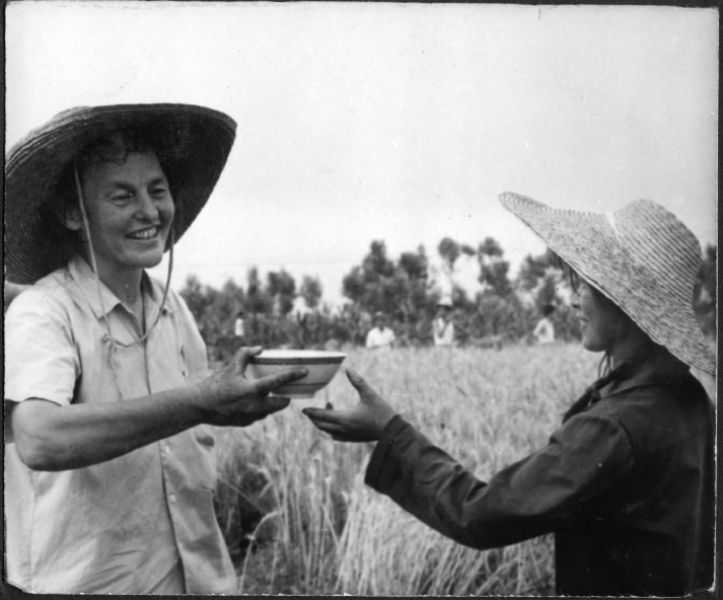
Featured Image: Joan Hinton on a farm in Beijing in 1966 (Source: bjreview.com, COURTESY PHOTO).
References
Brubaker, Rogers. 1994. ‘Nationhood and the National Question in the Soviet Union and Post-Soviet Eurasia.’ Theory and Society 23(1): 47–78.
Chou, Dao-yuan. 2019. Silage Choppers and Snake Spirits: The Lives and Struggles of Two Americans in Modern China. Paris: Foreign Languages Press.
Engst, Fred. 2019. 寒春阳早画传 [Life and Times of Two American ‘Reds’: Joan Hinton & Erwin (Sid) Engst in China]. Beijing: 机械工业出版社 [China Machine Press].
Fairbank, John King, and Merle Goldman. 2006. China: A New History. 2nd enlarged edn. Cambridge, MA: Harvard University Press.
Grimes, William. 2010. ‘Joan Hinton, Physicist Who Chose China over Atom Bomb, Is Dead at 88.’ The New York Times, 12 June. www.nytimes.com/2010/06/12/science/12hinton.html.
Hinton, William. 1965. Fanshen: A Documentary of Revolution in a Chinese Village. New York, NY: Monthly Review Press.
Hinton, William. 1972. Hundred Day War: The Cultural Revolution at Tsinghua University. New York, NY: Monthly Review Press.
Hinton, William. 2016. The Great Reversal: The Privatization of China, 1978–1989. Delhi: Aakar Books.
Lautz, Terry E. 2022. Americans in China: Encounters with the People’s Republic. New York, NY: Oxford University Press.
People.cn. 2021. ‘纪念国际友人寒春诞辰100周年研讨会在京举办 [Symposium Commemorating the 100th Anniversary of the Birth of International Comrade Joan Hinton Held in Beijing].’ People.cn, 21 October. world.people.com.cn/n1/2021/1021/c1002-32260408.html.
Perry, Elizabeth J. 2012. Anyuan: Mining China’s Revolutionary Tradition. Berkeley, CA: University of California Press.
Qi, Benyu. 2014. Memoir of Qi Benyu. Hong Kong: Chinese Cultural Revolution Press.
SBS TV. n.d. ‘The Gate of Heavenly Peace: The Tiananmen Square Massacre.’ Transcript.
Shanghai Municipal Archives (SMA). 1963a. ‘中国人民保卫世界和平委员会上海市分会办公室关于接待美国辛顿夫人及其女儿琼辛顿的工作计划 [The Shanghai Office of the Chinese People’s Committee to Defend World Peace’s Work Plan for Hosting Mrs Hinton and Her Daughter Joan Hinton from the United States].’ 22 May. C36-2-176-15.
Shanghai Municipal Archives (SMA). 1963b. ‘中国人民保卫世界和平委员会上海市分会办公室关于接待美国辛顿夫人及其女儿琼辛顿的工作汇报(一) [The Shanghai Office of the Chinese People’s Committee to Defend World Peace’s Report on Hosting Mrs Hinton and Her Daughter Joan Hinton from the United States (I)].’ 25 May. C36-2-176-18.
Shanghai Municipal Archives (SMA). 1963c. ‘中国人民保卫世界和平委员会上海市分会办公室关于接待美国辛顿夫人及其女儿琼辛顿的工作汇报(三) [The Shanghai Office of the Chinese People’s Committee to Defend World Peace’s Report on Hosting Mrs Hinton and Her Daughter Joan Hinton from the United States (III)].’ 28 May. C36-2-176-21.
Shanghai Municipal Archives (SMA). 1963d. ‘中国人民保卫世界和平委员会上海市分会办公室关于接待美国辛顿夫人及其女儿琼辛顿的工作汇报(四) [The Shanghai Office of the Chinese People’s Committee to Defend World Peace’s Report on Hosting Mrs Hinton and Her Daughter Joan Hinton from the United States (IV)].’ 29 May. C36-2-176-27.
Shanghai Municipal Archives (SMA). 1963e. ‘中国人民保卫世界和平委员会上海市分会办公室关于接待美国辛顿夫人及其女儿琼辛顿的工作汇报(五) [The Shanghai Office of the Chinese People’s Committee to Defend World Peace’s Report on Hosting Mrs Hinton and Her Daughter Joan Hinton from the United States (V)].’ 30 May. C36-2-176-27.
Yang, Jisheng. 2021. The World Turned Upside Down: A History of the Chinese Cultural Revolution. Translated and edited by Stacy Mosher and Guo Jian. New York, NY: Farrar, Straus and Giroux.
Zacharias, Ellis M. 1953. ‘The Atom Spy Who Got Away.’ Real Magazine, July: 33–35.