
Jesus on Mars
(Translated and introduced by Yahia MA)
I first experienced Cui Zi’en’s work in mainland China in the early 2000s, when I was an undergraduate at a university in the country’s northwest and was becoming increasingly aware of my own sexuality. At that time, Cui was creating his queer-themed films and fiction, including Pseudo-Science Fiction Stories (偽科幻故事, 2003/2023), the anthology that includes ‘Jesus on Mars’ (火星上的耶穌), the story that I translate here. Encountering his fiction felt akin to watching a film, whereas viewing his films (most of which were produced with low-budget digital video) was like reading a sequence of poems projected on the screen. Bold, provocative, mind-bending, experimental, avant-garde, brave—none of these words fully captures the essence of these literary and cinematic productions.
The interweaving of religion, queer sexuality, and non-normative lifestyles is paramount in Cui’s oeuvre, which unfolds—or at least provides a glimpse of—the imaginary of a queer China in the early 2000s and what it might yet hold for the future. This came shortly after the de-pathologisation of homosexuality in the People’s Republic in 2001. It was also a period when queer communities in China gained (limited) visibility in mass media and through queer films and cultural events. Based in Beijing at that time, Cui stood at the forefront of such events, as captured in his own documentary Queer China, or, in the original title, ‘Comrade’ China (誌同志). As a filmmaker, writer, critic, and activist, Cui has blurred the boundaries of personal identity and social roles, while disrupting rigid binaries of gender, sexuality, and time—not to mention the traditional dichotomy of heaven and earth in his speculative fiction.
With the continuing impact of his work both within and outside China, Cui Zi’en’s 2003 anthology Pseudo-Science Fiction Stories was reissued in traditional Chinese in Taiwan in 2023, 20 years after its first publication in simplified Chinese in mainland China. Cui’s Platinum Bible of the Public Toilet: Ten Queer Stories was published in English the following year—the first book-length collection of his literary work available in English translation. Pseudo-Science Fiction Stories contains 17 queer stories featuring the protagonist Hua Mulan, who journeys across the cosmos in unfolding eerie interplanetary episodes entangled with desire and the recollection of memories. The stories in this collection, including ‘Jesus on Mars’, depict interplanetary, incestuous, trans-temporal encounters that challenge our assumptions about gender, sexuality, the body, religion, desire, reproductivity, and life itself. Through highly imaginative narratives, Cui Zi’en blends fantastical imagination with black humour and satire, structuring his stories as both fairy tale and science fiction, and presenting the world with a dreamlike yet absurd work of art in words.
‘Jesus on Mars’ was translated from the 2023 traditional Chinese version of the anthology. Translating such an allegorical, poetic, cinematic story—which hybridises fiction, biblical allusion, and erotic poetics—from Chinese into English, I approached it as a queer translation studies scholar and practitioner. Drawing on my transnational lived experience as a queer person and my interest in queer literature, I attended carefully to its refusal of linear, monolingual, single-temporal narrative. Immersing myself in Hua Mulan’s story, I was mindful of transgressions, slippages of signification, and the fluidity of sex, gender, and sexuality. At the same time, I recognised that the work’s challenges to heterosexual, sexist, patriarchal norms can be neither reduced to equivalents in the translating language nor contained within traditional methods of translation—such as the binarism of domestication and foreignisation—particularly when crossing times and planets. In this way, I practised a comparatively queer translation.
Ultimately, ‘Jesus on Mars’ proceeds as a mosaic tableau, in which queer desire and spirituality mingle like water with milk, or saliva with semen. Through its fragments of imagery, the story critiques earthly systems of authoritarianism in religion, politics, and family, while reimagining queer alternatives that emerge across planets, bodies, and times.
Yahia Ma
29 August 2025
1
The road from Earth to Mars is long, far longer than the boundless thousands of light-years from Triangle City to Square City; you walk with me, walking this out-of-the-way road; we carry no food, no water, no extra clothing, not a single book—not even a Bible; we walk, across the roadless road through the boundlessness of space. The wilderness of space surrounds you on all sides, it surrounds me on all sides too; there are only travellers—no shepherds, no shepherds’ ballads, no shepherds’ flutes. You need not worry about being merely a traveller—not farming, nor weaving—and whether we will have food to eat or clothes to wear.
Halfway through, we will catch sight of the most beautiful star in the universe; yes, Paradise Star; the Martians cannot see it; they can merely vaguely discern the ladder of clouds that leads to it; Earthlings cannot see it either nor do they know of its existence, not even the great astronomers. Only you and I will come close enough to press against its orbit.
You are trembling a little, aren’t you? Come, hold my hand tight; my hand, neither male nor female, gentle and erect; it is as fragile as yours, as upright as yours. My legs can hardly bear the supersonic speed: they suffer rheumatoid arthritis, an injured ankle from a twist plus strain, and varicosities of both veins and arteries; thankfully, we did not attempt to step into a faster-than-light journey, my legs and feet would never have kept up with my will otherwise.
By the way, I forgot to remind you before we departed: do not tell the Martians my secret when we arrive on Mars, especially not that my hometown is Paradise Star. Since we have taken off from Earth, just tell them we are Earthlings; call me Hua Mulan, and your name is Hua Mutao; I am the older brother and you the younger brother, or you are the older sister and I the younger sister. Come, hold on tighter; we need to fly faster, or else the cross will rot.
2
The road is long, do not grow weary. I will keep telling you stories, like Scheherazade in One Thousand and One Nights, who tells stories out of fear of being killed by King Shahryar (or, in another version, the vizier’s daughter tells a story each night to save women from execution). Right, your addition is reasonable. While she finishes telling him stories or, in the middle of storytelling, she has to make love to him; and she would have been expertly skilled at that too, no less than in storytelling. Even so, you and I had better skip it; mating mid-flight does not quite align with human custom—after all, we are not swans or other birds like that. Telling you stories does not mean you are a king; children love to listen to stories too, they just do not have as many extra desires and demands as you or Shahryar. My storytelling serves another function: it erases my own boredom and loneliness. Between you and me, one of us must enjoy moving their mouth, while the other enjoys moving other parts. The so-called partnership simply means mutual affection, mutual reliance, like loving God and dwelling side by side with your neighbours.
3
Tonight is our first night, the very first night we spent together since take-off. How about a story about a first night? Are you already standing erect to listen?
At the age of 12, I dreamed for the first time about flying to Mars. Before the dream, my mama worried I might go without return; she stuffed my upper body full of the finest white rice—too much, too heavy; I looked a bit pregnant at take-off. You know, at the age of 12, I was surely a virgin, but the neighbours who saw me scattering white rice and rising into the sky would not have seen it that way. They chattered and whispered: Hua Mulan got pregnant by someone while she substituted for her father in the army, Hua Mulan was fucked by her fellow comrades / Hua Mulan went to Mars to give birth / Hua Mulan fled to Mars out of shame. I was furious hearing those ugly words; overlooking Triangle City growing smaller with its lights growing dimmer and more distant, I swore I would never come back.
Teaching Martians to sing was a sleepwalking program I had already set for myself back in kindergarten. I am someone born with a sense of mission; at the age of three or five, I mourned on Mars as I never heard singing there, and I was moved to pity by the desolation and emptiness of the place. I longed to spread the sound of singing, whether joyful songs or mournful tunes. I practised my skills in kindergarten: conducting, soloing, leading choruses, singing in rounds, choir singing—I tried every method and form; I could sing with extreme sonority—my voice cleaving the clouds; I could also sing down to extravagantly low depths, moving bees and ants; in the sound of my singing, mantises in the leaves and rabbits in the grass mated harder and stickier; to my little friends, I said it was my original poetry recitation with musical accompaniment.
I flew to Mars and formed the Flowering Life youth rock band; I was the lead vocalist, the bassist was Caesium, the keyboardist Iodine, and the drummer Zinc. We were all 12 years old, strictly speaking, we were ‘buds of youth’, but our songs and performances were bold, with characteristics of religious hymns against worldliness. First, we smashed the Momo Stage in the centre of Lixi City, located in the Ninth Quadrant of Mars (Mars has 13 quadrants, unlike Earth’s four cardinal directions: east, south, west, and north); then, we rebuilt it three days later. The debut performance of Flowering Life appealed to many prostitutes and their paying customers (most of whom were solar energy specialists); not a single Pharisee attended. In the sound of my singing, the Martian audiences sat still, solemn and dignified; each prostitute was seated with two clients, their hands intertwined, eyes full of tears, an attitude towards music strikingly different from mantises or rabbits on Earth.
According to paragraph 119,783 of Chapter 3 of The Martian Chronicles, that was the first time the sound of a song ever echoed on Mars (since the beginning of history, or even the formation of the planet); it was the first time Martians had heard music composed of skin, flesh, and mucous membrane. Of course, I believe such a ‘historical record’ bears distorted grooves, like warped lines on a wooden record causing sound skips or the mosaic glitches on a VCD in play; were Caesium, Iodine, and Zinc Martians? If they were, they must have heard my singing countless times while rehearsing, and they added vocal harmony to it too. The ‘Number one on Mars’ claim may simply be the solemn flourish where the historian’s pen leaves its mark, however, it remains uncertain.
Martians are incredibly clever; they quickly mastered the development and usage of the sound of singing, just like the mastery of solar energy development. Inspired by the New Momo Stage’s ticket sales, they canned Flowering Life’s sounds of singing in all types of bottles and jars, stamping prices and serial numbers on them using the same labelling devices used in supermarkets, selling them to those who did not have sufficient money or any chance to attend the performances in person at the New Momo Stage; the price depended on the extravagance of the external packaging. Their sales slogans were witty and humorous; the most touching ones I heard included: 1) Bottling the sound of singing is like locking the devil in hell (which reminded me of Decameron on Earth); 2) Dress the songs in trousers so they will not expose the nether regions; 3) The shelf life of a pop-top can is one year and three months; 4) Spread your wings and soar like a mosquito in the universe of a bottle.
These jars and cans, named ‘Monster Sounds’, quickly became a craze in Lixi City (and later, reportedly, all across Mars); almost everyone had one; on the streets, stylishly dressed young people shook their heads, swaggering by as though no-one else existed; each of them held a colourful Monster Sound in one hand, pressing it beneath their ear, immersed—entranced and intoxicated—in the world inside the bottle or can, seemingly forgetting reality. On tree-lined small paths, elderly people also held Monster Sounds in their hands, tilting their heads and necks—in excessive earnestness, investing their remaining life and hearing into the sound. Young people of Lixi City resembled new humans on Earth, while the elderly looked somehow like old penguins; the solar industry had shaped each of them uniformly cartoonish, exhibiting a striking, non-individualistic sense of a collective.
The craze of Monster Sounds swept in quickly and faded fast; the bottles and cans became superficial litter abandoned across the streets. Feeling deceived, crowds of people stormed the New Momo Stage, interrogating why we had smashed the old Momo Stage and taken three days to rebuild it. They raised their iron fists, smashed the New Momo Stage, and expelled me along with the other three members of Flowering Life. Therefore, we went into exile in the Mile-Bobibi mountains between cities, growing into the age of 15 without anyone ever knowing.
One day, the bassist, Caesium, had a fever; I stepped out of the cave to pick up herbs and wandered into the depths of a hundred flowers (by then, I believed all poisons and honeys resided in blossoms, just as now I believe all sex and love gather in the anus or mons pubis). In the depths of a hundred flowers, 13 large-bodied men were hiding, escaping arrest by the police; like myself, they were part of the city’s exile population, drifting along its edges. They were already slightly allergic to the scent of the hundred flowers; encountering a beautiful boy who was singing while picking herbs pushed their lust beyond control; they blindfolded me, seduced me. I call it ‘seduction’ because I did not resist, nor did I want to resist. My mind was absolutely clear, and I thought, since they needed me this badly, I had no reason not to satisfy them. It was God who gave them such an impulse, not themselves. It hurt me badly—I could not accommodate 13 men inside myself, but I fought desperately not to faint—like birth, like death. That was my mission in that moment; if one day I should need someone’s body this badly, they would dedicate theirs to me as I had just offered mine to them; I believe that would be their mission.
Thirteen men shared my first night, and that made it all more religious.
4
Second night. Second story: about ants.
There are not many ants on Mars; each one is as large as a rabbit on Earth, with red eyes and antennae on their head, and their body covered in white fur; the joints across their body remain readily visible. Generally speaking, they are afraid of humans and avoid being noticed by moving discreetly. But there was one ant that was different; he anxiously carried another ant on his back, crawling at a near-flying speed; whenever he encountered an obstacle, he would quickly tap it with his antennae, then climb over it nearly without pause; he seemed so brave, so determined. A few times he passed through bushes, and a few more times through brambles, always the same. Sometimes I called out to him, asking him to wait for me, or else I would ask if he was in trouble and whether I could help; however, he always acted as though he had not heard me, continuing at his flying speed along his own path.
By then, I had lost contact with the other members of Flowering Life, because, as you might guess, I had to exhaust every part of my body and soul to satisfy each of the 13 big men; therefore, by the time they left me, I was already completely disoriented; I lost my way, wandering through the desolate mountains and wild lands of Mars and singing as I went; then I encountered two ants: one was on the verge of death or perhaps already dead; the other crawled forward at a steady pace, never decreasing his speed no matter the circumstances, carrying his fellow ant on his back, and showing no fear of humans.
In a way, we were fellow travellers; by nightfall, he immediately retracted all his limbs and lay flat on the ground without a single movement, only a pair of his antennae throbbing continuously like a radar transmitting waves. At a moment like this, I would fetch water, eat food I could grab or feel in the dark, and bring some for him too, such as honey produced by bees. I would pour water over their heads, but the food was never touched; when day broke and we resumed the journey, I would put the food into my own belly.
One day I noticed he had changed how he treated his fellow ant; he used the serrated edge of his rear left leg to pierce the other ant’s front right leg, dragging him forward at the same speed as before. Only upon closer observation did I realise that the body being dragged had already dried out, shrivelled and lifeless. Along the way, I constantly questioned the living white ant: He is already dead and all that is left is empty skin, where are you dragging him? Are you looking for a grave to bury him? He did not respond—as though he had no time to spare, crawling forward at a flying speed as before.
We crossed over a highway where solar-powered vehicles passed one after another; I did not wave to hitch a ride but continued following him; we crossed over a field for solar energy harvesting—an almost boundless stretch of unpolluted industrial zone emitting synthetic metal light. Perhaps it was the reflection from the energy-collecting panels that irritated me; I lost my patience in following him; I stepped before him and he turned his antennae and crawled left; I blocked the left, he turned right; I blocked the right, then he moved backwards, and I blocked the back; he became the centre of a circle and I became the circumference, there was no way for this centre to escape this circumference and reach wherever it wanted to go. After a long while, he suddenly fell to the ground, without a movement, as though the night had fallen; his rear left leg still clung to the dead one’s front right leg. Under the orange-yellow sunlight, the two of them looked like a specimen of prehistoric life, purely lifeless.
I questioned him, again and again, what the point was of carrying a dying fellow ant. Occasionally he would glance at me but never say a word, stubbornly guarding a secret of his own or even that of his entire species. Whether in the night or direct sunlight, whether I left or stayed to guard him, he no longer crawled or even moved again; only one day when I said to him, go, go wherever you want, and do whatever you want, did he begin to crawl again at the same speed as before, carrying the dead ant further and further away, until neither sunlight nor my vision could reach them.
To this moment, I still do not understand what their relationship was. Where was he taking the dead body across thousands of miles? How would he make arrangements for the dried body? Would he too die eventually, like a human dying for love? Or was he taking him back to the place of his birth or to the place where they had met and fallen in love? Or was he simply a stagecoach in the Kingdom of Ants responsible for transport alone and knowing nothing of the rest? …
5
One thousand and one nights, the one thousand and first story. I am going to tell you the acts of the 13 disciples.
In Martian Year Zero, 13 Martians departed from the Thirteenth Quadrant; armed with fire guns, they headed towards the Twelfth Quadrant in search of the supposed God of Eternal Life. Their confidence was nothing like that of young boys and girls who were once sent overseas by an emperor to seek the elixir of immortality, as told in legend (it is said they arrived at an island named Japan, married, settled down, and never returned to the Heavenly Empire); in other words, these Martians were unshakeable, they were determined to shoot dead with fire guns every demon getting in their way and to one day meet the God of Eternal Life, and then fire a collective salute skyward.
Like Earth, Mars went through a process of modernisation. In Year Zero, the solar era had not yet begun; therefore, the 13 musketeers from the Thirteenth Quadrant on the way to the Twelfth Quadrant solely relied on their God-given legs, refusing to touch the gasoline-powered cars that emitted exhaust gas non-stop and destroyed the ozone layer of Mars. If they had had limitless bullets, they would have shot out every passing tyre, disabling the cars to prevent them from emitting harmful gases and particulate matter if only for a brief moment.
They never questioned why the God of Eternal Life dwelled in the First Quadrant as a hermit instead of the vast, resource-rich Thirteenth Quadrant—they never thought about it; they firmly believed that having doubts or questioning on the path of faith were the biggest enemies, enemies that bullets could not kill. They strongly believed that the God of Eternal Life resided in the First Quadrant and there were 99 demons standing in their way; bullets were limited and not easily produced anytime anywhere, thus, they had to be reserved for demons; tyres might escape the fire guns, but the boundless gas clouds out of vehicles eventually burst into massive dust storms after all the musketeers had died; every few years, the storms gathered in the First Quadrant and blew over Quadrants Two to Thirteen (sometimes the Second and Third Quadrants also became breeding grounds for such storms). Hua Mulan once recorded many stories of this in another of his sleepwalking journals; if interested, you may consult Volume III of the Encyclopaedia of the Universe, ‘Quasi-Angel’, where you will see images of Paradise Star and waves of refugees upon the advent of dust storms. In Martian Year One, the 13 disciples walked towards the border between the Twelfth and Thirteenth Quadrants; the first demon—dragged in gaudy grace, exuding excessive extravagance—stepped out of a grove of sweet peaches, blocking their path. In appearance, he resembled the youngest of the 13 disciples, perhaps even younger and more beautiful. If not for the demon’s excessive supermodel-like swaying of the waist, and the floral accessories on his head and body, which looked like folk costume and lacked signs of faith, even I might have been unable to recognise his true identity, let alone the disciples on their path to becoming saints.
He moaned delicately and said to the disciples: I’m thirsty, please feed me your water. The disciples looked at one another; they had not brought water, just as they had brought no food or clothing. He suggested that they feed him with their saliva. The disciples followed the revelations of the God of Eternal Life whom they had never met; they neither blushed nor feared; each of them opened their mouths, kissed his lips, and transmitted water through their oral mucous membranes. He then said he was no longer thirsty, but still craved their lips, teeth, and tongues; he wanted kisses; and this time, no saliva transmission was needed. They cooperated unconditionally; thus, he, too, unconditionally returned each of their lingering kisses, until they grew a bit aroused, entranced, and lost themselves in the moment. Then, the demon further proposed anal intercourse. The youngest disciple agreed instantly, while the other 12 had already concluded that he was a demon (on Mars, anal sex was a demonic obsession); but they could not fire their guns then for fear of mistakenly injuring their comrade who was now having anal sex with the demon. When the youngest disciple eventually withdrew from the demon’s body, satisfied and sweating, the 12 gunmen fired their ammunition together. Thus, the first demon was conquered.
After that, on the way, the 12 elder disciples no longer spoke to the youngest; the atmosphere was a bit tense. They walked past the Twelfth Quadrant, shooting dead four demons; they arrived at the Eleventh Quadrant, killing five more; the God of Eternal Life had not yet appeared. They walked towards the Tenth Quadrant and, at the junction of the Tenth and Ninth Quadrants, the number of demons matched that of disciples: 13 versus 13; then the disciples fired all 13 guns together, and 13 demons were killed. They continued to the Eighth Quadrant, the demons formed a small squad of 25; the 13 disciples fought fearlessly, using up 25 bullets to take 25 demons’ lives. They were firmly convinced that everything in the world had a life and deserved to be cherished, only demons’ lives were filled with evils and intoxicants and thus must be smashed and blown to pieces by bullets and explosives. From the Seventh through to the Second Quadrants, they conquered 33 more demons, sometimes smoothly, sometimes at the cost of injuries and pain. Finally, they entered the First Quadrant. By then, it was spring of Martian Year Thirteen.
But the God of Eternal Life was not expecting them there. Or perhaps the God was there but did not show up. Something must have gone wrong; it might be that one of the 81 demons who had died was a false demon—mistakenly killed—or perhaps a new demon just surfaced. Everyone turned their eyes to the youngest and most beautiful disciple.
A tree was cut down and fashioned into a cross; the youngest disciple took part in the labour too, though his strength was modest and his skills insufficient; he always performed merely minor tasks and was not of much use, not so indispensable as he had been when fulfilling the first demon’s lustful need.
The cross was erected, and the youngest disciple was nailed to it; he was identified as a demon because he had engaged in anal intercourse with a demon and he had demonic desires; it was also because he was the only one whose gun still held a bullet while the other disciples had fired all theirs; he had not shot when dealing with the first demon (under that circumstance, back then, of course he had had no time). The last bullet was shot into his young chest; the one assigned to fire the gun had a large beard and resembled Judas, the Earth Jew. At the moment he raised the gun, his beard took on a dark purple-red hue.
In April of Martian Year Thirteen, the youngest disciple let out his final breath upon the cross. Behind the cross, they saw a splash of colour surface, and the sound of singing came from the same direction; gradually, they could see it clearly: it was the first demon they had encountered on the path to the God of Eternal Life; his body now bore 12 bullet holes. They knew if they added just one more bullet, he would genuinely die, and the God of Eternal Life would show up to bring them into Paradise Star. But all the guns were emptied, no bullets were left. They had used the last bullet on the youngest disciple. They failed to attain eternal life, only because they had doubted that others were all demons.
6
The one thousand and first story, and the one thousand and first night; this night took place in the post-industrial era of Mars when solar energy had already pervaded both body and soul; convenience, high speed, and maximum efficiency had elevated Mars’s political, economic, cultural, and religious status across the universe, making it below a single star but above all others. Earth had been exceeded by Mars, when the Earthling Hua Mulan sleepwalked back to Mars again, people began to suspect him of intending non-lawful immigration, thus his length of stay and the amount of white rice in his arms were placed under strict and tight surveillance. Such unimaginative interstellar wealth competition and discrimination against the poor and the weak left me exasperated, and this exasperation motivated me to tell the Martians a fable in a voice like a blaring megaphone.
Long, long time after, on a night so dark you could not see your fingers in front of your face, the end of Mars approached. Martians were stuck with terror, as though scorched by the flames of purgatory, feeling unbearably painful and intolerably hopeless; some committed suicide using solar energy, some drowned their newborns, some crazily had sex; some sang without taking a single breath until they suffocated to death, some lay flat on the ground, about to dissolve into smoke or ash with the planet. No-one could stop the coming force of termination, no-one’s power could postpone or prevent it; pairs of eyes filled with despair stared into the depth of the cosmos; money, power, talent, benevolence, love, forces of evil, missiles, lips, guns, cannons, vulvas, semen, eyes, aspirations, intelligence, or youth—none of it could reverse the sweeping tide. People even forgot Paradise Star, they forgot the ladder of clouds in the Thirteenth Quadrant leading to Paradise Star, they forgot the most-loved ones of their lives—their ‘quasi-angels’; they sat and waited for death, ready to sacrifice the planet and humanity to the hands of annihilation.
All of a sudden, there appeared a figure; he held a golden lampstand, was dressed in a gown that flowed to his feet, a golden belt fastened at his chest; his hair was soft and white, like wool, like snow; his eyes were like flames, his feet were like bronze glowing in a furnace; his voice was like the sound of many waters; in his arms, he carried a handful of fine rice from Triangle City on Earth. He appeared calm and unhurried, walking on the street without saying a word or making a sound, not even the sound of footsteps. At first, a child came out to take a piss on the street; afterwards, the child followed him. The two of them walked along: one after the other, making no sound of footsteps. The child wore a long gown, white as snow, flowing to his feet; the two figures, two white shadows, moved silently across the city streets, guided by the lamp, heading into the faraway distance. By then, midnight was approaching, and the moment of destruction was at hand.
A voice of complaint was heard, interrogating the one who had once worked miracles: if you are truly the son of God, come down from above, save yourself, and save your brothers and sisters. The darkness grew even darker than last moments; anyone with their eyes open could see the golden lamp and the two drifting white figures, but none followed; more voices of complaint arose into the darkness, making it darker: now that you cannot save yourself, you cannot save anyone else, so why did you claim you came here to save? For a moment, just a moment, the lamp lost its glow, only the two white shadows—one tall, one short—remained, swaying at the far end of the city streets, like white flames in the distance about to extinguish.
The instant the lamp lit up again, the voices of complaint, the darkness, and the darkness-shrouded planet all began to slide down abruptly, shrinking swiftly in the falling, until they finally diminished into a single droplet of black rain; the raindrop landed on Earth, and the page of my manuscript was hit by the splash; the lamp and human shadows merged into a brand-new morning on Earth. The miracle of salvation came in me, as I had followed that ray of light and immigrated to Earth; he left the lamp for me, placed on my desk; he left the white rice for me too, stored in my mama’s rice crock; since then, it grew all by itself as though it were in a myth, and my mama has never worried about food or clothing anymore.
7
Well, now, let go of your hands, stand steady; look this way, this is the Thirteenth Quadrant where there is the ladder of clouds leading towards Paradise Star. Look that way, that is the First Quadrant where Martian dust storms often amass, shadowing the sky and dimming the sun. Look at that figure, the smiling elder walking towards us—that is Zinc, the drummer of Flowering Life; he has grown terribly old, not by his wish but simply because of time. Look at that patch of orange-red sky, when the end of Mars comes, night will fall from there, enveloping the planet, until the darkness transforms into a single pellet, or a drop of inky rain.
This is Mars, the Mars that haunted your soul and dreams while you were still on Earth; take a good look at it, listen to the sound of its innermost organs; and you’d better collect some of the discarded Monster Sounds from the rubbish station, and listen to the old music of Flowering Life.
You were born in Triangle City, not in Lixi City; you are 17 this year, in your flowering youth; you have crossed tens of thousands of light-years to follow me up to Mars, your face gleams with joy and purity; you have listened to one thousand and one stories; along the way, you never indicated the slightest sign of fatigue; your body is still light in bone and flesh, so, you will drift across the surface for a long while before suddenly sinking into the boundless darkness of night. Therefore, you must take a careful look at this star; the hope of the Earth’s eternal life rests on your eyes; if, one day, Earth faces a great explosion, a mass destruction, or a collision with an asteroid, it will be your eyes that decide whether we migrate here or stick around on Earth even if the mountains roared and seas howled, the Earth turned over and the sky collapsed.
You have carried out a mission: to observe, to decide; will you live up to it, without disgrace?
8
Now let us sit down, no need to look around in alarm; this is Zinc’s house, Zinc’s home; he has three sons all of whom have gone out cruising in their solar-powered cars and are yet to return; each of them is robust and bursting with strength; at night, when they come back, we sisters share a bed with them, and soon we will be impregnated, giving birth to the most magnificent interplanetary children of Earth and Mars. Our children will certainly be beautiful and intelligent, radiant with rays of light.
Take off your top layer, do not worry about spilling the fine white rice that you are carrying in your arms; this time, the two of us came together, so the amount of rice we brought is far more than I brought alone, therefore, there is enough to scatter in commemoration of everything we do. Come with me to the orchid room, Zinc is already expecting us there; he will bathe us, using his hands to wash off the bacteria and dust adhering to our hair and bodies. His hands may be rough, but they will not cause you pain. If he sings to you, please do not respond; it will not be genuine singing, no-one on Mars sings anymore; what you hear will be merely illusional sound of a song. If he also raises you into the pond, please do not scream in fright as though you have encountered a sexual harasser on the street in Triangle City; you should accept it calmly and peacefully; the first Martian phallus you taste will not be his, there will be other arrangements. What is meant to enter you will enter you, what is not meant for you will never be yours, you should remember the old saying from Earth.
After the bath, we will have dinner together. Attendees at the evening banquet will include Caesium and Iodine (both of whom have already grown terribly aged, only I am still in the flowering of youth as I have my own beauty secrets), Caesium’s three lovers—each young and stunningly beautiful, and Iodine’s three lovers—each upright and heroic; with Zinc’s three sons added in, there will be 13 people in total. On Mars, the first evening banquet held for a guest from another planet is called the First Supper. At the First Supper, the guest is seated at the centre of the table; since this is not my first time, you shall take the central seat. The one seated at the centre must perforate their own fingertip, dripping a drop of blood into each guest’s wine glass, so that the grape juice deepens in red and takes on the taste of fresh blood. If you are afraid of pain, you may substitute it with semen, so the grape juice will carry the taste of fresh semen. Before raising glasses together, the one at the centre must kiss each attendee one by one, each kiss should last no less than 10 minutes and no more than 50 minutes (Martian time); otherwise, you will be punished and asked to mimic the bray of a donkey on the spot. At the end of the supper, you must wash the feet of every guest, one by one, cleansing them thoroughly, offering your blessing that everyone may walk a pure, unsoiled path.
As the Psalms say, day and night, your hands lay heavy upon me; my semen was dried up, like the drought of summer. After the supper, Zinc’s three sons will recite this verse together; you must listen sincerely, but do not take it literally, because it is irony; when Zinc carried the pregnancy of the three sons in his womb, he was constantly drumming and making outrageous claims, each sentence an irony; therefore, the three boys were accustomed to an environment of irony even while in their mother’s womb. Do not worry that they will presumptuously and sycophantically twist the sacred scriptures or die on your body during sex; rest assured, they will not; to gods, what is sacred is not the material or textual form of scripture, but gods themselves; the paper may be contaminated, the voice reciting scripture may sound obscene, the meanings of scripture may be distorted or misinterpreted; only the gods hidden in the depths cannot be contaminated by humans.
When you have intercourse with Martians, do not assume they suffer premature ejaculation or that they are all strength on the outside, hollow within; Martians do not experience time the same way as we do, the one-thrust mating habits of horses and sheep are entirely different from those of us humans in the post-industrial era. As the saying goes, a day in the mountains equals ten thousand years on Earth, Martians’ sense of time during sex is completely worldly, while we humans are inclined towards insatiable addiction, as though dwelling in immortal fairy mountains, losing the sense of time and mistaking ten thousand years for a day. The truth is, we last too long, it is not they who finish too early; you must remember this.
Sexual harmony enables you to coexist with Martians; without it, it will be hard to move an inch. A psychological state of contentment, a radiant smile gleaming like sunshine, and the gesture of gently cupping your belly in a pregnant posture—all of these will help your pursuit of gentle, blissful days on Mars. Whether you are actually impregnated, whether you carry the child for 10 months or 10 years, whether you give birth to the child or keep him inside your womb—all entirely depends on your own wish. Even the child’s facial features, height, and weight can be determined by us (I know your personal wish, to make him more like a human of Earth). There is one thing, however, we sister-brothers cannot decide: each pregnancy must not lead to one infant, but five. In other words, when we bear interplanetary children, there should be exactly five, no more, no less. You are happy with it, right? You like the reproductive context and rules here on Mars, and that reassures me; if you were not smiling, I would worry you might suffer a hard labour or squash all the newborns with your own hands.
During your pregnancy or labour, an extraordinary vision will appear in the pink sky: a woman (you know, Martians make no distinction between man and woman, though) clothed with the sun, stepping upon Phobos and Deimos, wearing a crown of 12 stars; she is pregnant, like you, crying out in pain during difficult labour. The pink sky is the silver screen before your eyes, on which another extraordinary vision will soon appear: a gigantic red dragon with seven heads and 10 horns, each head wearing a crown whose texture and colour are indiscernible; his tail drags behind, almost sweeping down Mercury, Venus, Earth, and Jupiter; if he flicks his tail, Saturn at the tip of his tail will bounce up and then crash down, transforming into a meteor lost in the boundlessness of space. On the celestial screen, these two extraordinary visions will draw close: the dragon approaching the woman about to give birth, opening his bloody maw, waiting to devour her children upon their birth. When the film in the sky reaches this point, your children will be born, five in total, no more, no less; each of them will be beautiful and intelligent, radiant with rays of light. Like a mother wolf, you will watch the surroundings with worry and alertness, fearing the dragon might come to devour them. The dragon is the Satan of Revelation, and he followed us to Mars from Earth. He dislikes humans (including Martian humans), just as we instinctively hate cockroaches and rats, no reasoning needed. In the eyes of God, we are precious: pearls like lovers, stars like children. But in his eyes, we are flies or gnats. Therefore, you and I must be well prepared, whether we are swallowed, or our 10 interplanetary children are. I agree with you, better for you to be swallowed into his bloody maw than for your children to fall into the demonic realm and suffer torment. At the last moment, all we can choose to do is offer our bodies, sacrifice ourselves.
After you have sacrificed yourself, you do not need to worry about the children (I will not either); there will be a force nurturing them into adulthood; among the 10, one will become a legendary singer who will compose our stories into songs, spreading and singing them widely; Mars will then re-echo sounds of singing for us once more. If you dislike a heroic finale, then let him not sing of us that way but sing songs that are more sensual, more fashionable; let singing never cease on Mars, whatever the song may be. By the way, there should not be elegies, nothing like Jeremiah’s laments; we are already in Satan’s bowels, chanting laments only gives him more satisfaction as he digests our bodies; we cannot let this buddy feel too much self-satisfaction and confidence after his victory, how about we stab a few holes in his guts, perforate his intestines and stomach until he is too pained and ashamed to show his face?
9
Now is our final threshold, you must listen closely, this is the hour between life and death; when we open our mouths, there is only a splash of vinegar to moisten our dry lips; when we open our eyes, we only discern a formless blur at the border between life and death; we are sisters and brothers, hand in hand, though our hands no longer bear much strength. Even in my struggle, I must say to you: Eli, Eli, lama sabachthani. In the language of Earth, it can be violently translated as: My God, my God, why have you forsaken me?
The journey from Earth to Mars was long, tens of thousands of light-years further than the distance we can walk in a lifetime on Earth. We travelled together, taking turns to tell stories, more than one thousand and one; but we denied kingship, none of us played the king, and none the queen, that is why we did not make love like birds mating while flying. Of course, when we arrived on Mars, we welcomed Zinc’s three sons and others as we had to satisfy their curiosity, their desire for knowledge, their longing for intimacy with Earthlings; we had to enter each other’s lives in the most straightforward and profound way (Martian or Earthling alike), pursuing the ideal of merging into one. We gave birth to 10 interplanetary children—you bore five and I bore five—and left them on Mars; one of them will write songs, one will travel to Earth, the remaining eight will interbreed and flourish across endless generations.
Let us now close our eyes, inside the dragon’s womb, his intestines and stomach have been perforated, and soon he will depart from the mortal world. This too is his final day, however, all he knows is to howl, he does not even know how to cry out Eli for mercy; I sympathise with him and wish to teach him the voice and grammar for begging, but I can no longer make my voice heard loudly enough. My brothers, my sisters, come, let us press the nail holes in our hands together; this way, we will leave behind a narrow gate, through which someone may one day pass to be gathered with us.
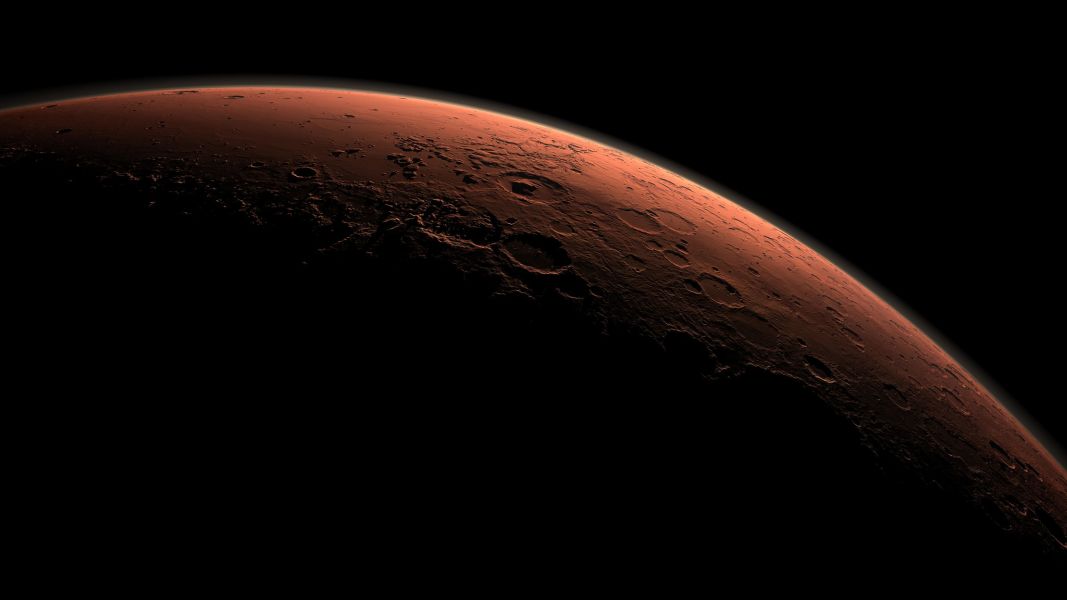
Featured Image: Mars, Daybreak at Gale Crater. Source: NASA, Flickr.com (CC).