

‘Marriage Fraud’? Reflections on Marriage of Older Queer Men in Shanghai
In April 2025, Aqiang, a renowned gay rights advocate, published an online article titled ‘Condemning Gay Elders for “Marriage Fraud” Is as Absurd as Blaming Ancient People for Not Using the Internet’ (谴责老年gay‘骗婚’, 与骂古人不上网一样搞笑). By marriage fraud (骗婚 pianhun), Aqiang was referring to the practice of gay men marrying unwitting straight women, who then become tongqi (同妻, jargon for gay men’s wives). He argued that such condemnation of the older gay generation now aged in their sixties and seventies risks overlooking the historical context. He wrote: ‘You can’t expect LGBTQ individuals to bravely embrace their true selves in an environment where homosexuality was condemned as a psychological disorder.’ While some comments seconded Aqiang’s view, others disagreed:
I refuse to sympathise with closeted gay individuals who enter deceptive marriages. Social pressure does not justify harming an unwitting spouse—that betrayal is unforgivable.
Their times may have been harsh, and their plight deserves sympathy—but that doesn’t justify dragging an innocent straight woman into a living hell, doomed to a lifetime of misery.
Aqiang’s post points to a highly morally and emotionally charged issue in gay identity politics in China. In public discourse, tongqi are often portrayed as ‘living widows’ (活寡妇), suffering emotionally and sexually while facing heightened risks of sexually transmitted infections (Tsang 2021). Consequently, gay men who marry straight women are framed as morally reprehensible, and such marriages are condemned as inherently deceptive. Yet, Aqiang’s argument complicates the picture. While not justifying mixed-orientation marriages, he introduces a generational perspective that goes beyond this sweeping condemnation: he emphasises that older gay men, too, were victims of a heteronormative society.
My essay joins Aqiang in challenging simplistic moral judgements by exploring how these marriages are understood by the older gay men themselves—individuals whose stories often remain marginalised in the public debate. In 2021 and 2022, I conducted 14 months of ethnographic fieldwork among older working-class queer men in Shanghai. These men called themselves laotou (老头, literally ‘old heads’), were aged between 60 and 85, and were mostly retired industrial workers or low-level employees from state-owned enterprises. I spoke regularly to 55 older men: 33 in their seventies or early eighties and 22 in their sixties. Forty-five of them were or had been married—some widowed or divorced. Only three informants in the 70-plus age group (born in the 1940s) had never married or had children, while among those born in the late 1950s and early 1960s, seven remained unmarried. Most of the married men lived with their spouses, while their adult children lived elsewhere. The unmarried men lived alone, either in their own homes or in rented apartments.
As retirees, these men spent much of their time with queer peers—hanging out in parks, dining together, singing karaoke, and going on local sightseeing tours. While exploring their social lives, I also became curious about their views on marriage and their wives. Did they feel guilty for marrying women who were unaware of their homosexuality? Did they see their marriage as a ‘fraud’? Did they consider their wives tongqi?
Given that many of the men with whom I worked seemed to be enjoying their lives outside marriage, it would be easy to cast judgement. Before beginning my fieldwork, as a gay man who refuses to marry a straight woman and who finds mixed-orientation marriages deeply troubling, I brought my own discomfort into the field. However, after listening to how my interlocutors talked about their marriages, I came to realise that the reality is far more nuanced than sweeping labels such as marriage fraud and tongqi would suggest.
Homosexuality as Play
Not long after I started my fieldwork, I was struck by the ubiquity of the word ‘play’ (玩 wan) in the men’s everyday language. They repeatedly described their attraction to and sexual relations with others as just ‘play’ (Shen 2024). While the men often referred to themselves as tongzhi (同志, ‘comrade’, the most common term for homosexuals in China), their invocation of play suggests that they understood their homosexuality in ways that diverge sharply from contemporary Western notions of queerness—understandings that typically place authenticity and commitment at the centre. It is in this difference that I locate their ‘queerness’.
From the perspective of identity politics and the ‘marriage fraud’ narrative, it would be easy to dismiss the men’s explanations that the homosexual dimensions of their lives are ‘just play’ as excuses or false consciousness. I realise, however, that to best understand how the men make sense of their marriages, we must take the claim of homosexuality as play seriously. Many men frequently told me things along the lines of the following:
[Homosexuality] is, after all, not the main thread [主线] of our life.
I’ve had this hobby [homosexuality] since I was young.
You can only treat this thing [homosexuality] as a dish rather than your staple food [当菜不当饭].
The culinary analogy can be interpreted as a premodern understanding of same-sex relations as a pi (癖, obsession or hobby) or an individual sexual indulgence (Chou 2000; Kang 2009; Wei 2007). The ‘homosexuality as a hobby’ trope serves as a reminder that one should keep separate one’s homosexual activities and one’s marriage.
Making a Life Together without Romance
Framing homosexual relations as play is consistent with the common perception that heterosexual marriage belongs to the realm of non-play and is a serious endeavour. While the tongqi narrative adopts romantic love as the benchmark against which to measure the authenticity of marriage, it is easy to overlook the fact that romantic love was not a significant concern in spousal selection until the 1990s, and loveless marriages among heterosexual people were quite common (Yan 2003). As Jingshu Zhu (2018) argues, the ‘marriage fraud’ discourse valorises romantic love—a myth that does not necessarily reflect the realities of marriage.
As one laotou in his seventies told me: ‘There was not so much talk about love at the time. If you were introduced by your parents or relatives to a woman and you felt she was okay and she was okay with you, then you got married.’ Instead of romantic passion, more practical concerns played into the men’s decision to enter marriage. Access to subsidised housing was one. During the Mao era, the welfare housing system in urban China was administered by state-owned enterprises. These dictated that only married employees were entitled to subsidised housing. Therefore, marriage became the mechanism through which the men obtained their own homes during a time of housing shortage before the privatisation of Shanghai’s property market.
The men I knew rarely viewed their marriages as fraudulent. Instead, they insisted that they treated their marriage as seriously as did heterosexual men. Sociologist Amy Brainer’s 2019 ethnography of queer kinship in contemporary Taiwan reveals that the middle-aged gay men she interviewed did not see their marriage with heterosexual women as fake. Referring to the widespread custom in Taiwan of non–love-based marriages, Brainer (2019: 23) notes that, ‘after all, if few people chose their spouses based on romantic love or sexual attraction, what made one marriage “fake” and another “real”?’. As my interlocutors typically agreed, marriage, for the most part, is more of a commitment to ‘pairing up and getting by together’ (搭伙过日子), and nothing to do with romance. This view was even stronger in my older informants. As the men entered the later life stage, they only grew more cynical about the romantic basis of marriage and more insistent on its material aspects. ‘What does love have to do with us at our age? How many (heterosexual) couples out there really love each other?’, a man in his late seventies once rhetorically asked me.
In addition, the men to whom I spoke typically held normative views of marriage, particularly in terms of its value for elderly care. Knowing that I was single, they often kindly encouraged me to get married, echoing a concern commonly found among parents of queer children: who will look after you when you grow old if you don’t get married and have a child? This concern is deeply felt among the older working-class generation, who have lived through the state’s retreat from the provision of subsidised elder care, leaving the family as the primary—if not sole—mechanism of support.
‘I’ve Been Cooking for Them for 40 Years’
In Travis Kong’s (2021) research on older gay men in Hong Kong, the men in disadvantaged economic conditions he interviewed were proud of their roles as fathers and husbands as they, as breadwinners in their households, worked hard to sustain their family. My interlocutors also repeatedly emphasised their contributions to their family. First, they tried their best to live up to the typical image of a caring Shanghainese man responsible for cooking, cleaning, and other household chores. Men told me things such as:
People like me take good care of everything in our household before we come out to play. Why would my wife be suspicious?
As long as you are a man who takes care of everything in your household, your wife wouldn’t propose a divorce.
I’ve been cooking for them [my wife and son] for 40 years!
Second, they handed their income over to their spouse and/or surrendered to their spouse’s authority when handling household finances. This transfer of authority helped them win their spouse’s trust. It is not uncommon that, given the income gap between men and women, my interlocutors’ wives depended on their financial support. This was especially true for the older generation affected by the mass layoffs of the late 1990s, when women workers were more likely than men to lose their jobs. Big Auntie’s wife, for instance, was laid off in the mid-1990s and later became bedridden. To support the family through the economic hardship brought on by his wife’s mounting medical costs and inadequate insurance, Auntie worked as a freelance entertainer performing drag shows—a job often stigmatised within the queer community but one that enabled his family to get by. ‘It is my support that let her live 10 more years,’ he told me. He added that his wife received minimal care from her family of origin as her mother had remarried and made her the neglected child in a new marriage. Auntie confided that his wife had known about his homosexuality and accepted it. She even got along well with his queer friends, who regularly visited their home. I believe her acceptance of his sexuality may have been, at least in part, shaped by the fact that Auntie was her sole source of support in the context of abandonment by both her blood family and the state.
The Weight of a Lifelong Marriage
Among men aged 70 and above whose homosexuality was typically framed as a hobby it is unsurprising that their marital experiences—contrary to common assumptions about pain, repression, and tragedy—were often described as peaceful. This was partly because their wives were largely unaware of their husband’s sexuality. A common explanation was generational ignorance: the wives, having grown up in an era with little public discussion of homosexuality, simply never considered the possibility. The men also emphasised that they did not display feminine mannerisms, which further deflected suspicion. Others suggested that even if their wives did harbour suspicions, their advanced age meant the women no longer saw the point in confronting the issue. Instead, they just left their husbands on their own.
For men in their sixties or newly retired, however, the situation was more complex. Several unmarried men explicitly rejected the idea of heterosexual marriage, stating that they had no interest in women and viewed mixed-orientation marriages as immoral. Some married men acknowledged that, before marriage, they were not clear about their sexual identity. As time went by, they felt a growing sense of moral discomfort or a feeling that they were harming others (害人), expressing regret for having involved women in relationships that lacked emotional or sexual authenticity from the beginning. This perspective—rare among men in their seventies and eighties—reflects a generational shift in moral judgement and self-awareness.
‘If I had entered this circle before I got married, I wouldn’t have married in the first place,’ Hua, a 63-year-old man, told me. While he did not characterise his marriage as unbearable, it was not a life he would have chosen if given the chance. Hua was not entirely sure whether his wife knew about his sexuality. According to several men, wives in their generation seemed more conscious of their husband’s queerness than those of the older cohort, but such awareness was rarely verbalised. In my fieldwork, I encountered only one instance where a wife explicitly asked her husband whether he was homosexual and he denied it.
This silence may be rooted in structural vulnerability. Divorcing a husband would likely place a woman in economic jeopardy (Zhu 2018). Chinese women generally earn less than men and their husband’s income often constitutes a vital source of support. Some wives, however, appear to leverage their awareness of their husband’s queerness to exert control. This bargaining power manifested in financial arrangements—such as demanding husbands hand over their full income while returning only a small allowance—and domestic expectations. Several men confided that their marriages were difficult not because of sexual repression but because of domineering wives who assigned them the bulk of household chores. Some felt their queerness put them in a position of subjugation within the marital relationship.
Hua, for instance, had been cooking for his wife and son for decades. He longed for a life outside domestic obligation. A few months after we met, he had been encouraged by Monkey King—another man in a similarly strained marriage—to travel around China or spend a few months away from Shanghai. At one point, Hua seriously considered joining a queer friend in Shenzhen to help run a flower shop. When I asked how his wife and son would respond to his departure, he snapped: ‘I’ve been cooking for them for 40 years!’
Hua is not alone. Once when Monkey King was talking about his vision for his life in the future, he shrugged off the idea that he would need to babysit his grandkids if his only son were to marry. Another informant seconded him and grumbled: ‘I don’t want to babysit either. I’ve been “a cow and a horse” [做牛做马] for them for so many years. Now that I’m old, do I still have to work for them?’
However, despite the insouciance they flaunted about the possibility of abandoning their family duties after retirement, men like Hua often did not have much of a choice when the time came. Hua’s plan was interrupted. Several months after he made up his mind to travel to Shenzhen, Shanghai was thrown into a sweeping lockdown due to surging Covid cases. The plan was further placed on hold by his son’s upcoming wedding and the expectation that Hua would soon help babysit a grandchild. Once again, familial duty won over personal desire. I believe that Monkey King, like Hua, would eventually have to shoulder the family duty he had been assigned for decades no matter how genuine it might sound that he would shed those responsibilities once and for all. As Monkey himself sometimes lamented, he could only afford to treat his queerness as merely play since it was not the ‘main thread’ of his life.
Backward Subjects
Do my interlocutors identify their marriages as fraudulent? And to what extent does this question matter? As I have shown, it is reductive to frame their marital experiences simply as ‘marriage fraud’. Public discussions, as in the comments to Aqiang’s article, often cast older queer men as backward subjects, trapped by historical conditions and morally dubious practices. Similarly, for many younger gay men who reject the older identity of tongzhi in favour of tongxinglian (同性恋, homosexual)—a once-medicalised label now reappropriated as a badge of resistance (Zhou 2022)—my interlocutors’ understanding of homosexuality as ‘play’ appears retrogressive and out of tune with a more progressive queer politics in China.
Yet, I suggest that these experiences should not be dismissed as merely generational residues. The men’s framing of queerness as play and their ambivalent negotiations of mixed-orientation marriages may resonate with the lives of countless queer individuals in small towns and rural areas, whose material conditions make it impossible to live outside heteronormative expectations and whose stories we barely know. In this sense, their reflections matter not because they confirm or refute the charge of ‘marriage fraud’, but because they bring into view ‘backward’ voices that are systematically excluded from progressive queer discourses.
References
Aqiang 阿强. 2025. ‘谴责老年gay“骗婚”, 与骂古人不上网一样搞笑 [Condemning Gay Elders for “Marriage Fraud” Is as Absurd as Blaming Ancient People for Not Using the Internet].’ 阿强同志 [Comrade Aqiang], 22 April. mp.weixin.qq.com/s/EYH1RDhmIBUhrEcTTV4WkA.
Bao, Hongwei. 2018. Queer Comrades: Gay Identity and Tongzhi Activism in Postsocialist China. Copenhagen: NIAS Press.
Brainer, Amy. 2019. Queer Kinship and Family Change in Taiwan. New Brunswick, NJ: Rutgers University Press.
Chou, Wah-shan. 2000. Tongzhi: Politics of Same Sex Eroticism in Chinese Societies. New York, NY: Haworth Press.
Kang, Wenqing. 2009. Obsession: Male Same Sex Relations in China, 1900–1950. Hong Kong: Chinese University of Hong Kong Press.
Kong, Travis S.K. 2021. ‘Be a Responsible and Respectable Man: Two Generations of Chinese Gay Men Accomplishing Masculinity in Hong Kong.’ Men and Masculinities 24(1): 64–83.
Shen, Qing. 2024. ‘Just for Fun: Playfulness as Self-Entrapment among Elderly Working-Class Queer Men in Shanghai.’ Social Analysis 68(4): 76–94.
Tsang, Eileen Y. 2021. ‘A “Phoenix” Rising from the Ashes: China’s Tongqi, Marriage Fraud, and Resistance.’ The British Journal of Sociology 72(3): 793–807.
Wei, Wei. 2007. ‘“Wandering Men” No Longer Wander Around: The Production and Transformation of Local Homosexual Identities in Contemporary Chengdu, China.’ Inter-Asia Cultural Studies 8(4): 572–88.
Yan, Yunxiang. 2003. Private Life under Socialism: Love, Intimacy, and Family Change in a Chinese Village, 1949–1999. Stanford, CA: Stanford University Press.
Zhou, Benson Zhiqiu. 2022. ‘Besides Tongzhi: Tactics for Constructing and Communicating Sexual Identities in China.’ Journal of Linguistic Anthropology 32(2): 282–300.
Zhu, Jingshu. 2018. ‘“Unqueer” Kinship? Critical Reflections on “Marriage Fraud” in Mainland China.’ Sexualities 21(7): 1075–91.
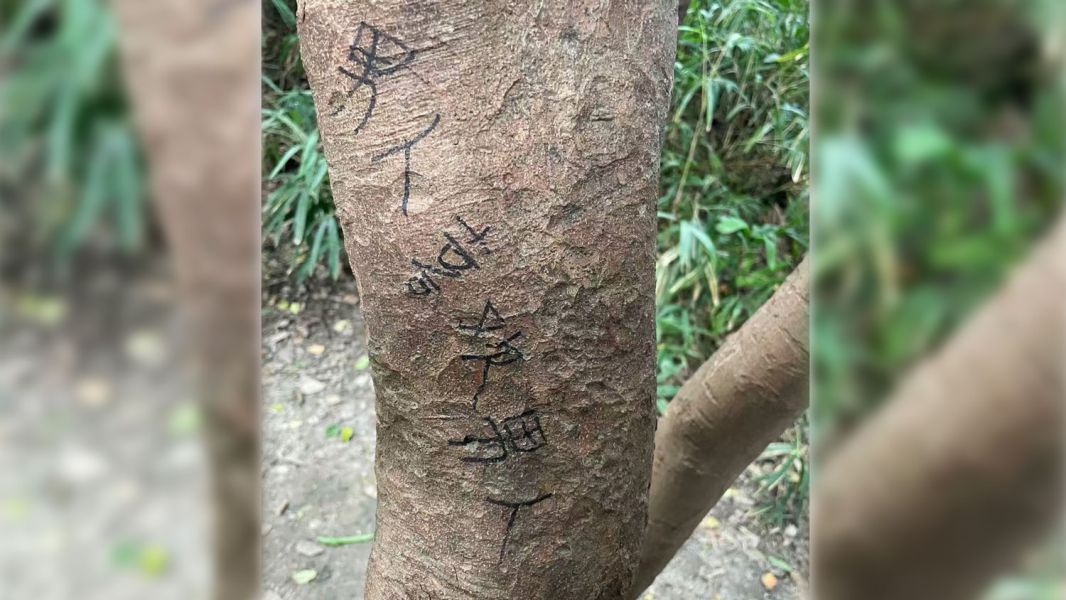
Featured Image: Carving reading ‘Men like men’ on a tree trunk in a Shanghai park frequented by the queer men at the centre of this essay, 2021. Source: Qing Shen (CC).