

Rural Spaces of Digital Labour
Taobao Villages and New Cycles between Tradition and Platformisation
As I walked through the village of Junpucun in Guangdong Province, I was struck by how different rural China was from idyllic images of the countryside as a peaceful, natural space. In the narrow streets of the village, tuk-tuks zipped between courtyard houses, with packages stacked everywhere. Shutters were slightly lowered, and the sound of sewing machines echoed in the background. A chicken wandered among the packages next to a brand new Porsche, which seemed to be the latest model. It was evident that this rural area was undergoing significant changes. What stood out the most was not the speed of these transformations, but their consistency: the way infrastructure and domestic rural lives were intertwined in their ordinariness.
In Junpucun, what was once a peripheral rural settlement has, over the past 15 years, been reshaped by the rise of e-commerce: courtyard houses double as storage spaces and daily life unfolds amid flows of goods, data, and labour. The place is one of a vast network of ‘Taobao Villages’, a model of rural revitalisation promoted through the integration of online sales and digital logistics into the local economic system. Rather than standing outside processes of technological modernisation, Taobao Villages exemplify a form of modernisation that unfolds through what has been conceptualised as ruralisation. They materialise a trajectory in which digital platforms, logistics infrastructures, and data-driven forms of governance are territorialised through rural spaces and social relations, rather than through the canonical urban sites that usually anchor narratives of technological change. In this sense, Taobao Villages align with—and empirically ground—recent scholarly efforts to decentre the dominant discourse of planetary urbanisation and to redirect analytical attention towards the rural as an active and generative arena of contemporary transformation, as advanced in work on global rural geographies (Roy 2016; Gillen et al. 2022; Wang et al. 2023; He and Zhang 2022).
I describe this process as recursive not because it signals a nostalgic return to an untouched rural past, but rather because it marks a re-entry of capital and technology into the countryside, where the residues of industrial and urban modernity are reorganised to generate new cycles of value (Luo and He 2017). The countryside thus becomes the ground on which global capital seeks to reinvent itself, folding back into spaces once marginalised by modernisation. This recursion is at once spatial (from city to countryside), technical (from factory to platform), and social (from wage labour to family-based and reproductive work). In this sense, Taobao Villages offer a lens through which to examine the socio-spatial reconfiguration of the countryside within the broader logic of platform capitalism (Mezzadra et al. 2024; Barns 2020; Mörtenböck and Mooshammer 2021). The broader tendency of recursive ruralisation finds its most tangible expression in the trajectories of return migration that followed China’s industrial crises. What began as a conceptual pattern—capital and technology folding back into the countryside—has also been a lived historical process. The next section traces how this return unfolded through the reconfiguration of labour and space, revealing how Taobao Villages such as Junpucun emerged from the debris of export-oriented urbanisation.
The Return: From Factories to Platform Courtyards
Official recognition as a Taobao Village requires that at least 10 per cent of households, or a minimum of 100 online shops, actively operate on Taobao with an annual turnover exceeding RMB10 million (Wei et al. 2020; AliResearch 2014–16). This status grants institutional visibility and access to state-led and platform-led support—such as logistics infrastructure, training, credit, and inclusion in rural e-commerce programs—but simultaneously binds local economies more tightly to proprietary platforms and logistics networks, reinforcing asymmetric dependencies and forms of infrastructural and algorithmic control.
Through this scheme, local economies and labour practices become embedded within the circuits of digital accumulation, revealing how the rural is not outside modernity but one of its recursive engines (Woods et al. 2021). However, the story of Taobao Villages does not begin with the platform itself, but with a return: bodies circulating between factory dormitories and ancestral courtyards, bringing with them fragments of urban work, habits of speed, and the memory of industrial repetition. The 2008 Global Financial Crisis accelerated this movement: with the collapse of export-oriented factories along the Pearl River Delta, millions of workers returned to the countryside. Some reinvented themselves as precarious entrepreneurs in search of livelihoods that could absorb both their skills and their debts. The countryside thus became a testing ground for a new phase of Chinese modernisation, characterised by digital infrastructure and informal enterprises (Wallis 2014).
In Junpucun, these trajectories have materialised in domestic experiments: what began as a survival tactic—selling surplus clothing online—has gradually reorganised the spatial and social fabric of the village (Wang 2020). Here, the platform does more than connect sellers and buyers: it reconfigures the relationship between labour, life, and space, translating kinship into logistics and domestic intimacy into productive time (Zhang 2024). Digitalisation does not erase the rural, but it reabsorbs and reorganises it, revealing a reverse of urban modernity: a techno-spatial fix that externalises the frictions of industrial capital into the peripheries (Wei et al. 2020).
This reconfiguration echoes the long arc of Chinese modernisation, in which labour has been repeatedly reorganised through successive regimes of urbanisation. From the collectivised labour of the Maoist communes to the institutional bifurcation of citizenship under the hukou system and, later, the ‘three rural issues’ (三农)—namely, agriculture, countryside and farmers—identified by Hu Jintao and Wen Jiabao in 2006, the countryside has persistently functioned as both the margin and the motor of China’s development (Day 2013; Bray 2013; Jacka 2017). State-led investment in hard and soft infrastructure—drinking water, electricity, broadband internet, health insurance, and social assistance—has often deepened structural dependency on state provisioning and urban-centric development rather than resolving it (Wen 2021; Zhang and He 2022).
The platform economy represents a new iteration of this recursive dynamic as it integrates global logistics networks elsewhere (Steinberg 2025). By embedding these networks within the domestic sphere, Alibaba’s Taobao changes kinship into circulation and reproductive labour into a source of value extraction. In this sense, it extends Harvey’s (2001) spatial fix into what might be called a techno-spatial loop: a transformation by which capital returns to the peripheral areas to remake itself in three senses—spatially, as a return from cities to rural peripheries; technically, as a shift from industrial factories to digital mediation; and socially, as a shift from wage labour to domestic and reproductive labour.
Rather than reading Taobao Villages as instances of rural revitalisation or bottom-up development, they can be interpreted as laboratories of platformised reproduction, sites where the domestic, entrepreneurial, and logistical dimensions converge (Zhang 2024; Wang et al. 2021). Following Latour’s notion of engendering, these processes are both generative and reproductive: they blur the boundary between production and care, between the economic and the affective (Latour 2018; Miranda 2019). Through such recursive circuits, global capital discovers new terrain for expansion while rural life articulates new rhythms of persistence and adaptation (Latour 1993).
The return of migrant workers after 2008 therefore indexes a broader structural phenomenon of what may be described as looped modernisation: a nonlinear temporal and spatial reorganisation in which the exhausted forms of industrial capitalism are revived precisely in the peripheries that they once supplanted. Far from disappearing, industrial capitalism re-emerges through new configurations (digital platforms, logistics, and precarious labour) in the margins that it had previously left behind (Gillen et al. 2022).
The Clothing Village: Junpucun at the Origins of Rural Taobao
Junpucun offers an illustration of how e-commerce’s penetration of rural China materialised spatially and socially. As one of the first officially recognised Taobao Villages, Junpucun provides a concrete vantage point from which to observe how the platform economy reorganises everyday life and labour in the countryside. Often described as a ‘model’ Taobao Village, it was among the first to embody the promise of digital rural modernisation while exposing its contradictions (Lee and Mueller 2017). The village offers a tangible site through which to observe how platformisation operates as a recursive form of Chinese modernisation—a process in which the logic of industrial production, urban migration, and global capital returns to the countryside in transformed, digitised forms (Wang 2020; Steinberg 2025).
Located in the hinterland of Jieyang, a city in Guangdong Province beyond the main corridors of the Pearl River Delta, Junpucun lies at the periphery of China’s great urban industrial zone (Liao and Zhang 2024). Its distance from the metropolitan core is not simply geographic but also structural: Jieyang is known less for innovation than for dispersed manufacturing clusters and enduring patterns of out-migration. Until recently, Junpucun itself was an almost anonymous settlement. As Zhang Xin (a pseudonym, as are all other personal names in this essay), a lifelong resident, recalled during an interview in March 2024, she once felt ashamed of her ‘rural origins’. Her sentiment began to shift around 2009, when the digital economy started to take root and the village was reimagined as a site of possibility rather than backwardness.
Here, before the Global Financial Crisis, most households had at least one family member employed in Guangzhou’s garment factories. When international demand declined sharply, workers such as Mr Xu, who had spent years sewing and finishing jeans on the factory line, returned to their villages and began experimenting with selling surplus clothing online. What began as an improvised alternative to migrant labour soon evolved into a household-based business, transforming living rooms and courtyards into multifunctional spaces of production, storage, and packaging (Qi 2019).
Returning inhabitants often generate new forms of entrepreneurship, yet their success depends on infrastructure and networks unevenly distributed across the countryside (Pahl 1965; Murphy 2002; Zhao 2002; Ma 2002; Wahba and Zenou 2012). Since the early 2000s, state investments in digital infrastructure such as internet connectivity have enabled rural residents to participate in online marketplaces and support this entrepreneurship. Kenney and Zysman (2016) identify this as the latest stage in the digital economic transition, while others emphasise how platforms consolidate power during crises, whether financial recessions or pandemics, by reorganising not only production systems but also domestic life (Steinberg 2025).
The magnitude of these transformations becomes particularly evident during China’s online shopping festivals. On 11 November 2023, Singles’ Day or Double Eleven, online sales in China hit RMB1.15 trillion (US$158 billion)—more than four times the spending during Cyber Week (Black Friday to Cyber Monday) in the United States. In Junpucun, shops nearly sold out by midnight, while across 235 counties, RMB1 billion in payments and 657 million parcels were processed, revealing how deeply rural spaces are now woven into global circuits of digital production and consumption.
In little more than a decade, e-commerce has transformed rural China, producing both new opportunities and profound socio-spatial shifts (Lee and Mueller 2017; Wang 2020). Emerging from marginal and unplanned areas, Taobao Villages demonstrate that technological innovation is not simply imposed from above but can unfold through grassroots adaptation and everyday improvisation (Cowen 2014; Safina 2023)—what Choplin and Pliez (2015: 16) describe as ‘globalisation from below’.
Everyday Practices: Space, Labour, and Infrastructure
While these structural processes and statistics capture the magnitude of rural digitalisation, they only partially reveal how platformisation is lived, embodied, and spatialised. To grasp its everyday implications, it is necessary to descend into the textures of daily life in Junpucun—to observe how families, in their courtyards and workshops, translate digital infrastructure into their spatial and social routines. Entering Junpucun through the main gate, marked with the characters ‘电子商务’ (‘e-commerce village’), one encounters not simply a village transformed, but a landscape where rurality is being reconfigured. Junpucun, once an off-the-map village reliant on traditional subsistence agriculture, has, since 2009, become a thriving e-commerce hub hosting more than 1,100 online shops and processing hundreds of thousands of orders each month. Here, courtyards, alleys, and family homes are integrated into global supply chains, demonstrating how the rural adapts to globalisation through its local practices. Junpucun is a site where the theoretical notions of platformisation, recursion, and engendering can be observed, tested, and reformulated through situated practices (Figures 2 and 4).
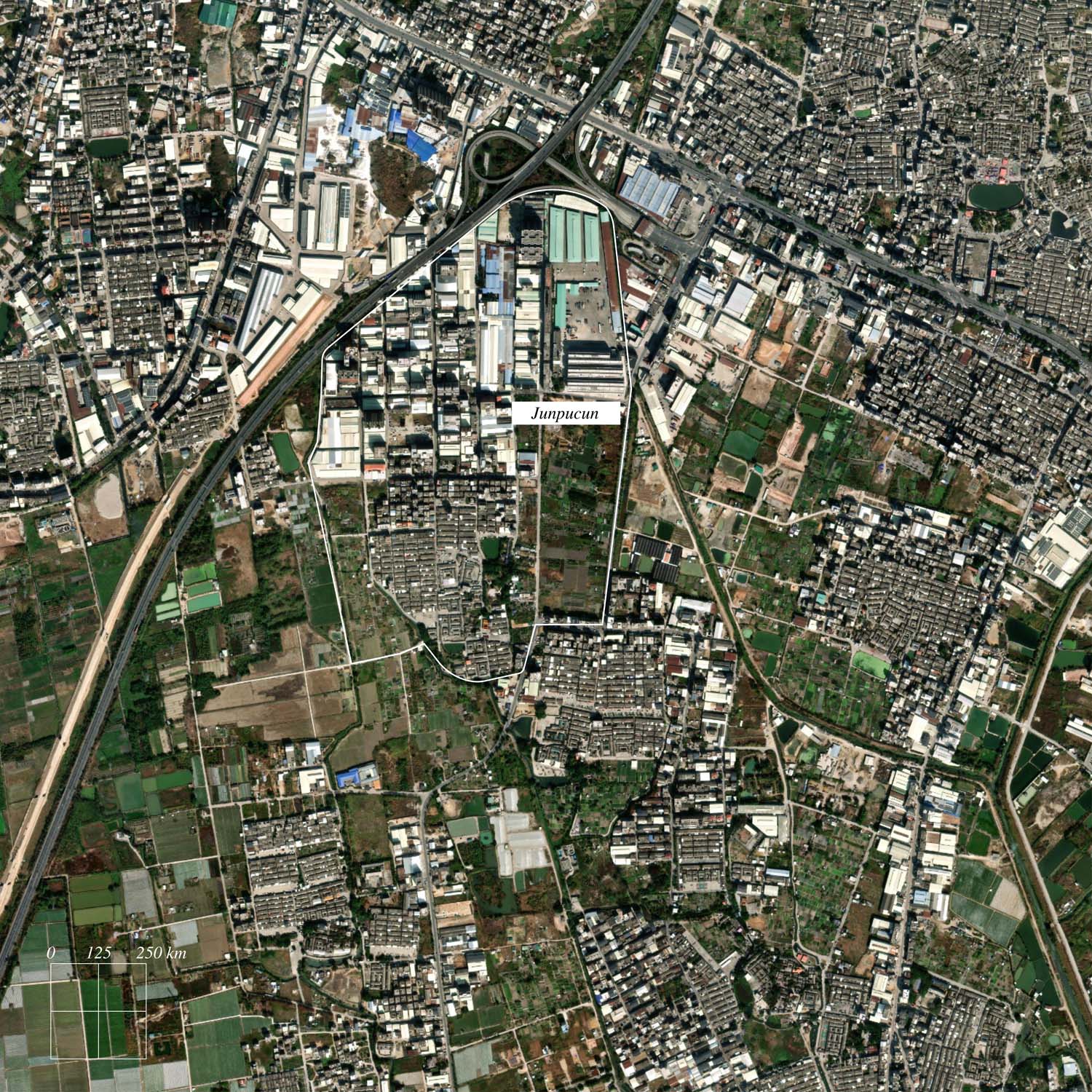


To understand this entanglement, I collected a series of micro-stories through direct interviews with rural entrepreneurs, offering situated accounts of how structural transformations are experienced, negotiated, and interpreted in everyday life. One example comes from Xu Zhuangbin, 35, who successfully launched his boutique on Taobao after returning from years of factory work in Guangzhou. On reuniting with his family in Junpucun, he began selling personalised T-shirts, sourcing materials from nearby Jieyang and adapting products to current trends. This case illustrates how family labour replaces factory discipline through domestic digitalisation—visible in his workspace—which exemplifies the hybrid use of domestic environments: a 40-square-metre shop with a packaging room, an outdoor finishing area, and a small room where his wife manages online sales across three computers, assisted by cousins and parents.
This organisation of labour in Xu’s family makes visible engendering—the generative process through which production and reproduction are inseparable (Miranda 2019). In Junpucun, productive work, such as sewing, packaging, and shipping, is sustained by reproductive work, such as care, cleaning, feeding, and emotional management, largely carried out by women. Following Cavallero et al. (2022), this can be read as a form of feminist domestic infrastructure—a system that extracts value from pre-existing gender roles while reconfiguring them through digital mediation. While men often handle procurement, production, or logistics, women dominate the front-facing roles of sales, communication, and live-streaming—tasks that demand not only technical literacy but also affective performance. As Zhang and Hjorth (2017) observe, these broadcasts rely on ‘affective proximity’—a sense of relational authenticity that turns domestic labour itself into a form of marketable content.
The overlap of reproductive and productive time reveals how digital capitalism reorganises not only labour but also life itself. Family labour replaces wage labour; domestic time is synchronised with algorithmic time. The home becomes an infrastructural interface where reproductive rhythms are absorbed into the 24/7 temporality of digital capitalism—a temporal regime characterised by constant availability and algorithmic responsiveness (Crary 2013; Liu 2024). Xu Zhuangbin’s wife, for example, works for several hours in the morning—when engagement is highest for live-streaming—and spends the afternoon caring for their children while continuing to chat with clients online.
Similarly, the case of Huang Jiexi, 30, illustrates the compression of time characteristic of platform labour. After leaving a fabric factory where he had worked—and with which he still collaborates—Huang opened an online shop selling jeans in 2016. He now runs two stores side by side while living upstairs with his wife and two children. His shop offers a limited yet varied selection of jeans and has recently expanded into customisation, featuring prints, beads, and other details, catering to younger buyers. The expanded premises include multiple storage and sewing rooms, as well as a personal office equipped with four computers and an improvised photo studio. At the entrance, delivery riders come and go throughout the day, collecting packages destined for 13 logistics depots just outside the village. As Huang explains, he ‘never really has time’: he works on demand, often replying to clients late at night or during meals. Such perpetual connectivity reflects a new organisation of labour in which the platform dictates the rhythm of everyday life, effectively transforming family time—once marked by rest and domestic intimacy—into potential moments of productivity.
Most e-commerce boutiques in Junpucun specialise in clothing produced in nearby factories. Many owners previously worked in those factories or maintain connections to them, enabling rapid responses to market trends. On average, a wholesale bag shop sells about 20 pieces per day, but demand can rise to 200 during shopping festivals such as Singles’ Day. Entrepreneurs generally fall into two categories: intermediaries, who trade without owning stock, and producers, who rely on family labour and flexible workshops. Many are aged in their twenties and are driven by aspirations for independence through digital commerce.
To launch an online shop, most families incur some degree of debt by purchasing computers, initial stock, and advertising credits on the platform. In some cases, Alibaba itself provides start-up loans or small grants to encourage rural entrepreneurship, reinforcing local dependence on the company’s financial and logistical ecosystem. However, the initial invested capital remains relatively low: households can repurpose their existing homes as workplaces or build small workshops within their courtyards without needing to buy land or rent additional commercial space (Wang 2020; Wang et al. 2021; Luo and He 2017). Their success, however, depends less on entrepreneurial skill than on algorithmic visibility and consumer reviews—factors largely beyond individual control. The celebrated image of autonomy thus conceals a regime of auto-exploitation, in which family members work collectively, often effectively unpaid, under the pressure of constant connectivity and uncertain returns (Srnicek 2016; Zuboff 2019); the boundary between ‘being one’s own boss’ and ‘being a slave to one’s own business’ is fragile.
Moreover, the visible sphere of online entrepreneurship conceals multiple layers of dark labour. The garments sold in Junpucun are typically produced in small, subcontracted workshops or informal factories in nearby towns, where working conditions remain precarious and wages low. Taobao Villages thus externalise the most labour-intensive phases of production while profiting from their reduced costs—a distributed, digital version of the putting-out system that recalls pre-industrial labour arrangements (Zhang 2023; Gray and Suri 2019).
Agriculture, though not entirely abandoned, has receded to fragmented, semi-subsistence practices maintained by older generations. As Mr Zhu explained to me: ‘Nobody seems to care anymore.’ He continues to farm because, as he put it: ‘Chinese villages remain rural, and their residents still have a strong attachment to the land.’ His words, interrupted by chickens pecking at discarded packaging waste, encapsulate the contradictions of a rurality reshaped by global flows yet still tied to tradition. These tensions are not remnants of backwardness, but expressions of Junpucun’s generative hybridity, which is reflected in its daily rhythms. While the village seems quiet in the early morning, activity picks up around 11 am when buyers from all over China begin placing orders. Shops extend onto the streets, blurring the boundaries between inside and outside—a pattern typical of rural China (Day 2013).
Huang Zhang is one of the 13 logistics entrepreneurs. He opened his business in 2020 on the outskirts of the village—forced to move due to the tripling cost of land in Junpucun. His company employs 40 people—primarily aged between 16 and 24 years. The internal layout is open and unobstructed except for structural pillars supporting the metal roof. The metal shelves that typically furnish warehouses are replaced here with large horizontal surfaces that fill up with products, emptying within hours before being rapidly restocked (Figures 2 and 3). This architecture is reduced to its essentials: a vast stage where space is defined not by the human body but by the objects that fill it. In these post-Anthropocene settings of forklifts, pallets, and scanners, human life persists: workers move, rest, and gather, and even a small tea table signals the quiet endurance of human sociability (Young 2019; Koolhaas and OMA 2020).
Recursive Ruralisation: Infrastructural Intimacies of Labour and Kinship
The intimate spaces of Junpucun’s domestic economy exemplify what this essay defines as recursive ruralisation: a cyclical process through which digital infrastructures regenerate earlier forms of social organisation while simultaneously producing new dependencies. Junpucun is shaped by strong infrastructural and logistical dynamics, where everyday practices continuously balance formal and informal elements. Within the village, activities follow partially standardised patterns yet remain profoundly improvised: human labour is entangled with the material life of boxes and products, while new spatial configurations emerge within and around domestic structures. This section argues that Junpucun’s infrastructural and kinship arrangements constitute a form of platformised reproduction, in which social relations themselves operate as infrastructure. The result is a palpable sense of domestic density and intensity. Boundaries between inside and outside blur; products are stored within homes and courtyards and living rooms often double as workstations or packing areas. Many of these spaces lack architectural refinement, instead reflecting a logic of bricolage and adaptation. Buildings open like unfinished works, becoming arenas for layered uses—what Gregson et al. (2018) and Chua et al. (2018) describe as live–work architectures.
The spaces of Junpucun are thus intricate and multiscale. The first layer is that of sales, reduced to a few computers and a makeshift photo setup for displaying products online (Figure 5). The second involves production, finishing, and packaging, where semi-finished items are prepared to meet the accelerating demands of digital markets. Courtyards and backyards function as loading and unloading zones, while other former agricultural spaces now serve as sites of negotiation and coexistence among the small, family-run enterprises making up the village’s economic fabric (Figures 6 and 7). The fourth layer is living: the traces of daily life, including water usage, spatial maintenance, and domestic care, which make visible the persistent presence of habitation. Commercial and residential functions thus overlap, producing a porous ecology of labour in which living and working cannot be disentangled. Yet, Junpucun’s space extends beyond its administrative boundaries: its logistical flows connect it to distant industrial geographies and global markets, transforming the village into a hybrid logistical hub—a node mediating between the spaces of distribution and those of production (Polanyi 2001; McFarlane and Waibel 2012; Chua et al. 2018).
This entrepreneurial landscape is sustained by a deep reorganisation of labour—one that reactivates kinship as the central infrastructure of production. This recalls what Fei Xiaotong identified as the differential mode of association characterising traditional Chinese rural society. Here, familism operates as both social glue and productive mechanism: labour is divided along family lines, and the family unit itself is transformed into an economic entity (Yan 2016). Women manage online sales and customer relations, cousins and siblings handle packaging and delivery, while parents contribute care work (looking after children, maintaining the home). This social infrastructure reveals a clear gendered division of labour, in which women directly engage in online sales and live-streaming on platforms such as TikTok, WeChat, and RedNote, resulting in a hybrid work dimension in which affective, reproductive, and digital labour are intricately intertwined.
The resulting configuration represents a hybrid labour infrastructure, in which affective, reproductive, and digital labour converge. Labour is not merely economic, it is also relational, embodied, and intergenerational. The digitalisation of the rural economy does not erase earlier modes of labour organisation but rearticulates them through new technological mediations. As feminist scholars Cavallero et al. (2022) argue, the casa como laboratorio, or ‘home workshop’, becomes an analytical stance: the domestic space operates as a site where production and reproduction collapse, generating value precisely through their indistinction.
In a sense, e-commerce activities coexist with traditional rural practices without entirely replacing them, as is evident in Mr Zhu’s efforts to cultivate tomatoes. Farming and digital practices also coexist through the mediation of kinship obligations and communal reciprocity, creating what we can call a familist economy of coexistence. Unlike the post-human logistical landscapes described by Lyster (2016) or Young (2019), Junpucun’s infrastructure remains deeply social, organised not only by barcodes and boxes but also by kinship, gender, and generational aspirations.
This hybridity is not merely spatial but also temporal and social. Returning migrants bring back from the city skills, savings, and networks, reshaping family economies and rural subjectivities (Murphy 2002; Yan 2016). Rural time, once synchronised with agricultural cycles, is now aligned with the always-on temporality of online commerce, especially during shopping festivals such as Singles’ Day. These overlapping temporalities give rise to new ways of living: entrepreneurial, precarious, and affectively driven, but still beholden to the memory of agrarian rhythms. The reinvention process is thus twofold. First, a counter-migration occurs—from urban to rural—through which migrants reinsert urban forms of labour and management into village life (He and Zhang 2022). Second, the notion of infrastructure itself is redefined beyond its technical domain: in Taobao Villages, people become infrastructure (Simone 2022). Rather than automation replacing human work, social relations, guanxi networks, and everyday improvisation become the scaffolding of the digital economy. As Choplin and Pliez (2015: 17) note: ‘It is often in the most ordinary and invisible places that globalisation takes root and consolidates.’
In Junpucun, residents move within a complex network of tasks, spaces, and relationships that support a form of social infrastructure that is both local and global. The platformised village functions like a recursive machine, absorbing global capital into domestic life and reformulating it through the enduring logic of family and care, following a recursive ruralisation. In this cyclical process, the global reabsorbs itself into the rural to create value. The outcome is a platform-based labour system that relies heavily on family networks and domestic spaces. Within this system, work often takes the form of digital sharecropping (Terranova 2022; Scholz 2019), in which villagers produce content and goods for digital platforms without owning the means of distribution or data. Although this model might be framed as a form of individual entrepreneurship, in practice, it reproduces dependence on the platform’s infrastructure and algorithms (Srnicek 2016; Zhang 2023). What emerges is a form of rural cyber-feudalism, in which the premise of rural autonomy conceals new forms of algorithmic dependency and exploitation—not the disappearance of the rural, but its reinvention as the recursive substrate of platform capitalism (Durand 2024; Zuboff 2019).


Re-Embedding Capitalism in the Countryside
This essay argues that Taobao Villages such as Junpucun should be understood neither as peripheral residue of China’s urbanisation nor as straightforward exemplars of rural revitalisation, but as strategic sites in which platform capitalism is materially re-embedded in the countryside. Through the concept of recursive ruralisation, my analysis has shown how digital platforms, logistics infrastructure, and family-based labour reorganise rural space by reactivating historically sedimented forms of kinship, domesticity, and informal production, while simultaneously generating new regimes of dependency and exposure (Gillen et al. 2022; He and Zhang 2022; Woods et al. 2021).
In Junpucun, the ‘household’ emerges as a key infrastructural unit, expanding conventional understandings of infrastructure beyond technical systems to include intimate, domestic, and reproductive arrangements (Cavallero et al. 2022; Simone 2022). Approaching the home as infrastructure foregrounds the political significance of intimacy and unsettles the boundary between public and private, revealing reproductive labour as not only work but also a central component of the social infrastructure that sustains platform economies (Federici 2012; Fortunati 2025; Cossutta 2023; Zhang 2024). Rather than erasing rurality, platformisation rearticulates it as a constitutive socio-spatial formation of contemporary capitalism, in which global circuits of value are anchored in gendered, familial, and improvised rural forms of life (Srnicek 2016; Mezzadra et al. 2024; Wang et al. 2021).
Featured Image: Products ready to be shipped, May 2024. Source: Sofia Leoni.
References
AliResearch. 2014–16. Research Report on China’s Taobao Villages. Hangzhou: Alibaba.
Arendt, Hannah. 1970. The Human Condition. Chicago, IL: University of Chicago Press.
Barns, Sarah. 2020. Platform Urbanism: Negotiating Platform Ecosystems in Connected Cities. London: Palgrave Macmillan.
Bonino, Michele, Francesca Governa, Maria Paola Repellino, and Angelo Sampieri. 2019. The City After Chinese New Towns: Spaces and Imaginaries from Contemporary Urban China. Basel, Switzerland: Birkhauser.
Bray, David. 2013. ‘Urban Planning Goes Rural: Conceptualising the “New Village”.’ China Perspectives 3: 53–62.
Cavallero, Luci, Veronica Gago, and Liz Mason-Deese. 2022. La Casa como Laboratorio [The Home Workshop]. Buenos Aires: CLACSO.
Choplin, Armelle, and Olivier Pliez. 2015. ‘The Inconspicuous Spaces of Globalization.’ Journal of Urban Research: Inconspicuous Globalization 12: 16–31.
Chua, Charmaine, Martin Danyluk, Deborah Cowen, and Laleh Khalili. 2018. ‘Introduction: Turbulent Circulation: Building a Critical Engagement with Logistics.’ Environment and Planning D: Society and Space 36(4): 617–29.
Cossutta, Carlotta. 2023. ‘Le case sono infrastrutture? Riproduzione, intimità e lavoro negli spazi domestici [Are Houses Infrastructure? Reproduction, Intimacy, and Labour within Domestic Space].’ Scienza & Politica: Per Una Storia Delle Dottrine 35(69): 73–88.
Cowen, Deborah. 2014. The Deadly Life of Logistics: Mapping Violence in Global Trade. Minneapolis, MN: University of Minnesota Press.
Crary, Jonathan. 2013. 24/7: Late Capitalism and the Ends of Sleep. London: Verso.
Cuppini, Niccolò, and Irene Peano. 2022. Un Mondo Logistico [A Logistic World]. Milano: Ledizioni.
Day, Alexander. 2013. The Peasant in Postsocialist China: History, Politics and Capitalism. Cambridge, UK: Cambridge University Press.
Durand, Cédric. 2024. How Silicon Valley Unleashed Techno-Feudalism: The Making of the Digital Economy. London: Verso.
Federici, Silvia. 2012. Revolution at Point Zero: Housework, Reproduction, and Feminist Struggle. New York, NY: PM Press.
Fortunati, Leopoldina. 2025. The Arcana of Reproduction: Housewives, Prostitutes, Workers and Capital. London: Verso.
Gillen, Jamie, Tim Bunnell, and Jonathan Rigg. 2022. ‘Geographies of Ruralization.’ Dialogues in Human Geography 12(2): 186–203.
Gray, Mary L., and Siddharth Suri. 2019. Ghost Work: How to Stop Silicon Valley from Building a New Global Underclass. Boston, MA: Houghton Mifflin Harcourt.
Gregson, Nicky, Mike Crang, and Constantinos N. Antonopoulos. 2018. ‘Holding Together Logistical Worlds: Friction, Seams and Circulation in the Emerging Global Warehouse.’ Environment and Planning D: Society and Space 35(3): 381–88.
Guillibert, Paul. 2023. Exploiter les Vivants: Une Écologie Politique du Travail [Exploiting the Living: A Political Ecology of Labour]. Paris: Éditions Amsterdam.
Harvey, David. 2001. Spaces of Capital: Towards a Critical Geography. New York, NY: Routledge.
He, Shenjing, and Yongsheng Zhang. 2022. ‘Reconceptualising the Rural through Planetary Thinking: A Field Experiment of Sustainable Approaches to Rural Revitalisation in China.’ Journal of Rural Studies 96: 42–52.
Jacka, Tamara. 2017. ‘Translocal Family Reproduction and Agrarian Change in China: A New Analytical Framework.’ The Journal of Peasant Studies 45(7): 1341–59.
Kenney, Martin, and John Zysman. 2016. ‘The Rise of the Platform Economy.’ Issues in Science and Technology 32(3): 61–69.
Koolhaas, Rem, and OMA. 2020. Koolhaas. Countryside, A Report. New York, NY: Taschen.
Latour, Bruno. 1993. We Have Never Been Modern. Cambridge, MA: Harvard University Press.
Latour, Bruno. 2018. Down To Earth: Politics in the New Climatic Regime. Cambridge, UK: Polity Press.
Lee, Dennis, and Jens Mueller. 2017. ‘Junpu “Taobao” Village: A Validation of Porter’s Diamond Model?’ Journal of Asia Entrepreneurship and Sustainability 13(1): 51–72.
Liao, Zhenjie, and Lijuan Zhang. 2024. ‘Analyzing and Predicting the Urbanization and Ecological Resilience Coupling and Coordination of Guangdong Province.’ Humanities and Social Sciences Communications 11: 1322.
Liu, Lizhi. 2024. From Click to Boom: The Political Economy of E-Commerce in China. Princeton, NJ: Princeton University Press.
Liu, Yansui, and Haolou Long. 2014. ‘Transformation of Rural China.’ In The Geographical Transformation of China, edited by Michael Dunford and Weidong Liu, 88–100. London: Routledge.
Luo, Zhendong, and Heming He. 2017. ‘A New Bottom-Up Process: The Rural Urbanization Driven by E-Commerce in China.’ China City Planning Review 26(4): 125–53.
Lyster, Clare. 2016. Learning from Logistics: How Networks Change Our Cities. Basel, Switzerland: Birkhauser.
Ma, Zhongdong. 2002. ‘Social-Capital Mobilization and Income Returns to Entrepreneurship: The Case of Return Migration in Rural China.’ Environment and Planning A: Economy and Space 34(10): 1763–84.
McFarlane, Colin, and Michael Waibel. 2012. ‘Introduction: The Informal–Formal Divide in Context.’ In Urban Informalities: Reflections on the Formal and Informal, edited by Colin McFarlane and Michael Waibel, 5–26. London: Routledge.
Mezzadra, Sandro, Niccolò Cuppini, Mattia Frapporti, and Maurilio Pirone. 2024. Capitalism in the Platform Age: Emerging Assemblages of Labour and Welfare in Urban Spaces. Berlin: Springer.
Miranda, Carolina. 2019. ‘Issues with Engendering.’ [Interview with Bruno Latour, translated by Stephen Muecke.] Revue du crieur, no. 14. www.bruno-latour.fr/sites/default/files/167-TROUBLES-Engendering-GB.pdf.
Mörtenböck, Peter, and Helge Mooshammer. 2021. Platform Urbanism and Its Discontents. Eindhoven, Netherlands: Nai Uitgevers Publishers.
Murphy, Rachel. 2002. ‘How Migrant Labor is Changing Rural China.’ The China Journal 50: 72–90.
Pahl, Raymond Edward. 1965. Urbs in Rure: The Metropolitan Fringe in Hertfordshire. Geographical Paper No. 2. London: Department of Geography, London School of Economics and Political Science.
Poell, Thomas, David Nieborg, and José van Dijck. 2019. ‘Platformisation.’ Internet Policy Review 8(4): 1–13.
Polanyi, Karl. 2001. The Great Transformation: The Political and Economic Origins of Our Time. Boston, MA: Beacon Press.
Pollio, Andrea. 2025. ‘“Silicon Elsewheres”: For Plural Geographies of Reinvention and Technology.’ Dialogues in Urban Research 3(3): 342–55.
Qi, Hao. 2019. ‘Semi-Proletarianization in a Dual Economy: The Case of China.’ Review of Radical Political Economics 51(4): 553–61.
Roy, Ananya. 2016. ‘What Is Urban About Critical Urban Theory?’ Urban Geography 37(6): 810–23.
Safina, Astrid. 2023. ‘Formalità e Informalità dentro il Sistema Logistico Pireo–Aspropyrgo [Formalities and Informalities within the Piraeus–Aspropyrgos Logistics System].’ TERRITORIO 103: 37–41.
Scholz, Trebor. 2019. Digital Labor: The Internet as Playground and Factory. London: Routledge.
Simone, AbdouMaliq. 2022. The Surrounds: Urban Life Within and Beyond Capture. Durham, NC: Duke University Press.
Srnicek, Nick. 2016. Platform Capitalism. Cambridge, UK: Polity Press.
Steinberg, Marc. 2025. ‘Platformization’s Elsewheres: Japanese Convenience Stores and the Platform Economy.’ Social Media + Society 11(1): 11–21.
Terranova, Tiziana. 2022. After the Internet: Digital Networks between Capital and the Common. New York, NY: Semiotext(e).
van Doorn, Niels, Eva Mos, and Jelke Bosma. 2021. ‘Actually Existing Platformization: Embedding Platforms in Urban Spaces through Partnerships.’ South Atlantic Quarterly 120(4): 715–31.
Wahba, Jackline, and Yves Zenou. 2012. ‘Out of Sight, Out of Mind: Migration, Entrepreneurship and Social Capital.’ Regional Science and Urban Economics 42(5): 890–903.
Wallis, Cara. 2014. ‘Micro-Entrepreneurship, New Media Technologies, and the Reproduction and Reconfiguration of Gender in Rural China.’ Chinese Journal of Communication 8(1): 42–58.
Wang, Chi-Mao, Maye Damian, and Michael Woods. 2023. ‘Planetary Rural Geographies.’ Dialogues in Human Geography 10(4): 394–413.
Wang, Wei, Huiying Xu, and Yuxuan Lu. 2021. ‘Platform Ruralism: Digital Platforms and the Techno-Spatial Fix.’ Geoforum 131: 12–19.
Wang, Xiaowei. 2020. Blockchain Chicken Farm: And Other Stories of Tech in China’s Countryside. San Francisco, CA: FSG Originals.
Wei, Yehua Dennis, Juan Lin, and Ling Zhang. 2020. ‘E-Commerce, Taobao Villages and Regional Development in China.’ Geographical Review 110(3): 380–405.
Wen, Tiejun. 2021. Ten Crises: The Political Economy of China’s Development (1949–2020). London: Palgrave Macmillan.
Woods, Michael, Antonia Onyeahialam, Laura Jones, Francesca Fois, Jesse Heley, Samantha Saville, and Marc Welsh. 2021. ‘Assemblage, Place and Globalisation.’ Transactions of the Institute of British Geographers 46(2): 284–99.
Yan, Yuxiang. 2016. ‘Intergenerational Intimacy and Descending Familism in Rural North China.’ American Anthropologist 118(2): 244–57.
Young, Liam. 2019. Machine Landscapes: Architectures of the Post Anthropocene. London: Wiley.
Zhang, Dino Ge, and Larissa Hjorth. 2017. ‘Live-Streaming, Games and Politics of Gender Performance: The Case of Nüzhubo in China.’ Convergence: The International Journal of Research into New Media Technologies 25(5–6): 807–25.
Zhang, Huang, and Ruimin He. 2022. ‘A Study on Digital Inclusion of Chinese Rural Older Adults from a Life Course Perspective.’ Frontiers in Public Health 10: 121–29.
Zhang, Lin. 2023. The Labor of Reinvention: Entrepreneurship in the New Chinese Digital Economy. New York, NY: Columbia University Press.
Zhang, Lin. 2024. ‘A Social Reproductive Perspective into Rural E-Commerce and Internet History in China.’ Communication and the Public 10(4): 254–58.
Zhao, Yaohui. 2002. ‘Causes and Consequences of Return Migration: Recent Evidence from China.’ Journal of Comparative Economics 30(2): 376–94.
Zuboff, Shoshana. 2019. The Age of Surveillance Capitalism. London: Profile Books.