

‘Keep Politics in Games’: Reactionary Circuits between the Anglo-European Sphere and China
Black Myth: Wukong (黑神话: 悟空; hereinafter BMW), an action role-playing game developed by the Chinese studio Game Science (游戏科学), became both a commercial and a cultural phenomenon after its release on 20 August 2024. BMW belongs to the ‘Souls-like’ genre, named after the Dark Souls series, whose punishing difficulty is by design: it appeals to an audience that prizes endurance in the face of repeated failure, bodily mastery of the controls, meritocracy, and an anti–casual ‘hardcore’ elitism—all values that partially overlap with those of anti-inclusive gamer subcultures (Hemmann 2025). As one of the first ‘AAA’ titles (blockbuster games with massive production budgets, distributed by major publishers) from a Chinese developer to achieve global success—selling more than 25 million copies worldwide (Obedkov 2025)—BMW attracted intense interest from players and commentators alike.
As a cultural phenomenon in China and globally, BMW has also attracted considerable scholarly attention, most of it focused on the game’s role in the transnational circulation of Chinese culture. Several studies examine its adaptation of the Journey to the West story and its aesthetic rendering of traditional Chinese mythology (Yuan 2024; Zhang and Zeng 2025; Gao et al. 2025; Wang et al. 2025); others read its international commercial success as a model for exporting Chinese cultural intellectual property (Fan 2024; Lu and Liu 2025; Lei and Wang 2025; Wang et al. 2025). Emphasising how BMW ‘tells the Chinese story well’ to global audiences, this literature has largely left unexamined the controversies surrounding the game.
This essay shifts focus from the game itself to the controversies surrounding its production and reception, examining how these generate a transnational discursive formation linking Chinese and Anglo-European gaming communities. It argues that two ostensibly distinct ideological currents partially converge in their disavowal of feminist and ‘woke’ politics: Chinese critiques of baizuo (白左, literally ‘white left’, a derogatory term for Western liberalism) and the right-wing gaming communities that emerged from ‘Gamergate’ (the misogynistic online campaign of 2015–16 against progressivism and inclusivity in games journalism; see Mortensen 2018). They diverge, however, in their relationship to state power, censorship, and nationalism. Both mobilise a critique of political correctness, but they do so from different political contexts and to different strategic ends, including the appropriation of left-coded vocabularies such as anti-capitalism and anti-imperialism for reactionary purposes.
Even before BMW’s release, Game Science was embroiled in controversy over its history of sexism. On 20 November 2023, the prominent American gaming website IGN published an article by Rebekah Valentine and Khee Hoon Chan (2023) documenting a pattern of misogyny at the studio. The piece recalled a 2007 article in which Game Science co-founder Feng Ji described the difficulty of game development in China through an analogy about the ‘lack of virility’ of Chinese developers’ sperm—an image later reused for Game Science’s logo: a spermatozoon. It also highlighted a Weibo post from August 2020 in which Feng used sexual terms to express his excitement at the public reaction to BMW’s first-reveal trailer, provoking significant backlash: ‘I want to expand my circle and hire more people, get licked until I can’t get an erection … I got wet after watching it a couple of times … [T]he pressure in my crotch is immense!’ (Valentine and Chan 2023). Valentine and Chan further report that this rhetoric extended into workplace practices, sustaining a corporate culture marked by misogynistic discourse. Taken together, the revelations aligned BMW’s reputation with Gamergate discourses well ahead of the game’s launch.
The controversy did not end with the IGN article. In the runup to release, several content creators and streamers asked Game Science for review copies. The studio initially refused, then relented, sending review keys on 17 August 2024. Each key, however, arrived with a list of topics to avoid while livestreaming—a series of ‘dos’ and ‘don’ts’ for streamers to observe. Such notices are commonly associated with Chinese official censorship, but are rarely exported to foreign influencers:
Notice
By using the game key and creating content, you acknowledge that you have been informed of the following content, and your statements are not related to the marketing team.
Dos & Don’ts
DOS
Enjoy the game!
DON’TS
Do NOT insult other influencers or players.
Do NOT use any offensive language/humour.
Do NOT include politics, violence, nudity, feminist propaganda, fetishisation, and other content that instigates negative discourse.
Do NOT use trigger words such as ‘quarantine’ or ‘isolation’ or ‘COVID-19’.
Do NOT discuss content related to China’s game industry policies, opinions, news, etc.
This dispute is the starting point of the present essay. It opened a rare discursive space linking Chinese and Anglo-European gaming communities, structured at once by debates about censorship and by accusations of sexism directed at Game Science. Far-right commentators in Europe and North America read the studio’s restrictions—particularly the exclusion of feminist discourse—as evidence that China resists the global tide of ‘woke’ politics. Chinese online communities, in turn, mobilised these foreign reactions to legitimise their own, more explicit misogynistic rhetoric. What travels between them is partial and mediated: translations, selective quotation, and decontextualised readings move across languages and platforms, producing the exchanges we describe here as a transnational reactionary circuit.
A Vital Recovery: Capitalism, Humanism/Nationalism, and Masculinity
The ideological roots of BMW lie in narratives of cultural nationalism, economic reform, technological romanticism, and masculine grievance that have run through Chinese gaming culture from its earliest days. As the BMW game rose to prominence, these strands hardened into the reactionary discourses now circulating inside and outside China. Feng Ji’s own career offers a point of entry. In 2007 he published an essay titled ‘Who Murdered Our Games’ (谁谋杀了我们的游戏), diagnosing an industry plagued by the greed and shortsightedness of its producers:
What stands behind the operation of online games? Capitalism.
What is the essence of online games? The virtual sense of existence and achievement.
What does China’s vast population of disaffected individuals represent in the eyes of capitalists? The finest, most succulent flock of sheep awaiting slaughter …
This is not only due to the inherently predatory nature of capitalism, but also because Chinese games happen to be situated within a perverted ecosystem … Under such conditions, any spark of short-term opportunism is far more likely than at other times to spread into a conflagration. (Yocar 2007, authors’ translation)
Feng’s words gained retrospective force from his own trajectory. He had spent years at Tencent—the company that, more than any other, embodied the free-to-play model his essay condemned—before leaving to found Game Science and build precisely the kind of single-player title on which the industry had given up. BMW, in this sense, is as an act of redemption for an industry that had betrayed its own potential. Chinese games were widely considered lacklustre at a moment when Western studios such as Blizzard, Ubisoft, BioWare, Bungie, and Valve were releasing their most critically acclaimed titles. The early history of Chinese game development, as chronicled by Chew (2019) and Zhang and Sun (2026), was experienced as traumatic by developers themselves: for all their enthusiasm for innovation, their companies proved economically unsustainable amid mass piracy and a loose regulatory environment. To combat piracy, the industry reoriented towards massively multiplayer online games (MMOGs) and ‘free-to-play’ models that generated ongoing revenue through in-game purchases rather than one-time sales. This shift secured the industry’s survival, but at the cost of the early single-player experiments that had once seemed full of promise.
According to Wang (2025), BMW and Feng Ji are direct descendants of the ‘long 1990s’—an era of idealistic, humanities-centred intellectual ferment—and belong to the first generation of gaming enthusiasts formed by early game magazines and underground fandom. Wang characterises this gamer origin ethic as a triad of nationalism, humanism, and technological romanticism. Deng (2019) similarly identifies, in the same decade, an urgent drive to create games of zhongguo yixiang (中国意象, ‘Chinese imageries’): Chi Bi (赤壁, 1996), for instance, was a real-time strategy game set in the fictional universe of Romance of the Three Kingdoms. These early experiments were motivated less by state-sponsored chauvinism than by a felt intellectual crisis manifested in the need to make original games that were recognisably ‘our own’.
This sense of crisis found its resolution in the nationalist celebration of BMW, which marked both the culmination of the gamer-ethic triad and the literal realisation of ‘Chinese imageries’ three decades on. The ambition to release a game capable of competing with the AAA studios of the United States and Japan had always carried a charge of national pride; what BMW supplied was vindication. It thus represents a triumphant return of the humanities-centred gamer ethic of the ‘long 1990s’, but one now steeped in nationalist zeal and increasingly inflected by a politics of vengeance. Officialdom was quick to absorb it: BMW was taken up in propaganda as an icon of national soft power and, in his 2026 New Year’s address, Chinese President Xi Jinping (2025) named it alongside the animated blockbuster Nezha.
This narrative of national recovery is also deeply intertwined with gender politics. Video games, and particularly certain genres such as Souls-like games, are imagined by male gamers as a sanctuary outside the emasculating pressures of societal expectations. Over time, the medium has become a space for male grievance. The underlying crisis of masculinity and the longing for rehabilitation were the other messages of Feng Ji’s critique of the gaming industry in his 2007 essay. The ‘vast population of disaffected individuals’ was clearly an allusion to the self-identified disenfranchised male underclass whose most affordable pastime was video games.
Various new Chinese manosphere terms help illustrate the imaginary of this incel (‘involuntary celibate’) agony. Most recently, the term ligong siwei (力工思维, literally, ‘manual-labourer mindset’) sarcastically describes an archetypal male manual labourer who endures precarious working conditions and channels all his savings towards the ultimate familial goals of marriage, childrearing, and homeownership, only to face financial and emotional ruin. This narrative paints materialistic women as the villains and men as victims of an unequal society that ties socioeconomic status to ‘sexual resources’ (性资源, a Chinese internet term that refers to the material conditions needed for romantic and sexual access).
In addition, the term lao nü (捞女), which literally translates as ‘woman gold-digger’, has been extensively used on the Chinese internet in misogynistic male online narratives ‘to refer to women involved in news stories that have triggered feelings of male victimhood on social media’ (Wu and Zhang 2025: 819). Following Wu and Zhang, these narratives should be read not simply as ideological misogyny, but also as affective economies structured by precarious labour conditions and the material expectations of marriage, where resentment towards structural inequality is displaced onto women. BMW’s politics of recuperating masculinity is set in this social context, where games are imagined as a channel through which masculinity can be rehabilitated. As Yang Jing (2024) puts it:
The pleasure of (good) games is directly linked to sex and gender. The ‘hardcore’ in hardcore games refers not only to technical difficulty in beating the game, but also to aesthetic masculinity—‘not effeminate or decadent’—and naturally connects to male gratification: sexual pleasure obtained through sexual services … and fantasies of violently resisting the authority. (Authors’ translation)
Within this framework, video games, especially ‘hardcore’ games such as BMW, become the last sanctuary of masculinity, and feminism—not capitalism or the Party-State—emerges as the villain. For these disenfranchised gamers, the purity of video games must therefore be defended as the last battleground outside the unrelentingly oppressive socioeconomic and political ‘mainstream’. As Angela Nagle (2017: 101) observes, this move from ‘subcultural elitism to a sudden proletarian righteousness’ is a feature of the alt-right more broadly. For Feng Ji as well, this proletarian righteousness is imagined to ‘challenge the perceived feminist hegemony’ (Wilén 2025: 462). The gamer narrative mobilised by BMW’s developers, combining male victimhood and a proletarian ethos, echoes the larger misogynistic online subculture of the Chinese internet. Besides reusing the sexist trope of the lao nü, BMW’s developers identify themselves with the underclass, recalling how the online masculinist groups studied by Zhang Yihuan and Tang Ling (2025: 385) see themselves ‘as inhabiting the lowest rungs of the societal hierarchy’ by calling themselves ‘Rat-Rat’ (鼠鼠). As Zhang and Tang (2025: 385) argue, online misogynistic groups redirect their ‘frustration with the capitalist state’ towards women, in the same way Game Science’s co-founders articulate their diagnosis of Chinese society.
From Baizuo to Baiyou: China as Diagnostic Tool
BMW provided a unique opportunity for conservative forces in both China and the West to jointly project China as a bastion of anti-wokeness, largely through Chinese internet vocabulary that was then appropriated by prominent figures in gaming and politics. Baizuo is the primary example (King 2017; Zhang 2017): an insult that circulates widely against Western liberals and their ‘political correctness’. The term was originally positioned as a ‘cautionary tale’ of a potential future of societal corruption if left-wing feminist politics were to be left unrestrained. Prominent American conservative commentators such as Tucker Carlson have also picked up the term. It should be noted that the ‘whiteness’ in baizuo is the Occidentalist Other, except that the Occident is seen not as immoral but as too moral and empathetic, therefore unrealistic if not also hypocritical. Chenchen Zhang (2020: 90) describes the transnational dimension of baizuo in these terms:
[I]n criticising Western ‘liberal elites’ or the ‘white left’, the discourse: reconstructs China’s ethno-racial identity against the ‘inferior’ non-Western other with racial nationalism, on the one hand; and formulates China’s political identity against the ‘declining’ Western other with realist authoritarianism, on the other.
Related to baizuo, the more recent, still-unmapped discussions on a new coinage of baiyou (白右, or the ‘white right’) seek to capture new encounters with the political right from the West, especially the United States. In forums such as the China_irl Subreddit and Pingcong (品葱), the baiyou appear as relative voices of reason, favouring a pragmatic politics over one hostage to ideological purity. The traffic runs both ways: neoconservative and alt-right creators on Anglophone YouTube and Twitch, appraising BMW, reliably fall back on denouncing ‘the absurd priorities of Western liberal performative politics’ (Nagle 2017: 5) and, in their accounts, China appears as an anti-woke alterity, a bastion against the corruptions of political correctness. The asymmetry is instructive. For Chinese nationalist discourse, the enemy is external; disputes over national and civilisational purpose are, by comparison, minor. For American neoconservatives, the culprits of civilisational decline are internal: the liberal establishment and its media apparatus.
The praise for BMW’s success from American opinion leaders on social media is not simply flattering for Chinese national pride but also interpreted as proof that ‘our anti-baizuo’ realist ideology is in fact correct. BMW is a rare moment—if not the first—when the Gamergate events in the West and China engaged in a dialogue via translation. For example, the prominent Twitch and YouTube opinion leader Zachariah ‘Zack’ Hoyt (4.46 million subscribers as of 8 March 2026), more famously known as ‘Asmongold’, is known to be a BMW fan and has a relatively small but sizeable following in the Sinophone world. Asmongold is a political commentator close to the American far right, who frequently accuses the Western games industry of promoting ‘woke’ content (Houle 2024). There is a Taiwanese YouTube channel, 有聊 Youliao (80,000 subscribers as of 8 March 2026), dedicated to curating, subtitling, and reposting Asmongold’s videos. Many of Asmongold’s reaction videos are also translated into simplified Chinese and published on Chinese platform Bilibili, where he is given the nickname ‘Tiaomei Ge’ (挑眉哥, literally, ‘Raising Eyebrow Brother’). The Bilibili channel 挑眉哥字幕组 (Tiaomei Ge Fansub) has published 84 videos, with 3,631 followers and more than 3 million views as of 8 March 2026.
Asmongold’s defence of BMW, in rejecting the IGN article and calling the game a ‘wake-up call’ for the Western games industry, reveals both the reach and the contradictions of the anti-woke discourse (Asmongold TV 2024). His assessment resonates with Feng Ji’s 2007 exposé of the Chinese games industry in the 2000s. The difference, however, is that in the Gamergate discourse, the AAA games industry in the West is also internally sabotaged by diversity, equity, and inclusion (DEI) initiatives, in addition to bloated monetisation and corporate greed. Asmongold has contrasted the commercial failure of Concord—an AAA online multiplayer first-person shooter game that was permanently shut two weeks after its release in 2024 by Sony due to unprecedentedly low sales and criticism of its perceived DEI aesthetics in character design—with the success of BMW, a ‘beacon’ of quality outside AAA’s ‘sea of mediocrity completely devoid of creativity’. However, Asmongold has also vocally supported Chinese-made Gacha mobile games—which implement loot-box mechanisms via micro-transactions—such as Wuthering Waves, which are built on predatory, gambling-like monetisation systems that conflict with his anti-corporate rhetoric. This is where an incoherent, if not self-contradictory, discourse emerges: China is imagined as simultaneously a pioneer in devising complex exploitative systems of micro-transactions and the anti-woke vanguard.
Asmongold’s engagement with BMW demonstrates how China functions as a tool for diagnosing American failures. For him, the slanders against BMW are ‘another example of a probably upper-middle-class liberal privileged person in a first-world country that is trying to colonise another culture’. BMW thus provides another way for him to attack the American liberal establishment. Like the accelerationist obsessions with ‘the Industrial Party’ (Dreyer 2025) or Silicon Valley’s ‘China envy’ (Yuan 2025), Asmongold’s China exists only as an abstraction to help diagnose what has gone wrong in the United States, whether it is politically, economically, or even morally.
‘The Chinese Still Have a Pair of Balls’
The online controversy in France that followed the release of BMW in August 2024 demonstrates how the symbolic figure of China travels beyond Anglo-American contexts and becomes incorporated into local European culture-war narratives. The controversy began when progressive creators such as Exserv, a Souls-like gaming streamer with 205,000 subscribers, and the collective Share Players publicised Game Science’s ‘Dos and Don’ts’ document and called for a boycott. The day he received the document, on 17 August 2024, Exserv posted a video framing the issue in terms of censorship and human rights:
In 15 years in this job I have never seen anything so shameful, because it is very clearly a document explaining that we have to censor ourselves and that we must not talk about topics deemed negative, like politics or ‘feminist propaganda’. Since when is talking about feminism and people’s rights—you know, human rights—‘propaganda’? Admittedly, the Chinese regime is clearly not known for respecting human freedoms, but the fact is that here they are sending this document to everyone, to tell them: if you play our game, you accept these conditions. (Exserv 2024; authors’ translation)
The French YouTube gaming community quickly became polarised. Three days later, conservative gaming YouTuber JUNGO (34,800 subscribers) published a video titled ‘The Truth about the Black Myth Wukong Affair’ (JUNGO 2024). He argued that the controversy originated from the ‘woke’ consulting studio Sweet Baby Inc., which consults for video game developers to promote the advancement of marginalised groups in the video game industry:
Sweet Baby Inc., the famous studio that pushes the woke agenda in video games … tried to infiltrate and change things in BMW … According to a Chinese press release, which I won’t show you because it’s in Chinese, Game Science refused to follow the company’s advice because they demanded 7 million dollars. It’s a fucking monkey, what do you want, give him blue hair, multicoloured braids, makeup? … Apparently it’s Sweet Baby Inc. revenge; they’re the ones who staged the accusations of sexism in the studio and reported them to IGN. (JUNGO 2024; authors’ translation)
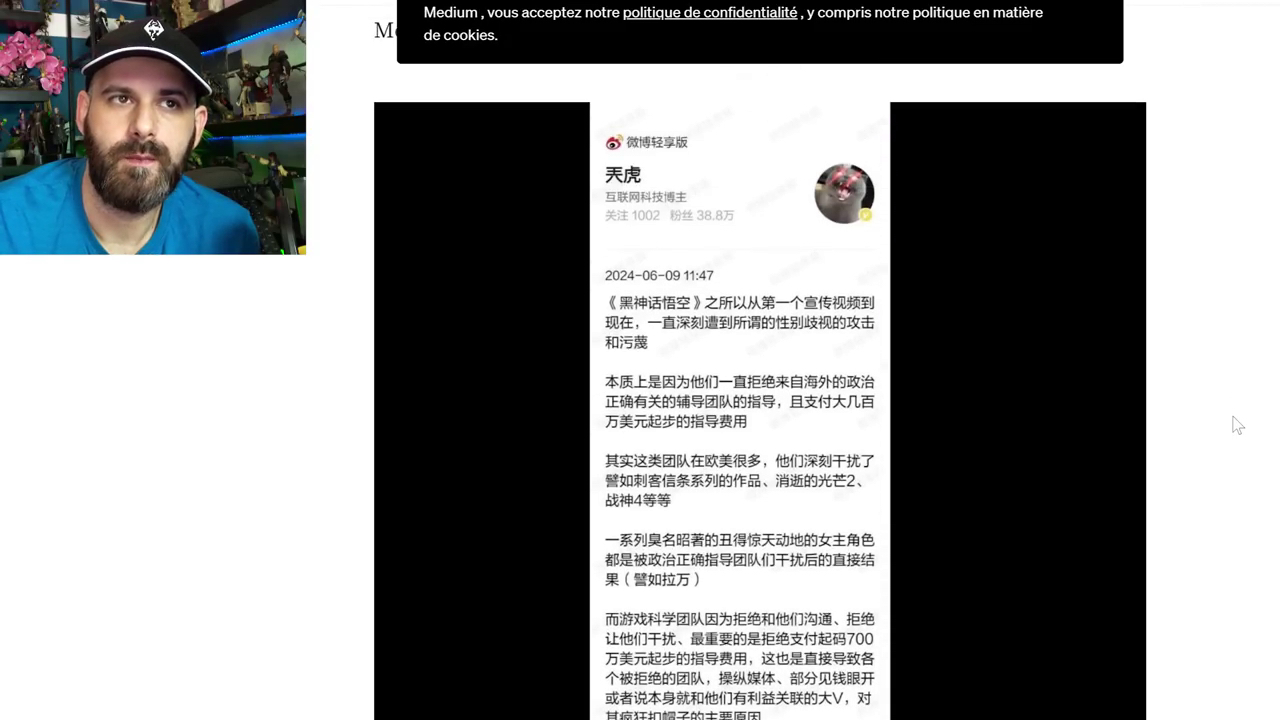
As evidence, JUNGO cited a Medium blog post by the user VolkColopatrion (2024), which in turn relied on a single Weibo post published on 9 June 2024 by the user Tian Hu (兲虎), who was later suspended from the platform for spreading misinformation (Shichang Zixun 2025). In JUNGO’s words, the Weibo post became a ‘Chinese press release’. The rumour’s authority depended precisely on transnational opacity: unverifiable Chinese-language claims were re-legitimised through Western influencer commentary and then recirculated as evidence of an anti-woke conspiracy.
Within this conservative YouTube sphere, creators framed themselves as investigators uncovering the ‘truth’ behind the controversy. By late August, more radical political YouTubers—sometimes outside the gaming community—connected the issue to a broader culture war between the ‘woke lobby’ and defenders of traditional masculinity. On 19 August 2024, the far-right political YouTuber Radio Maudin (123,000 subscribers)—also known as ‘Maudin Malin’, whose social media accounts regularly target LGBTQIA+ movements, Islam, and ‘woke’ ideology—published a video directly attacking Exserv and feminism, in which he said:
The Chinese are well aware that feminism brings nothing good to a society. Today’s feminism opened the door to gender theory that’s infiltrated everywhere … and we see a de-virilisation with disastrous consequences. And yes, the Chinese have understood that the West is in free-fall and that ultra-radical feminism is to blame. (Radio Maudin 2024; authors’ translation)
Radio Maudin leveraged the controversy to promote a political agenda aligned with a recurring theme in French far-right thought, particularly that associated with philosopher Alain de Benoist and the Nouvelle Droite (‘New Right’). Emerging in the late 1960s, this intellectual and political movement rejects modernity and advances an ethno-differential world view that emphasises the maintenance of distinct cultural boundaries (François 2014). In Radio Maudin’s words:
This game is a wonderful initiative. It stages a traditional legend without compromise. China is presenting us with a work that represents itself. Actually, multiculturalism only interests these people when it’s about importing millions of Africans to Europe. (Radio Maudin 2024; authors’ translation)
Other conservative creators adopted a more openly aggressive tone. The gaming YouTuber SLAPP REACT repeated the rumour that Sweet Baby Inc. had attempted to extort the developers to ‘rewrite’ the game. In one video, he praised the Chinese studio for refusing these demands, claiming that ‘the Chinese still have a pair of balls’ (SLAPP REACT 2024). In the same video, he also insulted and threatened violence against an IGN journalist who had criticised the game:
Finally, a game without ‘they,’ without morbid obesity, without any representation. See, that’s a video game reviewer who lowered the score because there wasn’t enough inclusivity. Look at this [he shows a picture of the journalist]. Look at her face. Do you want to have a dialogue with this person? I want to give her such a powerful falcon punch, a falcon punch of the patriarchy. (SLAPP REACT 2024; authors’ translation)
For these conservative YouTubers, support for BMW became intertwined with opposition to LGBTQIA+ representation, inclusivity, and feminism in video games. The controversy thus functioned as a vehicle for broader reactionary political narratives. Within this discourse, China—and Asia more broadly—was often portrayed as a civilisational alternative capable of resisting Western ‘woke’ cultural influence. Here, China functions less as an existing political system and more as a floating signifier onto which French reactionary creators project anxieties about masculinity, migration, multiculturalism, and national decline.
From Mao Collars to Black Myth: Wukong
The fascination of conservative YouTubers in the Anglo-European world with an imagined China recalls an earlier historical episode: the Western ‘China fad’ during the Cultural Revolution (Lovell 2019), particularly among the French literary group Tel Quel. Influenced by Maoism and works such as Maria-Antonietta Macciocchi’s Daily Life in Revolutionary China (Wolin 2010), members of the group produced highly idealised representations of China after a 1974 visit organised by Chinese authorities. As Wang Yichen (2023) shows, Tel Quel writers constructed two ‘imagined Chinas’: an ancient philosophical China used to critique Western logocentrism and a revolutionary China mobilised to address theoretical debates within French intellectual life.
Similarly, the BMW controversy reveals how China functions primarily as a symbolic reference in domestic ideological struggles. Once a left-wing political fantasy, China now appears in online discourse as a conservative critique of feminism and ‘wokeness’, serving as a rhetorical device through which commentators project their own political anxieties. This circuit is not exactly symmetrical: China often functions more prominently as an imagined symbolic resource for Western anti-woke discourse than vice versa. Nevertheless, selective translations and appropriations enable reciprocal forms of ideological reinforcement.
Featured Image by Dino Ge Zhang (CC).
References
Asmongold TV. 2024. ‘Black Myth Wukong Is a Threat | Asmongold Reacts.’ YouTube, 19 August. youtube.com/watch?v=8aILFKVTNgc.
Chew, Matthew. 2019. ‘A Critical Cultural History of Online Games in China, 1995–2015.’ Games and Culture 14(3): 195–215.
Deng, Jian. 2019. ‘游戏四十年: 中国游戏思想史刍议 [Forty Years of Gaming: A Discussion on the History of Chinese Game Thought].’ 澎湃 [The Paper], 20 July. m.thepaper.cn/newsDetail_forward_3912091.
Dreyer, Jacob. 2025. ‘The Industrial Party.’ The Ideas Letter, 20 March. www.theideasletter.org/essay/the-industrial-party-%e5%b7%a5%e4%b8%9a%e5%85%9a.
Exserv. 2024. ‘Censure et Black Myth Wukong: Les Choses à Savoir Avant d’y Jouer [Censorship and Black Myth Wukong: What to Know Before Playing].’ YouTube, 17 August. youtu.be/YVuo-oqw2EU?si=7mon_7ZsvfNwwrBB.
Fan, Flint Xiaofeng. 2024. ‘From Myth to Market: Lessons from Black Myth: Wukong’s Success.’ Accepted to DiGRA 2025. ssrn.com/abstract=5123353.
Feng, Yining 馮亦寧. 2024. ‘《黑神話悟空》製作人楊奇遭爆天安門前對毛澤東比中指 [Yang Qi, Producer of “Black Myth: Wukong”, Was Accused of Giving the Middle Finger to Mao Zedong in Front of Tiananmen Square].’ 自由時報 [Liberty Times], 16 August. ent.ltn.com.tw/news/breakingnews/4771445.
François, Stéphane. 2014. ‘The Nouvelle Droite and “Tradition”.’ Journal for the Study of Radicalism 8(1): 87–106.
Gao, Yuan, Jia Li, and Jianping He. 2025. ‘Hybridizing Tradition and Technology: Global Reception of Black Myth: Wukong as a Vehicle for Chinese Cultural Identity and International Media Flows.’ Global Media and China, [Online first]. doi.org/10.1177/20594364251385203.
Hemmann, Kathryn. 2025. ‘The Softer Side of Dark Souls Fandom.’ Sidequest, 14 July. sidequest.zone/2025/07/14/dark-souls-fandom.
Houle, Kamran. 2024. ‘The Paranoid Style of Internet Politics: Gamer Backlashes and “Politics” as Imposition.’ POLIS: Sociology & Anthropology Undergraduate Journal 1(1): 12–22.
JUNGO. 2024. ‘La VÉRITÉ sur l’Affaire BLACK MYTH WUKONG [The Truth about the Black Myth Wukong Affair]!’ YouTube, 20 August. youtu.be/SGfumQRT4GQ?si=S7OVUgloyL8y9fDN.
King, Dylan Levi. 2017. ‘“White Left”: The Internet Insult the West Has Gotten Wrong.’ Sixth Tone, [Shanghai], 10 July. www.sixthtone.com/news/1000477.
Lei, Yu, and Weibao Wang. 2025. ‘Beyond Black Myth: Wukong Itself: The Construction of Identity from an Intercultural Communication Perspective.’ Journal of Multicultural Discourses 19(1–2): 29–46.
Liao, Sara 廖雪婷. 2024. ‘数字行动主义与男性权益运动的民粹主义浪潮 [Digital Activism and the Populist Surge of the Men’s Rights Movement].’ Presented to Ninth Annual Conference of the Institute of Network Society, 9 November 2024, Chiang Mai University, Thailand. www.caa-ins.org/archives/12588.
Lovell, Julia. 2019. Maoism: A Global History. London: Bodley Head.
Lu, Xiao, and Liu Hong Yu. 2025. ‘From Copycat to Magical Monkey: Understanding the Video Game Development Culture in China.’ European Journal of Cultural Studies 29(1): 83–100.
McMahon, Christopher. 2022. The Corruption of Play: Mapping the Ideological Play-Space of AAA Videogames. Leeds, UK: Emerald Publishing Limited.
Mortensen, Torill Elvira. 2018. ‘Anger, Fear, and Games: The Long Event of #GamerGate.’ Games and Culture 13(8): 787–806. doi.org/10.1177/1555412016640408
Nagle, Angela. 2017. Kill All Normies. London: Zero Books.
Obedkov, Evgeny. 2025. ‘Black Myth: Wukong Tops 25 Million Copies Sold as Its Merchandise Sales Skyrocket in China.’ Game World Observer, 31 January. gameworldobserver.com/2025/01/31/black-myth-wukong-25m-copies-sold-merchandise-china.
Radio Maudin. 2024. ‘EXSERV OU LE NÉOCOLONIALISME DE GAUCHE (LE CAS BLACK MYTH: WUKONG) [Exserv or Leftist Neocolonialism (The Black Myth: Wukong Case)].’ YouTube, 19 August. youtu.be/P7IKO2hh1ww?si=0oCqWfp6VXKoX9wG.
Shichang Zixun 市场资讯. 2025. ‘诋毁抹黑! 多名汽车博主被禁言 [Defamation and Slander! Several Car Bloggers Banned from Speaking].’ 车联新生态 [Chelian xin shengtai], 22 October. finance.sina.com.cn/roll/2025-10-22/doc-infusqyk9620644.shtml.
SLAPP REACT. 2024. ‘EXSERV le COMMUNISTE se COMPORTE Comme un NAZ* PD (BLACK MYTH WUKONG Polémique WOKISTE) [Exserv the Communist Is Acting Like a Fag Naz* (Black Myth Wukong Wokist Controversy)].’ YouTube, 23 August. youtu.be/XHaiRvNOXYg?si=UU9597nX3Gsq7Bb0.
Valentine, Rebekah, and Khee Hoon Chan. 2023. ‘How Black Myth: Wukong Developer’s History of Sexism Is Complicating its Journey to the West.’ IGN, 20 November. www.ign.com/articles/how-black-myth-wukong-developers-history-of-sexism-is-complicating-its-journey-to-the-west.
VolkColopatrion. 2024. ‘Sweet Baby Inc Extortion Racket? The Dangers of Mass Delusions and Abusive Social Proof.’ Medium, 15 June: medium.com/@volkcolopatrion4/sweet-baby-inc-extortion-racket-the-dangers-of-mass-delusions-and-abusive-social-proof-fc6cc570bd54.
Wang, Aiqing, Thomas William Whyke, and Zhennuo Song. 2025. ‘Cultural Overflow vs. Cultural Export: Black Myth: Wukong and the Evolution of Chinese Gaming in Global Creative Industries.’ Creative Industries Journal, [Online first]. doi.org/10.1080/17510694.2025.2583652.
Wang, Hongze 王洪喆. 2025. ‘《黑神话: 悟空》为什么会出现? “长90年代”的技术浪漫主义与“80后”的多重时间 [Why Did “Black Myth: Wukong” Come About? The Technological Romanticism of the “Long ’90s” and the Multiple Timelines of the “Post-’80s” Generation].’ 开放时代 [Open Times], (4). www.opentimes.cn/html/Abstract/28327.html.
Wang, Yichen. 2023. ‘Two Imagined Chinas in Tel Quel.’ CLCWeb: Comparative Literature and Culture 25(3): article 10.
Wilén, Evelina Johansson. 2025. ‘Incel Epistemology: On Marginality, Experience and Legitimization of Knowledge.’ YOUNG 33(5): 459–75.
Wolin, Richard. 2010. The Wind from the East: French Intellectuals, the Cultural Revolution, and the Legacy of the 1960s. Princeton, NJ: Princeton University Press.
Wu, Hao, and Zhang Yihuan. 2025. ‘Wounded Hearts: The Affective Making of Misogynistic Male Victimhood Under the Familial Sexual Contract in Precarious China.’ International Journal of Cultural Studies 28(4): 814–30.
Xi, Jinping. 2025. ‘Chinese President Xi Jinping’s 2026 New Year Message.’ Xinhua, 31 December. english.www.gov.cn/news/202512/31/content_WS695522f3c6d00ca5f9a085fe.html.
Yang, Jing 杨静. 2024. ‘《黑神话: 悟空》— 能力越大 责任越大 风险越大 [“Black Myth: Wukong”—With Great Power Comes Great Responsibility and Great Risk].’ 端傳媒 [Initium Media], 24 August. theinitium.com/20240825-game-on-black-myth-wukong-zh-hans.
Yin-Poole, Wesley. 2024. ‘Black Myth: Wukong Has Massive Launch, Overtakes Cyberpunk 2077 to Become Most-Played Single-Player Game Ever on Steam.’ IGN, 20 August. www.ign.com/articles/black-myth-wukong-has-massive-launch-overtakes-cyberpunk-2077-to-become-most-played-single-player-game-ever-on-steam.
Yocar. 2007. ‘谁谋杀了我们的游戏 [Who Murdered Our Games].’ CSDN. blog.csdn.net/xiaoyaoACi/article/details/127302505.
Yuan, Li. 2025. ‘Silicon Valley Has China Envy, and That Reveals a Lot About America.’ The New York Times, 22 October. www.nytimes.com/2025/10/22/business/china-tech-silicon-valley.html.
Yuan, Wenjie. 2024. ‘An Imagological Analysis of the Video Game Black Myth: Wukong.’ Signs and Media 3(1–2): 55–75.
Zhang, Chenchen. 2017. ‘The Curious Rise of the “White Left” as a Chinese Internet Insult.’ openDemocracy, 11 May. http://www.opendemocracy.net/en/digitaliberties/curious-rise-of-white-left-as-chinese-internet-insult.
Zhang, Chenchen. 2020. ‘Right-Wing Populism with Chinese Characteristics? Identity, Otherness and Global Imaginaries in Debating World Politics Online.’ European Journal of International Relations 26(1): 88–115.
Zhang, Chenchen. 2026. ‘Mirror and Mismatch.’ Transnational Institute, [Amsterdam], 3 February. www.tni.org/en/article/mirror-and-mismatch.
Zhang, Dino Ge, and Jing Sun. 2026. ‘Vulgar Spirits of Games and Play from State to Society: An Alternative History of Video Games in China.’ In Internet Vulgarities in China, edited by Jian Xu and Dino Ge Zhang, 84–106. New York, NY: Routledge.
Zhang, Qianlan, and Hong Zeng. 2025. ‘Postmodern Mythmaking in the Digital Age: Black Myth: Wukong and the Reconfiguration of Journey to the West.’ Adaptation 18(3): apaf025.
Zhang, Yihuan, and Tang Ling. 2025. ‘“Rat Rat” Culture and Digital Misogyny: Extreme Misogyny, Problematic Feminisms, and the Governmentality of Gender in Post-Socialist China.’ Feminist Studies 50(3): 376–405.