
Migrants, Mass Arrest, and Resistance in Contemporary China

In today’s China, migrant workers are commonly perceived as criminals. This essay examines how this bias is reflected in mechanisms of crime control, as well as in the judicial and correctional systems. It also looks into the strategies adopted by migrants to cope with this kind of discrimination by the law enforcement bodies.

Snapshots of China’s ‘Uncivil Society’

Under the leadership of Xi Jinping, the Chinese Communist Party has reinvigorated its attempts to eradicate detrimental ‘Western ideas’. This has resulted in the assertion that civil society is nothing more than a concept, if not a trap set by the West. In practice, however, this effort has led to the emergence of a very different—uncivil—type of society.

Media Politics in China: Improvising Power under Authoritarianism, a Conversation with Maria Repnikova

Maria Repnikova’s new book Media Politics in China: Improvising Power Under Authoritarianism (Cambridge University Press, 2017) challenges conventional understandings of the role of critical journalists in authoritarian regimes, painting a picture of reporting in China as a balancing act of creativity, experimentation, and restriction. We spoke with her.

Collecting the Red Era in Contemporary China

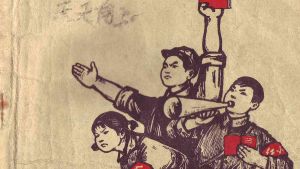
Since the 1980s the Chinese Communist Party has condemned the Cultural Revolution as ‘ten years of chaos’. Nevertheless, so far there has been very little discussion on the topic in the public sphere in China. This essay looks into how private collections of red relics can be used to confront this void in China’s recent past. It argues that collected objects play a much more complex role in history production than we may think, as they contribute to the construction of narratives, put forth counter-narratives, and fragment the very idea of historical narrative altogether.

Ai Weiwei’s #Refugees: A Transcultural and Transmedia Journey

After spending years advocating for human and civil rights in China, Ai Weiwei is now employing his artistic abilities and his sizeable social media presence to sensitise the West to the plight of the refugees who attempt to reach Europe from the Middle East and Africa. In doing so, he is putting European governments rather than the Chinese state ‘on trial’ while adding a ‘transcultural’ dimension to his work. Still, even his most recent endeavours stem from the same philosophy he has espoused throughout his career.

In the Shadow of Kem Ley: Is Civil Society the Solution to Cambodia’s Woes?

The assassination of political analyst Kem Ley in Phnom Penh in July 2016 suggests that civil society touches a nerve of great sensibility in today’s Cambodia. Cambodian democracy is currently experiencing its tensest period in two decades. If civil society plays a role in this context, it is not primarily within the traditional confines of the associational realm. Rather, in looking for a civil society challenge to party politics, we will have to shift our attention away from NGOs to the tentative emergence of social movements and to the fledgling grassroots democracy movement which Kem Ley himself spearheaded.

Beyond the Great Paywall: A Lesson from the Cambridge University Press China Incident

On 18 August it was revealed that Cambridge University Press had complied with the demands of Chinese government censors to block access on its website in China to hundreds of ‘politically sensitive’ articles published in its prestigious China Quarterly journal. The ensuing debate has generally overlooked the problematic nature of the commercial academic publishing industry. Isn’t it time to take the profit motive out of the equation and to rediscover a certain measure of idealism in academia?

Let a Hundred Flowers Bloom: A Response to William Hurst on the Field of Chinese Politics

In his powerful essay, William Hurst raised the question of how to make the study of Chinese politics relevant to the discipline of political science. Yet, the prevailing question should not be ‘how do we make China relevant to the discipline?’, but ‘how can the study of China help us rethink the study and practice of comparative politics?

Treating What Ails the Study of Chinese Politics

For almost as long as political science has existed as a discipline, the study of Chinese politics has been afflicted with a chronic disease. Depending on one’s perspective, this malady’s manifestations have amounted to either neglected isolation or arrogant exceptionalism. To treat this illness, it is important to set aside any rigid orthodoxy and resort to diversity and bold experimentation.

Prospects for US-China Union Relations in the Era of Xi and Trump

In October 2013, Richard Trumka, President of the American Federation of Labour and Congress of Industrial Organisations (AFL-CIO), visited the All-China Federation of Trade Unions (ACFTU) to establish formal bilateral relations between unions in China and the United States. This visit signalled an historic shift in labour policy, from Cold War-style hostility to normalisation of relations. Some […]

Subscribe to Made in China

Made in China publications are open access and always available as a free download. To subscribe to email alerts for each issue of the Journal, newly published books, and information about upcoming events, please provide your contact information below.


Back to Top