

Performing the Rabbit God
Imagining Queer Identity and Heritage in the Chinese Diaspora
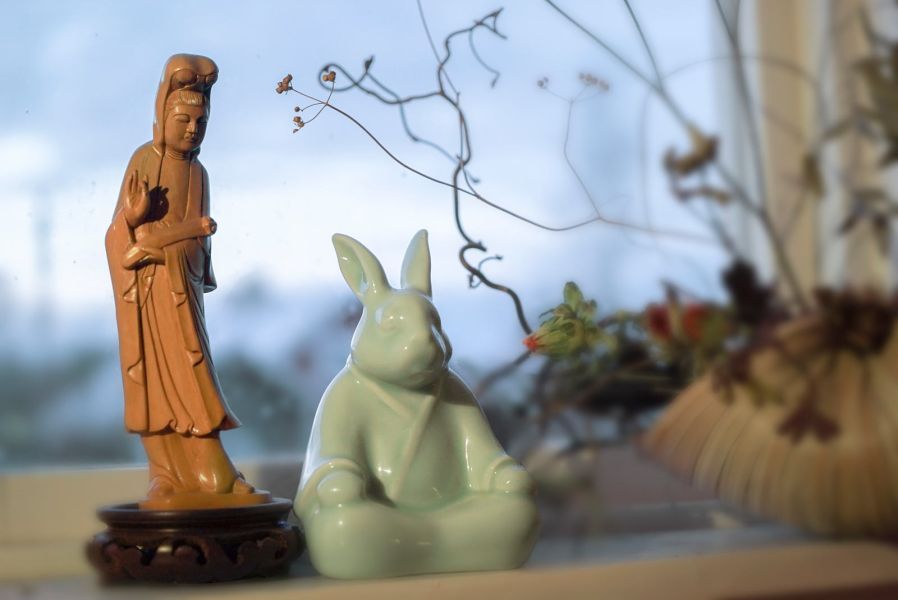
When I was growing up in China, I didn’t know about the Rabbit God, the patron saint of gay people in ancient China. The reason was simple: in China, queer history was not, and still is not, taught in schools; queer books are often banned online and unavailable in libraries and bookstores. After I left China to do a PhD in Australia, I had the opportunity to research this side of Chinese history. The Rabbit God story immediately captured my imagination. I have since been grappling with this story through my research and creative practice.
A simple version of the Rabbit God story goes like this: during the Qing Dynasty, a low-rank clerk by the name of Hu Tianbao 胡天保 fell in love with a senior official who was an inspector from the imperial court. Hu followed the official everywhere, even to the lavatory. Eventually, he was caught by imperial guards, interrogated about his motives, and sentenced to death. Once in the netherworld, he told Yanluowang 阎罗王, the King of the Underworld, the reason for his death. Yanluowang was deeply moved by his story and appointed him Tu’er shen 兔儿神, the Rabbit God, the patron saint of queer people (Santangelo and Yan 2013: 930).
This story was first told as a folk tale in the seventeenth century in Fujian Province, where there was a long tradition of male same-sex intimacy in the form of ‘sworn brothers’ (契兄弟) (Hinsch 1992). It was later recorded in books such as Qing Dynasty scholar Yuan Mei’s What the Master Doesn’t Discuss (子不语), originally published in 1788. While queer love has long been referenced in historical and literary tropes through symbols such as a ‘shared peach’ (分桃) and a ‘cut sleeve’ (断袖), it has seldom been moralised; but Yuan Mei’s deification of Hu Tianbao as the Rabbit God marked a clear celebration of queer love.
The Rabbit God story is a good example of how religion can treat sex and sexuality positively, challenging the popular, often Eurocentric, perception that religion and queer sexuality are incompatible. Tu’er shen is a Daoist deity, and Daoism is often known as a naturalist and pantheist folk religion that affirms the spiritual vitality of all beings and emphasises reverence for the natural world. Against this backdrop, the story dramatises a tension between two philosophical traditions in late imperial China: Confucianism, with its emphasis on order, hierarchy, and propriety; and Daoism, which advocates following the natural way and coexisting with the nonhuman, the unknown and the unusual. For me, the Rabbit God also serves as a good example of how queer Chinese identity and heritage can be reimagined in the contemporary context. Heritage is often seen as patrilineal and heteronormative, carrying normative gender and sexual associations, as in expressions such as ‘father mountain’, ‘mother river’, and ‘virgin forest’. Queer people’s history and culture have seldom been included as part of national and global heritage and warranted the status of state protection and preservation. The erasure of queer history in China and the Chinese diaspora in recent years has led to the fragmentation and disappearance of queer Chinese heritage. In this context, a more open, creative, and non-dogmatic approach to queer Chinese heritage is needed to keep that heritage alive and bring it to bear on contemporary society and life.
Instead of being obsessed with what it was, queer heritage should be reconceptualised as what it can do and what it can potentially become. This does not undermine the importance of researching queer Chinese history, as it is the study of the marginalised and forgotten history that makes the re-creation of that history possible. Rather, it suggests that queer Chinese heritage is not static, that it is in a process of constant making and remaking, and that it gains new meanings and relevance in new contexts. In what follows, I will use three examples to demonstrate how queer artists living in the Chinese diaspora use the Rabbit God as an inspiration to articulate a contemporary queer Chinese cultural politics.
Cultural Representations
The Rabbit God has appeared in numerous media and cultural representations in Asia, such as the 2010 Taiwanese TV drama The Rabbit God’s Matchmaking (兔儿神弄姻缘). In 2007, an openly gay Daoist priest named Lu Weiming 盧威明 even set up his eponymous Weiming Temple (威明堂), dedicated to the worship of the Rabbit God, in New Taipei City in northern Taiwan. Not coincidentally, the Rabbit God story has been picked up by many artists of East and Southeast Asian heritage in recent years, often in the context of rising awareness of queer Asian sexuality and identity, and of burgeoning queer Asian activism globally (Bao 2025).
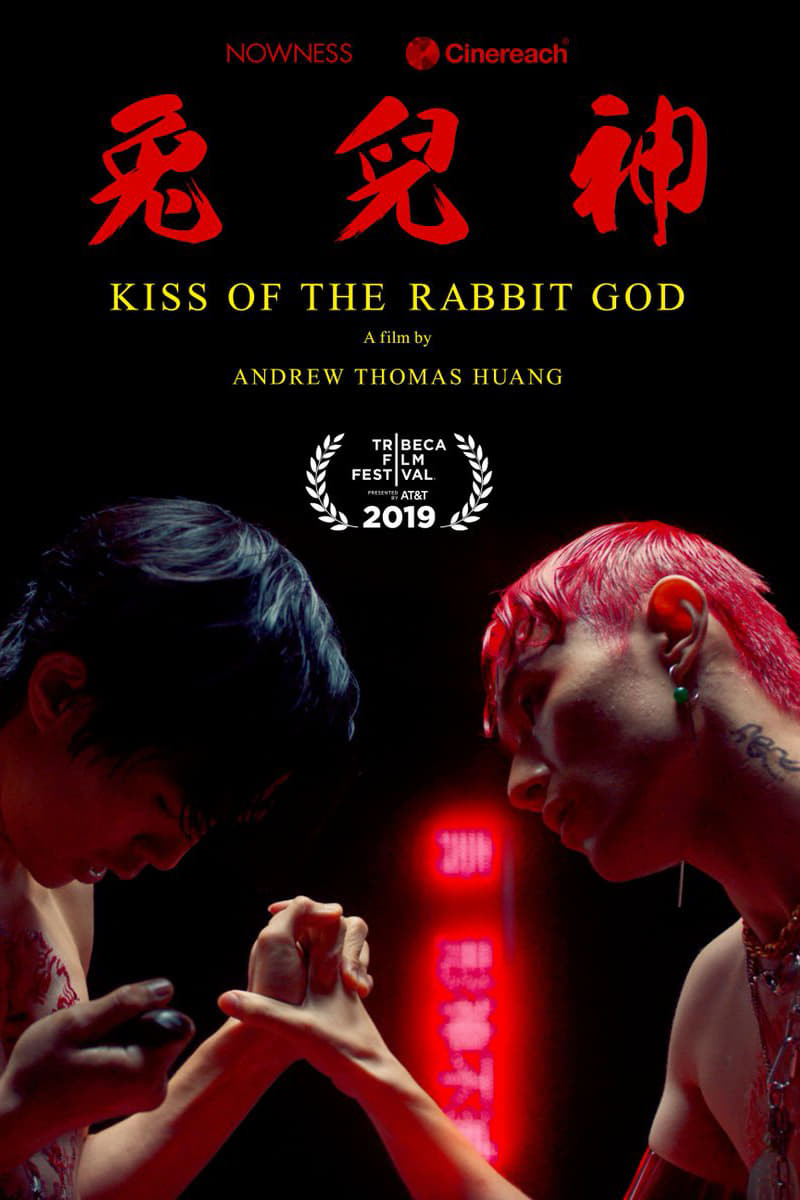
One example is Andrew Thomas Huang’s 2019 short film The Kiss of the Rabbit God, which tells the story of the sexual awakening of a young man working in a Los Angeles Chinatown restaurant kitchen. The protagonist is attracted to a pink-haired and fashionably dressed young man who frequently visits the restaurant and later reveals himself to be Tu’er shen. The encounter between the two men eventually leads to the protagonist coming to terms with his own sexuality. This aesthetically refreshing and stylistically innovative film places the Rabbit God story in a contemporary Asian diasporic context, situated within the history of Asian immigration to the West.
In an interview, Huang described the film as ‘a confession and a love letter to my queer Asian community’ and explained his reason for making it:
I grew up with a deficit of queer Asian visibility on-screen along with the frequent stigmatisation and devaluing of Asian male bodies in Western visual culture. I wanted to unpack these issues while also crafting a story that I felt enriched our collective imagination of what queer Asian male love, sex and intimacy could aspire to be. (Huang and Metcalfe 2019)
For Huang, retelling the Rabbit God story becomes a way to celebrate queer Asian sexuality, desire, and intimacy in a Western context in which queer Asian bodies are desexualised and rendered invisible both in heteronormative Asian culture and white-centric gay culture. The Tu’er shen figure in Huang’s film is young, fashion-conscious, and confident, articulating a bold and aesthetically original queer Asian diasporic imaginary.
Notably, Huang does not turn to Western queer symbols such as the rainbow, or identarian terms such as LGBTQIA+, for his film. Instead, he incorporates many traditional Chinese symbols such as the colour red, long robes, and the jade seal in the middle of a very realistic, documentary-style film set in a small Chinatown restaurant.
Poetic Inspirations
I took part in the retelling of the Tu’er shen story by writing poetry about him. I started writing poems at the beginning of the Covid-19 pandemic as a form of self-expression. The isolation experienced during the lockdowns and the racism and microaggression targeting Chinese communities became too much to bear. Poetry came to my rescue, thanks to its short form and intense emotional impact. I wanted to tell my own story as a queer Chinese person growing up in China and later migrating to the West (first to Australia, then to Germany, and now the United Kingdom), using the Rabbit God story as a backdrop. To do so meant that I would have to write in a language with which I did not grow up and in a literary form that was new to me.
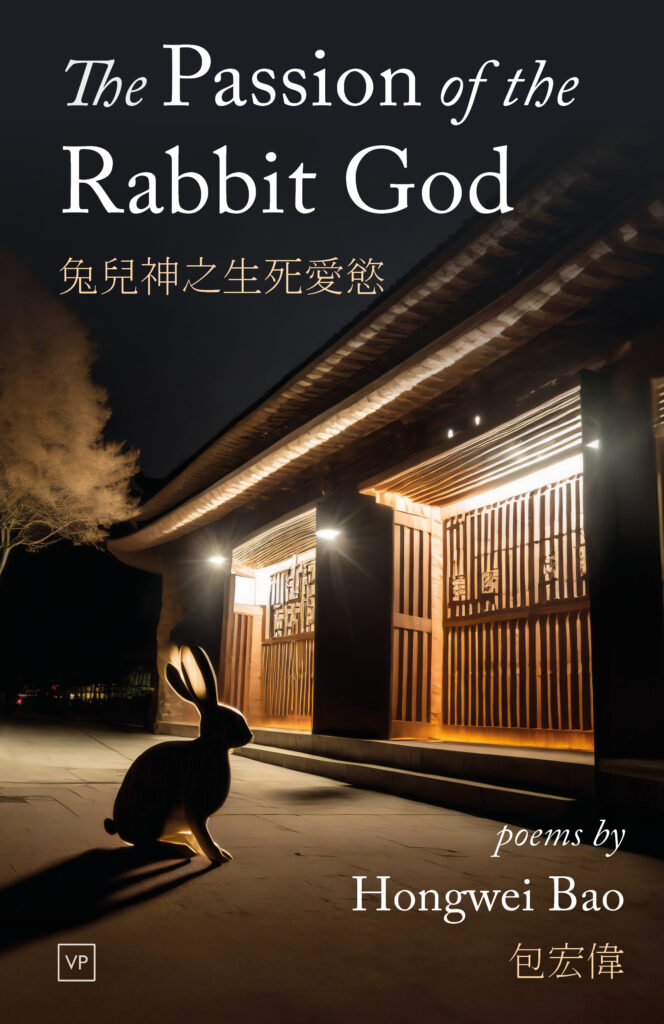
The Rabbit God became a perfect vehicle for my queer migration story. After all, the Rabbit God story is rooted in queer Asian folk religion and oral literature; it tells the story of a self-assured person bravely pursuing their love despite challenging circumstances. My debut poetry collection, The Passion of the Rabbit God (published by Valley Press in 2024), tells my story of sexual awakening during my upbringing in China, and of later coming to terms with my sexuality in the process of migration. I contextualise my experience in the queer Asian literary tradition and the genealogy of the Rabbit God story. The book is dedicated to the Rabbit God; the opening poems offer a retelling of the Rabbit God story, in the first-person voice of Hu Tianbao:
They call me the Rabbit
God because rabbit is a slang
for men who love men,
women who love women,
and people whose love is not
recognised by society.I was condemned
to death by the very man
I loved, the man whose beauty
I admired, whose shadow
I followed, whose body
I desired. He didn’t
appreciate my love. He doesn’t
deserve my memory.And yet I was
interrogated, forced to confess
my desire, taunted
for my audacity and sincerity
for who I am, by whom
I love.Crossing a hundred rivers
and a thousand mountains,
I stood before Yanluowang,
God of the Dead and King
of the Underworld. He didn’t
laugh at me. (He knew better.)Too many fools
in the human world, he said,
ignorant about love and not deserving
to be loved. From now on, you shall be
the Rabbit God, the patron saint
of all your people. You shall serve
as their protector, their guardian, bear
witness to their love. May your people
live and prosper
generation after generation.(Who’d have thought the Underworld
has more wisdom and justice?)
Sitting on the altar, I see in this mortal
World, queer people driven
out of their homes, their lands,
their homelands, with no place
to call home, no right to justice.
Come to my temple, my dear
children, I shall offer you sanctuary,
bless you with my magic, witness
your love as it buds, blossoms and spreads.
Like flowers. Like grass. Like fire.(Bao 2024: 13–14)
The poems were written at a time when queer communities and queer culture were under threat in mainland China, marked by the forced closure of the Shanghai Pride parade in 2021 and the Beijing LGBT Centre in 2023 (Liang 2023). I also used this collection to address contemporary social and political issues, such as China’s pandemic lockdowns and ‘White Paper’ protests, the impact of Brexit and fortified border-control policies, and historical and contemporary forms of Sinophobia and anti-Asian racism. In the book, the Rabbit God fights against not only homophobia and intolerance in ancient Chinese society, but also various forms of historical and contemporary social injustice, both in China and in the West.
Performative Acts
In 2024, Queer China UK, a queer Chinese community organisation based in the United Kingdom, invited me to lead a creative writing workshop as part of the community residency program at Queer Britain, a museum of British queer history and culture in London. I shared the Rabbit God story and my poem about the Rabbit God with the workshop participants. I also encouraged participants to write their own poems and prose texts about the Rabbit God, to ‘queer’ folk tales such as Mulan and the Butterfly Lovers. I was inspired by the participants’ creative energy. One participant noted the gay male bias of the Rabbit God story and re-created the Rabbit God as a nonbinary and genderfluid deity. In the workshop, participants experimented with a flexible approach to traditional Chinese culture: instead of treating it as fixed or given, they opened it to creative interpretations and contemporary issues.
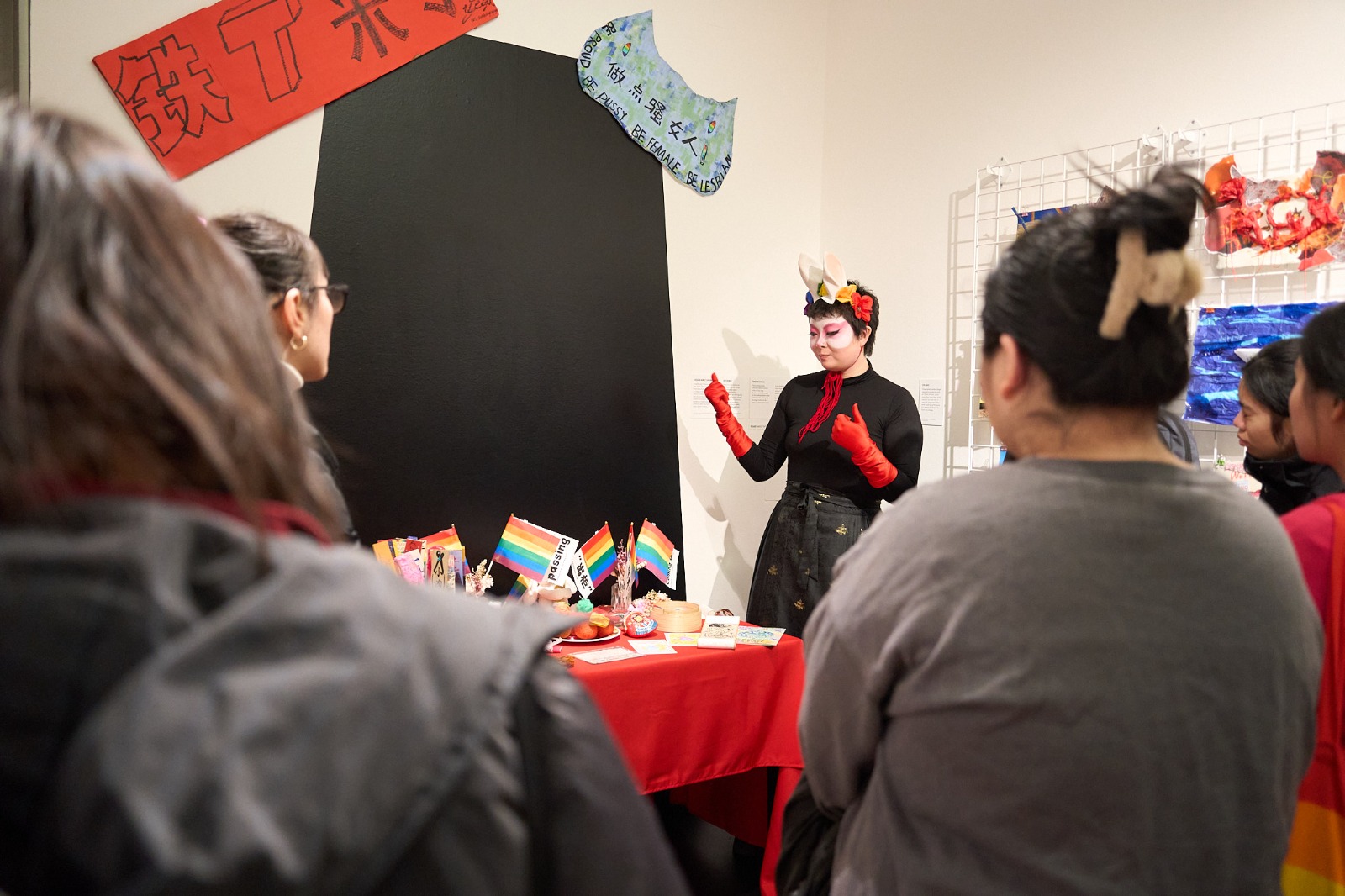
As part of the residency program, the group set up an exhibition titled ‘We Are LGBTQIA+ ESEA’. The centrepiece of the exhibition was a queer shrine, with joss sticks, red packets, oranges, and a rainbow flag. The exhibition also featured a series of nüshu (women’s script) artworks addressing contemporary feminist issues. For the opening night and the Lantern Festival celebration, a Rabbit God, performed by artist FJ (they/them), appeared, telling their story of the Rabbit God and guiding visitors through the exhibition. FJ’s Rabbit God was an androgynous, nonbinary, and trans person. In the opening night performance, FJ held a white balloon on which the Chinese character 家 (‘home’ or ‘family’) was written. FJ wrestled with the balloon, which eventually burst, symbolising the complex and often difficult relationships between queer people and their natal families. When I interviewed them later, FJ told me:
The making of the Rabbit God as my drag character is a critical rooting process for me. Researching the original story of the Rabbit God and the historical background made me know more about the culture that should be called my own; however, seeing it through a contemporary queer feminist lens pushed me to interpret it critically, to queer it up even more, but without putting the character again in a very fixed narrative. So now, to me, the Rabbit God means an ever-evolving, open, and fluid spirit embodied in a queer body. Yes, they bless queer people and queer love and, at the same time, their shrine is where queer diaspora can rest, can heal, can be seen and heard. (Written interview, 6 July 2025)
All this shows how the Rabbit God story is far from over. Perhaps it has just started. I hope it will continue to inspire queer Chinese people to articulate their identity, community, and desire, and to reimagine and perform the Rabbit God in new ways. Importantly, none of the artists has rigidly followed the original script of the Rabbit God. Instead, they have creatively reinvented the story and fabricated their own versions of the deity. While historical accounts preserve an archive of queer Chinese experience, it is in the constant retelling of the Rabbit God story that Tu’er shen is brought to life and that queer Chinese heritage comes into being.