
Queer Manifestos: Editorials from Chinese Queer Zines
Since the late 1990s, even amid continuing media censorship and sporadic government crackdowns on LGBTQIA+ activism, there has been a boom in queer groups, organisations, and events in urban China. Self-published queer zines, the Chinese queer version of samizdat, have catalogued the rise and fall of these queer communities and cultures. They have also functioned as a vital form of queer activism, constructing Chinese queer identities, and building Chinese queer communities in significant ways.
Most of these zines are independently published and circulated inside the LGBTQIA+ community. In this sense, they ‘narrowcast’ rather than ‘broadcast’, primarily serving a queer community readership rather than a general audience. They exemplify what Jin Cao (2009: 2) calls ‘alternative media’ or what I term ‘queer community media’ (Bao 2021: 31). Most are supported by voluntary, queer-identifying teams of editors, contributors, and distributors. These zines have been distributed in queer community spaces such as LGBTQIA+ centres, gay bars, clubs, saunas, and parks, often free of charge. Notably, most of these zines do not have an officially approved International Standard Book Number (ISBN) or International Standard Serial Number (ISSN) and therefore can be classified as unofficial, independent, underground, and even illegal publications. Their precarious status partly explains why most disappeared in the 2010s, amid waves of government crackdowns, a lack of funding, and the growth of digital media.
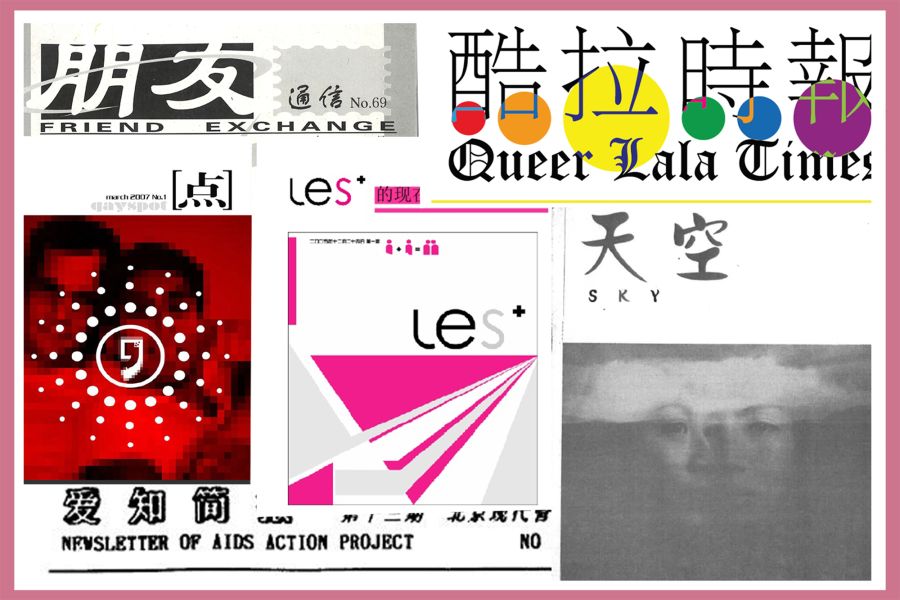
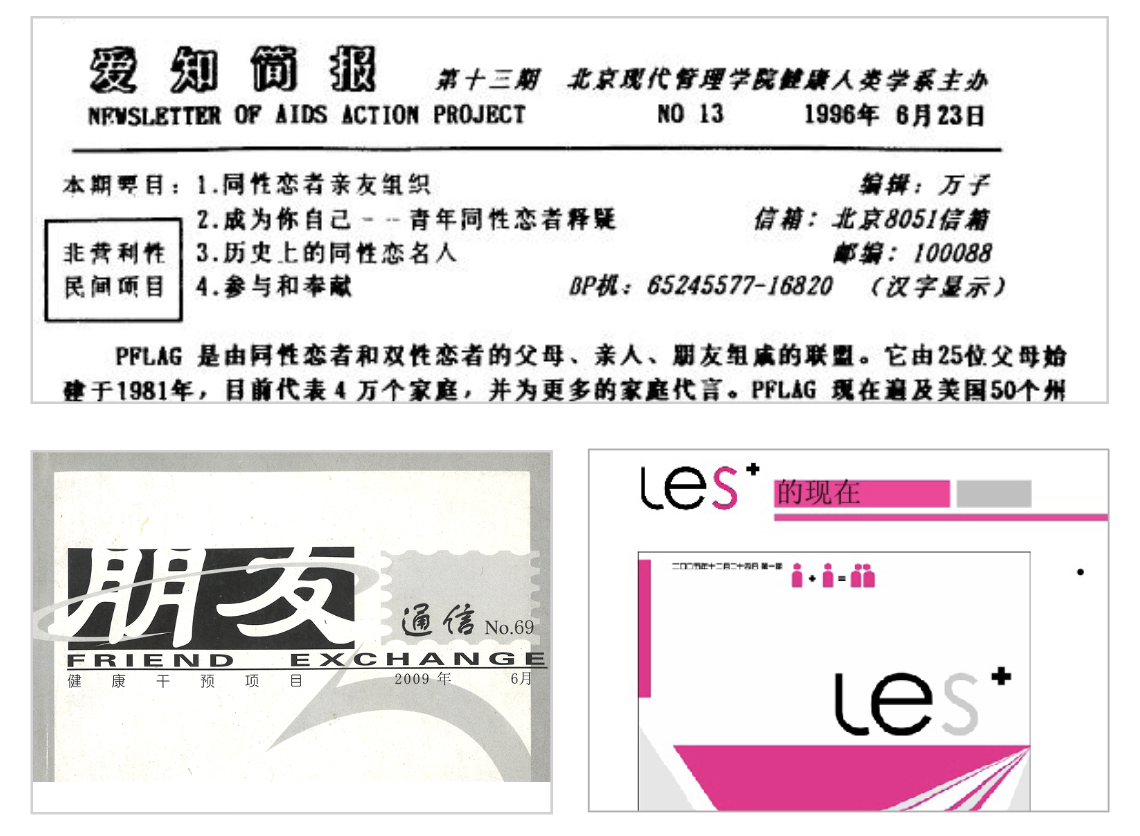
Among the many publications that have appeared over the years, the best-known are probably the Newsletter of the AIDS Action Project (爱知简报, 1994), Friends (朋友, aka Friend Exchange 朋友通信, 1998–2008), Sky (天空, 1999–2001), Share and Exchange (分享与交流, founded in 2003), Common Heart (同心, founded in 2003), Rainbow Sky (七彩天空, founded in 2004), Les+ (2005–15), GS (aka GaySpot 点, 2007–present), and Queer Lala Times (酷拉时报, 2013–16) (Bao 2021: 41–45). Each of these zines serves a specific section of the LGBTQIA+ community and they often champion distinct gender and sexual politics.
By 2025, most of the queer zines stopped printing, except for GS, which continues to champion the work of Chinese queer writers. For instance, recent GS publications include a poetry collection by queer poet Mu Cao, in 2022, and a collection of short stories by queer fiction writer Zhang Wang, in 2024. For various reasons, the print versions of these zines can no longer be found in public spaces; their social media accounts have either gone dormant or been shut down. In this context, preserving these zines, together with the queer historical material and cultural memories they represent, is an urgent task.
Enter the Leiden Chinese Queer Collection (LCQC). Officially launched at Leiden University in the Netherlands in July 2025, the LCQC aims to collect, preserve, and make accessible primary source material and scholarship on the Chinese queer experience, and to facilitate collaboration between academics, activists, and archivists (Gilbert 2025a). The LCQC collects Chinese queer material such as books, zines, leaflets, merchandise, artworks, DVDs, and digital files of major LGBTQIA+ organisations from mainland China, Hong Kong, Taiwan, and the Chinese diaspora. To encourage Chinese queer research and to facilitate cross-sector dialogues, the LCQC hosted its inaugural symposium for academics, activists, and archivists in July 2025, which also featured a Chinese queer history exhibition (Gilbert 2025b). Although in its infancy, the LCQC has already garnered much academic and community support, aspiring to serve as both a community archive and a place to support research and teaching.
Accessing the LCQC is free for readers, although for now most of the materials can only be viewed in Leiden University libraries. Plans are under way to digitalise some of the materials, copyright permitting, and make them accessible to a broader international readership. The LCQC also encourages the donation of funds and archival materials to support its various initiatives, including acquisition and digitalisation of materials, public events and conferences, research fellowships, and internships (Gilbert 2025c).
To showcase the wealth of material available at the LCQC and the diversity of these queer zines in terms of content, style, and purpose, in this article, I present the English translations of three editorials published in inaugural issues of different publications (the first two translations are mine, the third by Chris Ma).
‘A Free Sky Is Our Dream’
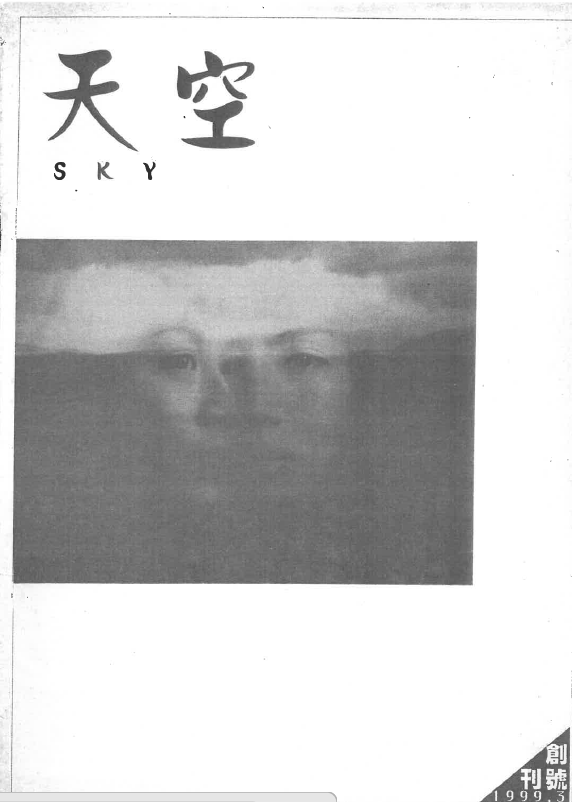
Sky (天空), the earliest documented lesbian community zine in mainland China, was founded by the Beijing Sisters Group (北京姐妹小组, 1998–2001) in March 1999 and published only a few issues. The Beijing Sisters Group also opened the first lesbian telephone hotline in mainland China. The inaugural issue contains community news, Sapphic literary history, creative writing, film reviews, and information about Chinese and international lesbian organisations. It also features an editorial titled ‘A Free Sky Is Our Dream’, which I translate below.
In this heteronormative society, homosexuality has long occupied a marginalised position. For a long time, heteronormative ways of thinking have been deeply ingrained in people’s minds, further consolidated by media representations and public opinion. This has fostered a pervasive indifference or prejudice towards homosexuality among the public. It has forced many lesbians and gay men to suppress their true selves, frequently leading to unhappiness and psychological stress. Same-sex love stories remain unspoken secrets.
Fortunately, with societal progress, technological advancement, and the relentless efforts of lesbian and gay activists, homosexuality is gradually gaining recognition in society. The journey from ‘seemingly non-existent’ to ‘being acknowledged’ has been long and arduous. Yet, throughout this process, we have scarcely heard lesbian voices. Indeed, in the current social climate, we have no space to express ourselves, let alone fully articulate our experiences.
Publishing an internal newsletter for lesbians has long been our shared dream. We hope to create a new, peaceful, and safe space for our own community. We hope to express all aspects of ourselves freely, in our own language, and address our own experience.
We all love our families and cherish our lives. We detest the stereotypes society imposes upon us. We refuse to perpetuate society’s misunderstandings of us, or our own misunderstandings of ourselves. We yearn to talk freely with like-minded friends, to confide in one another. We hope to hear our own voices and see the wider world.
Sky aspires to create a space where we feel free and joyful, unburdened by oppression or guilt. We declare openly: we are lesbian, and we are committed to serving all lesbians. We hope every lesbian discovering and embracing their identity can find a beautiful beginning here. Loving women is our choice; supporting women is our duty and responsibility.
Sky welcomes your contribution and encourages submissions on all subjects. We particularly look forward to hearing from lesbians who are willing to share their perspectives on social discrimination and self-awareness, as well as their personal feelings and experiences. Literary works are welcome, as are recommendations for excellent articles related to lesbian lives to enable broader sharing.
Submissions may be of any length, but the handwriting must be legible. We regret that we cannot return submissions. Contributors may choose to use their real name or a pen-name for their publication.
Do you remember ‘Through Wind and Rain’, the song that once moved so many hearts?
‘Let me carve out a sky for you, so you can dance freely, and pursue your dreams without fear.’
Come, my friend, this is the sky you have been looking for.
Let us be the happiest lesbians.
‘Ignite a Belief’
Founded in Beijing in 2007 and still running today, GaySpot (点杂志, GS for short) is the longest-running gay community zine in mainland China. The zine was initially supported by Beijing Aizhixing Research Institute (北京爱之行研究所), later run by the Beijing LGBT Centre (北京同志中心), and is now an independent organisation. It publishes online, on social media, and in print. Past versions of the zine focused on LGBTQIA+ community news, whereas current versions focus on creative writing. GaySpot also runs the GS Academy, a summer camp for LGBTQIA+-identifying writers.
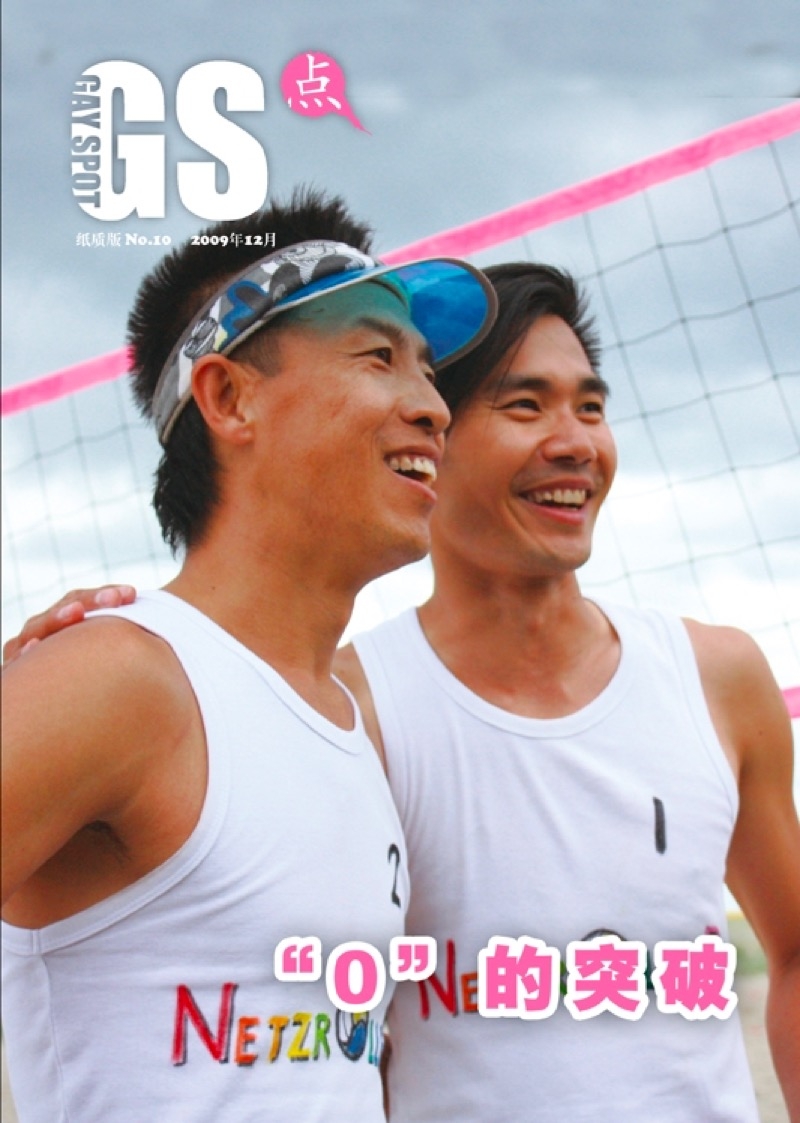
Spot: this word signals the start of a new journey.
It was in the cold winter that we started planning this inaugural issue. It will be March when the readers hold the zine in their hands. From flying winter snowflakes to blooming spring flowers, after a long wait, we have finally heard the first cry of life; it may not be that loud, but it represents our efforts, our hopes. These are all valuable experiences for us. There will be many difficulties and imperfections, but we have enjoyed every minute of the journey and look forward to sharing our joy with all beloved friends.
What will GaySpot become in the future? The answer lies in the hands of every reader. Perhaps it will become a multitude of perspectives, a kaleidoscope of viewpoints, a proud and euphoric moment, a gathering point for fellow travellers, a fulcrum for immense support, or a fleeting full stop—or perhaps, it’s just a simple dot: ‘.’ in its minimalist size, shape, and stroke. From this humble origin, all the scenes from the dreams will come true in real life. What that will look like is no longer the main point.
Ignite a belief, and may it stay with us. Thank you to those who came before us for their dedicated work; thank you to all the friends for your support. The journey is more meaningful than the destination. Let’s embark on our journey! Let’s explore the not-too-distant future through the little bits of our life experience …
‘We Are Lala’
Queer Lala Times (酷拉时报), run by the Chinese Lala Alliance (华人拉拉联盟), was a Chinese-language digital queer zine. Published primarily on digital platforms such as Douban, WeChat, and Weibo and active between 2013 and 2016, the zine championed queer women’s voices and challenged both heteronormativity in Chinese society and homonormativity in China’s LGBTQIA+ movement at the time. Ku’er (酷儿) is the Chinese transliteration of the English term ‘queer’; lala (拉拉) is the Chinese term for lesbian, bisexual, and trans women. ‘Our Statement’ (本刊宗旨), authored by Yujie Guo (郭玉洁, aka Datou 大头), was the first article published online by Queer Lala Times, on 6 May 2013, and later included in the printed version of the zine. The editorial is seen as an important manifesto for Chinese queer feminism.
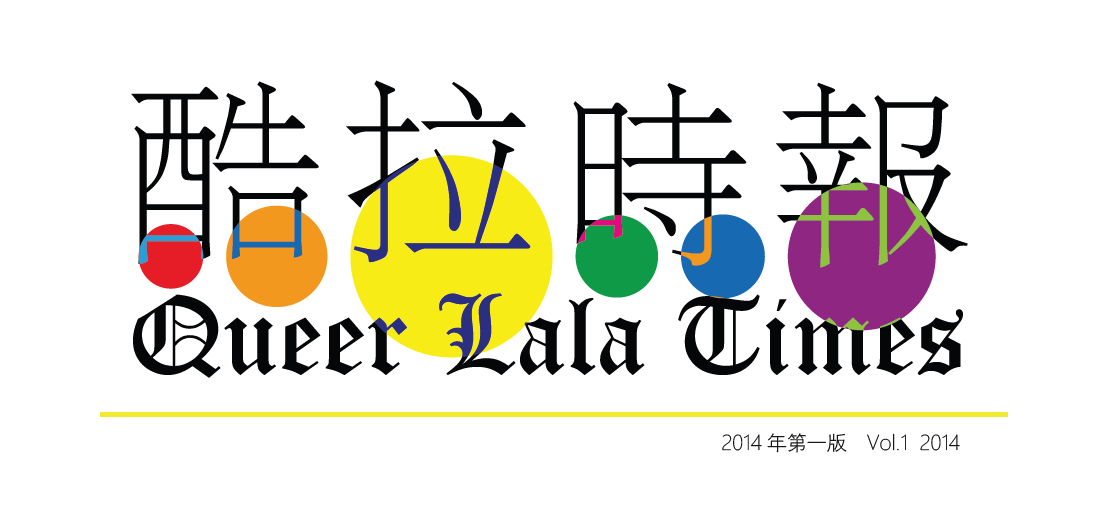
We are Lala (LBT). We are not dissoluble under the umbrellas of ‘women’, ‘gay’, ‘homosexuality’.
We are queer. We are not content with the binarism of gay/straight, man/woman, normal/abnormal. We seek diverse narratives that speak to the complexity of the world, and we seek a more diverse reality.
We are activists. With many others, we are committed to activism around gender and sexual identity in China. The experience of changing convinces us that changing minds is the ultimate pursuit of activism.
We are narrators. We believe in the power of words.
In starting a virtual magazine, Queer Lala Times, in China today, we face many challenges.
First, the LGBTQ movement has enjoyed some positive results. After more than a decade, we have achieved a large increase in social visibility and public awareness. Living conditions have improved, especially for gay men and women in large cities with higher socioeconomic status. However, this is far from sufficient. The lack of legal recognition, the fear and pressure that many LGBTQ people feel in their life, and the lack of material support still make life barely liveable for many LGBTQ people. To make matters worse, the public sphere cannot provide the conditions for robust politics and activism, and discrimination towards queer people and towards women always goes unquestioned in public.
Second, although originally motivated by the pursuit of equality, the LGBTQ movement is not immune to inequality within its own community. The lack of gender awareness, socioeconomic class divisions, ideological narrowness, and assimilation into mainstream society are problems that we must all confront. The rainbow-coloured diversity in the LGBTQ community deserves careful representation and equal respect, but it is obscured, reduced to a single narrative, and aligned with mainstream norms.
Third, China is witnessing a vigorous development of civil society. What shall we, as activists in the gender and sexuality movement, do to participate in this development and foster productive dialogue and cooperation with other movements? How shall we respond to China’s local realities within a global perspective?
To these many questions, we offer no answers—and a unified answer is precisely what we oppose. Instead, we encourage and foster reflection, critique, and representation of all aspects of our gender and sexual realities. We invite you—regardless of gender and sexual orientation—to join our discussion, to speak, and to listen. We wish for a coalition based on mutual understanding, rather than a unity that erases difference. We believe that the meaning of gender and sexuality activism lies not simply in the struggle for equality, important as it is, but in challenging and reimagining the structures of sex and sexuality that shape our world. This work will ultimately benefit us all, but it must begin with challenging ourselves.
References
Bao, Hongwei. 2021. Queer Media in China. London: Routledge.
Cao, Jin. 2009. The Production of Alternative Media in Mainland China: A Case Study of the Journal Friend Exchange. Harvard-Yenching Institute Working Paper Series. Cambridge, MA: Harvard University. www.harvard-yenching.org/wp-content/uploads/legacy_files/CAO%20Jin_Production%20of%20Alternative%20Media2.pdf.
Gilbert, Marc. 2025a. ‘The Leiden Chinese Queer Collection.’ Leiden, Netherlands: Leiden University Research. www.universiteitleiden.nl/en/research/research-projects/humanities/the-leiden-chinese-queer-collection.
Gilbert, Marc. 2025b. ‘The Leiden Chinese Queer Collection: A Workshop for Activists, Archivists and Academics at Leiden University.’ Leiden, Netherlands: Leiden University Research. www.universiteitleiden.nl/en/events/2025/05/the-chinese-queer-collection—a-workshop-for-activists-archivists-and-academics-at-leiden-university.
Gilbert, Marc. 2025c. ‘Crowdfunding for Leiden Chinese Queer Collection.’ Leiden, Netherlands: Leiden University Libraries. www.library.universiteitleiden.nl/news/2025/06/crowdfunding-for-leiden-chinese-queer-collection.