
Beyond Zouxian: The Making of Chinese Asylum-Seeking Workers in the US Platform Economy
‘Many of us who came and stayed here for more than two years are still stuck in Chinese-speaking communities.’ A Chinese asylum-seeker shared this with us during a conversation in late 2024. The sentiment is striking not because it is unusual, but because it is so widely echoed by Chinese immigrants who have sought asylum in the United States over the past four years.
Since 2021, the number of Chinese asylum-seekers arriving via the United States’ southern border has increased dramatically. More broadly, even as US legal immigration routes have been tightened and border enforcement intensified, asylum applications by Chinese nationals have only increased. According to UNHCR (2025) data, as of 2025 more than 140,000 Chinese nationals were seeking asylum in the United States, meaning it is still the top destination for Chinese asylum-seekers globally.
Public discussion, however, has tended to focus elsewhere. Over the past three years, media coverage and advocacy narratives in both the United States and Europe have concentrated on the often-spectacular journeys undertaken by Chinese asylum-seekers—crossing jungles, deserts, oceans, and borders—and on the legal drama of asylum adjudication itself. These accounts frequently attribute asylum-seekers’ migration to intensified political repression in China, framing their journeys as a quest for democracy and freedom. While such explanations capture important dimensions of displacement, they often reduce a complex set of motivations to a singular political narrative. In so doing, they risk obscuring the economic calculations, livelihood strategies, and heterogeneous migration pathways that shape asylum-seekers’ decision-making and trajectories. By privileging political causality, these narratives tend to reproduce a symbolic opposition between authoritarian departure and democratic arrival, leaving underexamined the infrastructural conditions and labour regimes of imperial states.
In discussing asylum-seekers, media accounts and migrant testimonies have rightly drawn attention to state violence, border militarisation, and humanitarian crises. Yet, they also produce a narrow temporal frame in which the story effectively ends once asylum-seekers ‘arrive’. What remains conspicuously absent from these conversations is sustained attention to what happens afterward—the everyday labour conditions asylum-seekers, including Chinese, encounter once they enter a new labour regime shaped by different, yet comparable logics of extraction and exploitation. Arrival signals entry into another terrain of stratification, surveillance, and entrepreneurial opportunities mixed with economic vulnerability.
This essay is a preliminary attempt to document the complexity of Chinese asylum-seeking workers’ interactions with the US labour regime and racial capitalism. We are particularly concerned with how labour regimes, urban infrastructure, and fear of deportation shape workers’ strategies for survival and constrain the possibilities for collective organising. At the same time, we aim to highlight how the platform economy is embedded differently across local labour markets, continuing to fragment an already segmented workforce while offering uneven forms of mobility and risk management.
The Politics of Segmentation among Asylum-Seeking Workers
To understand these dynamics, it is necessary first to move beyond a flattened view of Chinese asylum-seekers as a homogeneous group. The term zouxian (走线; literally, ‘walking the line’) has become a popular shorthand for the migration trajectories of Chinese asylum-seekers over the past four years, conjuring images of dangerous overland journeys and border crossings. Yet not all Chinese asylum-seekers ‘walked the line’. Some entered the United States on a tourist or student visa before filing for asylum. Even among those who crossed the United States’ southern border, experiences varied widely: people were subject to different lengths of detention, distinct forms of scrutiny, and uneven access to legal resources and networks. These differences matter not only for asylum outcomes, but also for how quickly and under what conditions individuals can enter local labour markets.
More importantly, once in the United States, asylum-seekers are rapidly sorted into different labour markets based on a constellation of social factors. Pre-existing assets, financial burdens, remittance obligations, access to social networks, location, and aspirations about long-term settlement all shape where people end up working and living. As in any working-class formation, these factors intersect with one’s regional origin within China, political and religious orientations, prior class status, and occupational experience, producing internal divisions that are more than sufficient to fracture collective identity.
Our research and organising work in New York City and California revealed starkly different labour regimes that not only shaped working conditions but also influenced who was drawn to each locality in the first place. These regional differences complicate any attempt to speak of ‘Chinese asylum-seeking workers’ as a single category.
In California, asylum-seekers face a local labour market that often requires greater upfront investment. High living costs and the state’s car-dependent infrastructure force workers to become more entrepreneurial. Outside a few dense urban areas—such as downtown San Francisco or parts of Oakland—a driver’s licence and a car are essential for basic survival, from running errands to accessing job opportunities. Family-run hostels in both the Los Angeles region and the Bay Area are significantly more expensive than comparable arrangements in Flushing or Brooklyn in New York City. As a result, many newly arrived workers in California experience periods of prolonged underemployment, burning through their savings in the weeks after arrival. In our fieldwork, we encountered workers who lived in their vehicles, relying on 24-hour fitness centres for showers and supermarket carparks for overnight rest. These conditions are not aberrations but structural outcomes of California’s labour and housing markets.
New York City presents a contrast. Dense ethnic enclaves lower the cost of entry and there are numerous ways for immigrant workers to compress living expenses to an extreme degree. Yet, this very density, combined with a large Chinese-speaking labour supply, has contributed to depressed wages and deteriorating working conditions, especially for those without work authorisation. Workers told us that during the peak influx of Chinese immigrants in 2024, when wages in the Chinese immigrant community fell noticeably, some employers even offered positions without pay, providing only free meals and accommodation. Generally, restaurants in New York City pay newly arrived asylum-seekers about US$1,500 to US$2,800 a month in cash, with free meals. Workers reduce their expenses by living in low-cost shared dormitory-style lodging. Such arrangements would be difficult to imagine in northern California, where similar jobs rarely pay less than US$3,500 per month.
Low wages in New York City also appear to produce greater geographic mobility. A higher proportion of the workers with whom we spoke was willing to accept temporary or seasonal jobs outside the state, while most California-based workers had never worked or even travelled beyond California. Compared with California, New York City functions as more of a hub for the transit of Chinese immigrant workers across the United States. Workers frequently temporarily shift to other states (which they refer to as waizhou 外州) once they obtain better jobs. At the same time, they often return to New York City and re-enter the local labour market during transitional periods, seeing New York City as their ‘big base’ (大本营). This link is so strong that some of them evocatively told us that returning to the city felt ‘like going back to our maiden home [娘家]’. This pattern is structured by New York City’s lower living costs and supportive infrastructure—such as public transportation, legal services, labour agents, and other social reproduction infrastructure—embedded in its dense ethnic enclaves.
Wages and working conditions are not the only factors that mediate the mobility of asylum-seeking workers. Deportation policies also play an important role in workers’ decisions about whether to work in other states. During periods of intensified immigration enforcement, workers prefer to abandon high-paid jobs in other states and return to New York City. For instance, a Chinese worker who shared his worries about being deported had to give up his plan to work in other states and accept lower-paid work in New York City in November 2025 when deportation efforts intensified. Similarly, we noticed that, after a strict crackdown on immigrants in Chicago in October 2025, a sudden labour shortage led to a sharp increase in the wages advertised for package delivery work, with job ads that circulated widely among the Chinese immigrant community at that time offering daily earnings of US$400—between 1.5 and two times the regular amount.
Across both regions, one structural bottleneck shapes nearly all labour trajectories: work authorisation. Asylum-seekers must wait at least six months after filling out their asylum application before receiving their first employment authorisation document—an identity credential that fundamentally reshapes their position in the labour hierarchy. Workers repeatedly told us that, in California, the wage gap between authorised and unauthorised workers doing the same restaurant job can exceed US$2,000 per month. Those without authorisation are often excluded from tip-sharing entirely, subjected to closer surveillance by employers, and more frequently bullied by co-workers. Similarly, asylum-seeking workers without authorisation in New York City reported that they are significantly marginalised in the labour market by being relegated to the most exploitative jobs, with lower wages, extended working hours, and intensified managerial control. For instance, one such worker said he could earn only US$2,000–2,500 per month working 11-hour shifts at a restaurant in Brooklyn—roughly half of what he could earn with a work permit.
Two factors contribute to this dynamic. First, with the formalisation of the labour market, employers are increasingly reluctant to hire unauthorised workers because of the potential penalties, leaving limited positions available to newly arrived immigrants. This reinforces the power asymmetry between employers and workers, as new arrivals are highly economically vulnerable and eager for work. Second, a lack of employment authorisation documents also deters workers from reporting their exploitation, given the potential legal consequences for their asylum claims.
For many, platform work affords the greatest spatial mobility and temporal flexibility, mitigating direct exposure to employer control and immigration enforcement agents, who typically target fixed workplaces such as restaurants and construction sites. Such platform-based work includes food and package delivery, warehouse work, and ride-hailing.
Platform Work as Survival
The geographic segmentation among asylum-seeking workers outlined above also structures platform labour into distinct formations and uneven prospects for survival in New York City and California—a regional unevenness that platform scholarship has largely overlooked.
In New York City, the rapidly expanding platform industry is reshaping the employment structure of Chinese male migrants, redirecting labour away from the historically dominant restaurant sector to gig work, particularly food and package delivery, as well as ride-hailing. Most Chinese delivery workers we encountered had prior experience in restaurant labour, ranging from decades-long careers to brief stints. Workers repeatedly emphasised that their primary motivation for shifting to platform work was the flexibility of scheduling and the opportunity to escape the physically intensive workload and high levels of managerial control characteristic of restaurant employment, especially the routine verbal abuse they reported enduring in those workplaces.
However, new arrivals to New York City are often forced to work in restaurants before they have enough savings to start gig work. In contrast with most researchers who emphasise gig work as a supportive ‘arrival infrastructure’ for immigrants (Andersen and Spanger 2024; van Doorn and Vijay 2024), new Chinese arrivals in New York City consider gig work something that demands investment and risk-bearing, including the purchase of a vehicle, the risk of that vehicle being stolen, potential traffic infringement tickets, and income instability while navigating algorithm rules. These financial costs and potential risks lead many new arrivals to prefer restaurant jobs in other states in their early period, which often come with free lodging and food, allowing them to save money in the short term.
In California, platform work is generally understood as a temporary hustle positioned between other forms of employment, such as restaurant work or house construction. Nearly all workers we encountered, both Chinese immigrants and United States–born platform workers, emphasised that earning a living solely through platform labour is extraordinarily difficult. Order volume and tip amounts are highly unpredictable, while idle waiting time can be substantial.
Moreover, securing even a barely liveable income requires meeting a demanding set of conditions: owning an efficient hybrid or electric vehicle, possessing detailed geographic knowledge of postcodes, mastering platform rules and algorithms, maintaining a longstanding premium account, and having at least a moderate command of English. Against this backdrop, to supplement their primary income, some Chinese workers take advantage of peak holiday periods, when tipping tends to be significantly higher. Others turn to delivery and ride-hailing work during periods of recovery from injuries sustained in physically intensive manual labour, treating platform work as a provisional and less-demanding fallback rather than a long-term occupational path.
California and New York City also vary in their digital platform ecosystem. While most Californian workers seek gig work on Anglophone platforms, part of New York City’s market is segmented by Chinese-language platforms that primarily serve the Chinese community. Although these platforms have fewer restrictions on account registration and work schedules compared with mainstream platforms, they often have higher labour intensity, stricter management, and lower pay. For instance, food delivery workers for Panda and Fantuan in 2025 generally earned US$120–180 per day for an eight to 10-hour workday. There is a lack of transparency for workers about their daily active delivery time—the paid duration between accepting and completing delivery orders—leaving these platforms with significant leeway to miscalculate or obscure workers’ active hours and thereby reduce their paycheques. Moreover, during peak hours, workers are required to deliver multiple orders—generally five or six and, in extreme cases, more than 10—in rapid succession. This workload is significantly higher than for platforms that do not target a Sinophone market such as Uber, which typically limits workers to three orders at a time. However, due to account restrictions and language barriers, Chinese asylum-seeking workers generally start their gig career in Chinese-specialised platforms and later shift to Anglophone platforms, such as DoorDash, Grubhub, and Uber. Workers use different strategies to maximise their take-home pay based on their circumstances. Some Chinese asylum-seeking workers periodically work on both platform types simultaneously or shift back to Chinese-specialised platforms when their Anglophone accounts cannot provide sufficiently high-priced orders or enough active time.
While geography remains a key axis of differentiation, arrival time in the United States has become an equally important line of division, shaping asylum-seekers’ engagement with the platform economy. For Chinese asylum-seeking workers who arrived during the past three years, platform labour has become markedly less viable as a source of income, even as reliance on it has increased.
Across nearly all major platforms, hourly earnings have sharply declined. In California, food delivery work offers a clear illustration. Due to the saturation of delivery workers in most postcodes, it is now effectively impossible for newly arrived workers to freely register accounts on platforms such as DoorDash. Even for existing users, the ability to ‘dash anytime’—a feature that once enabled flexible access to work—has been restricted to a small number of premium or highly ranked accounts. For newcomers without early platform access, the promise of flexible gig work is largely illusory. Similarly, in New York City, major platforms have imposed tighter controls on account registration and work scheduling in response to the introduction of a minimum pay rate in July 2023 (Fickenscher 2023). These corporate adjustments have not improved conditions for all workers; rather, they have intensified the internal hierarchy within platform labour, pushing newly arrived workers into heightened economic vulnerability.
These common constraints have fuelled a rapidly expanding grey market for platform access. Account rental, shared logins, and paid registration services are now widely circulating within Chinese-speaking communities. Newly arrived workers rent delivery and ride-hailing accounts from senior workers, absorbing additional costs and risks while remaining fully exposed to platform surveillance and deactivation. For instance, DoorDash account renters in California typically give away about 15 per cent of their in-app earnings to account owners and forfeit any additional perks, such as medical insurance subsidies.
Comparative Ranking and Transnational Labour Regime Imaginaries
Despite starkly regional differences between California and New York City, workers frequently engage in comparative ranking of platforms and gig jobs, placing them along a spectrum from ‘more Chinese-oriented’ to ‘more Americanised’ forms of work. The latter were widely perceived as more prestigious. Platform ranking is particularly pronounced among workers in the food delivery sector, especially those who worked as platform-based food delivery workers in China before migrating. Their work experience across multiple platforms in both China and the United States provides them with comparative perspectives: United States–based Anglophone companies such as Uber are considered the most prestigious, followed by United States–based Chinese-specialised platforms such as Panda and Fantuan, while China-based platforms such as Meituan and Ele.me occupy the bottom ranks.
Although Amazon has been a frequent target of the US labour movement, many Chinese workers regard Amazon Flex as a lesser evil than Chinese-specialised platforms. This preference reflects the higher take-home pay offered by Amazon compared with Chinese-specialised package delivery companies, which can squeeze labour costs more intensively due to the lower living costs within ethnic enclaves. It also stems from workers’ comparative perceptions of labour regimes in China and on Chinese-oriented platforms, which they portray as a more intense form of algorithmic despotism than that found on Western platforms, characterised by tight human oversight, monetary sanctions, and intensified dispatch during peak hours. Western platforms also adopt stricter qualification reviews and require a moderate level of English proficiency, which is understood to signal legitimacy and distance from ethnic informality. Workers’ platform rankings are therefore both economic and cultural. On the one hand, they reflect how multiple layers of labour exploitation unfold within the gig economy and how global inequalities of capitalism are crystallised within the imperial centre through the absorption of immigrant labour. On the other hand, they reflect workers’ assessments of risk, fairness, legitimacy, and linguistic demands, as well as their insights into the realities of Chinese and US capitalism. In this sense, platform choice becomes a moral and strategic decision rather than a purely economic one.
To capture this agentic process of comparison, we propose the concept of ‘transnational labour regime imaginaries’—workers’ ongoing sense-making across the multiple labour regimes they have experienced or learned about, spanning their country of origin (in this case, China), transit countries, and different US localities—which we plan to explore in another academic article. Even workers who have been physically confined to a single state often possess a rich comparative understanding of labour conditions elsewhere, informed by peers’ experiences and constant information exchange. This comparative imagination shapes how workers decide which platforms to enter, which risks to tolerate, and when to exit or resist.
In the case of Chinese asylum-seeking workers, these imaginaries are also sustained and amplified through Chinese digital infrastructure. Ride-hailing and delivery workers routinely document their daily labour through short videos, app screenshots, and posts on digital platforms, particularly Douyin and RedNote. What might appear as individual self-documentation often becomes collective knowledge production: comment sections evolve into informal labour forums where workers exchange real-time information about earnings, platform rule changes, enforcement intensity, and postcode-specific conditions.
Beyond public posts, many workers join WeChat and RedNote group chats dedicated to certain platforms, cities, or even neighbourhoods. These groups function simultaneously as social spaces, mutual aid networks, and nodes of informal market activity. Workers circulate tips for maximising income, warn against platform crackdowns, share technical workarounds and hacking strategies, and facilitate the rental and transfer of accounts. At the same time, they normalise a labour landscape in which access itself becomes commodified and where the boundary between legality and illegality is constantly blurred and renegotiated under pressure, reflecting insights that have also been made by researchers of informal migrant communities (Gago 2017; Piza 2025).
Fragmented and Constrained Collective Resistance
Transborder digital infrastructure constitutes critical arenas where transnational labour regime imaginaries are co-produced, circulated, and contested, shaping workers’ employment decisions and everyday solidarities. The effects of this assemblage are deeply contradictory. On the one hand, it provides indispensable multi-geographic–level support—local, interstate, and transnational—and forms mutual aid networks, enabling workers to navigate precarity and survive immigration exclusion. On the other hand, reliance on co-ethnic circuits can limit engagement with broader working-class coalitions, labour organising, and progressive political networks.
Rather than engaging in worker solidarity networks in the United States, Chinese platform workers’ collective actions are confined to localised circles and they generally adopt strategies to which they were accustomed before their migration, including wildcat strikes, collective wage claims directly against managers or employers, and even seeking police intervention. Their collective actions are spontaneous, fragmented, and confined to ethnic networks and community circles. Such strategies may be effective when workers confront small, localised companies, but could hit a plateau as platforms expand and rapidly absorb replaceable labour to substitute for workers.
The localisation and fragmentation of collective resistance among Chinese platform workers are also a result of border regimes and racially segmented labour politics in the United States. Categorised as independent contractors in New York City and as the third category of workers in California, platform workers are legally excluded from standard labour protections and deprived of the right to unionise and engage in collective bargaining. In California, there have been limited legal breakthroughs with the passage of Assembly Bill 1340 in October 2025, which enables unionisation for rideshare drivers. However, this reform applies to only one segment of the platform economy and organising platform workers more broadly remains an uphill battle. Notably, none of the Chinese workers we encountered in California had heard of this legislation. Such exclusion by industry, although represented as formally race-neutral, operates as a mechanism of racialisation (Dubal 2022). It prevents platform workers from joining the union-centred mainstream labour movement in the United States.
Chinese workers are also constrained by fragmented digital infrastructure. Even after migration, they remain embedded in Chinese-language digital platforms such as Douyin, WeChat, and RedNote, rather than transitioning to platforms such as Facebook, Instagram, WhatsApp, or more encrypted tools. This digital segmentation limits their access to established activist and labour-organising networks. Language barriers are also a problem, as Chinese workers are unable to effectively connect with existing platform worker centres, which are predominantly organised by and around Spanish-speaking communities—a gap that we are trying to fill in through our activism, for instance, by connecting Chinese food delivery workers with Los Deliverstas Unidos (LDU), a workers’ centre organising app-based delivery workers in New York City. Chinese platform workers are also marginalised by worker centres in Chinese enclaves, which primarily focus on earlier generations of migrants in traditional industries and, due to their limited resources, pay less attention to newly arrived migrants and platform workers (as these organisers themselves told us). As a result, Chinese platform workers remain disconnected from multiple layers of labour and activist networks.
Perhaps ironically, Chinese Christian churches, despite their conservative cultural orientations, have come to provide some of the most accessible spaces for socialisation and language learning for otherwise isolated and unsupported new immigrants. Workers told us they value churches’ free event spaces and English classes and some even reported finding potential work clients through church-based activities. These observations underscore the urgency of moving beyond orthodox leftist critiques to attend more closely to the material needs, infrastructure, and survival strategies of immigrant workers.
The intensifying mass deportations across the United States have deepened asylum-seeking workers’ insecurity, with many worried about being deported at any time and having to delay or suspend their asylum proceedings. This heightened precarity makes long-term planning and skill acquisition increasingly unattainable, while politically positioning workers in a prolonged state of legal limbo—neither fully undocumented nor securely documented. Under such uncertainty, platform work, with its promise of immediate earnings and flexible scheduling, emerges as a rational survival strategy. Asylum-seeking workers actively choose gig labour even as they become structurally trapped within it. In this sense, the insecurity actively produced by border regimes is systematically aligned with the flexibility embedded in the accumulation logic of the platform economy.
By tracing Chinese asylum-seeking workers’ integration into US labour regimes and the platform economy, our ongoing work challenges the dominant narrative that frames zouxian as merely a linear pursuit of political freedom. Moving beyond a state-centred lens, we argue that this recent wave of Chinese asylum-seeking must be understood through a transnational and post-arrival analysis of labour regimes—one that foregrounds workers’ comparative, agentic sense-making and everyday survival strategies. These strategies are shaped simultaneously by the expulsion of surplus populations in China and the ongoing absorption of racialised labour within the United States. While rejecting the logic of border capitalism remains crucial, we contend that an equally urgent task is reimagining modes of labour organising and solidarity capable of addressing these fragmented and unequal conditions. This, in turn, demands sustained conversations with workers that extend beyond moments of crisis, creating possibilities to reconnect and re-embed Chinese asylum-seeking workers in worker-centred movements, both alongside other racialised groups and within broader labour struggles.
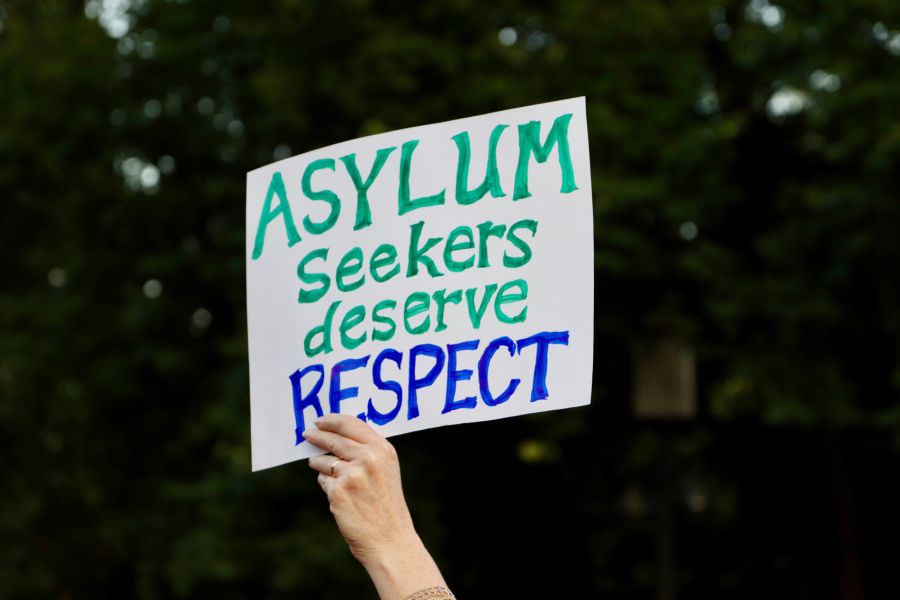
Featured Image: “Asylum seekers deserve respect”, Source: Joe Flood (CC), Flickr.com
References
Andersen, Magnus, and Marlene Spanger. 2024. ‘Gig Work in Transnational Spaces: Infrastructures of Migration and the Simultaneous Lives of Migrants in the Gig Economy.’ Journal of Ethnic and Migration Studies 50(15): 3751–67.
Dubal, Veena. 2022. ‘The New Racial Wage Code.’ Harvard Law & Policy Review 15: 511–50.
Fickenscher, Lisa. 2023. ‘Food Delivery Workers Face Reduced Hours and Tips after NYC’s Minimum Wage Hike: Report.’ New York Post, 19 December. nypost.com/2023/12/19/business/food-delivery-workers-face-reduced-hours-and-tips-after-nycs-minimum-wage-hike-report.
Gago, Verónica. 2017. Neoliberalism from Below: Popular Pragmatics and Baroque Economies. Durham, NC: Duke University Press.
Grohmann, Rafael, Gabriel Pereira, Abel Guerra, Ludmila Costhek Abilio, Bruno Moreschi, and Amanda Jurno. 2022. ‘Platform Scams: Brazilian Workers’ Experiences of Dishonest and Uncertain Algorithmic Management.’ New Media & Society 24(7): 1611–31.
Piza, Douglas de Toledo. 2025. Beyond Informality: How Chinese Migrants Transformed a Border Economy. Stanford, CA: Stanford University Press.
United Nations High Commissioner for Refugees (UNHCR). 2025. Refugee Data Finder. Geneva: UNHCR. www.unhcr.org/refugee-statistics/download.
van Doorn, Niels, and Darsana Vijay. 2024. ‘Gig Work as Migrant Work: The Platformization of Migration Infrastructure.’ Environment and Planning A: Economy and Space 56(4): 1129–49.