
Asian Reservoirs: A Conversation with Frédéric Keck

The Covid-19 pandemic has brought the whole world to its knees. Yet, this coronavirus is only the latest in a number of zoonosis events originating in different parts of the globe, and especially within Asia, over the last 20 years. For this reason virologists commonly refer to places like China, Hong Kong, or Singapore as […]


Download PDF

Leninists in a Chinese Factory: Reflections on the Jasic Labour Organising Strategy

This summer marks the second anniversary of the failed unionisation drive at the Shenzhen Jasic Technology factory, an episode in China’s recent history of labour activism that has drawn massive attention from China observers, leftist circles, and media pundits around the world. Compared with other influential instances of contentious labour action in recent years, the […]

Download PDF

Scholars and Spies: Experiences from the Soviet Union, Communist Romania, and China

In response to the renewed emphasis of the central government on national security, in November 2015 the authorities of Jilin province, in northeast China, introduced a hotline to report possible spies. The dilemma was how to recognise a spy. Local officials instructed concerned citizens to look out for eight revealing signs (Yang 2015). First, spies […]

Download PDF

Counterterrorism or Cultural Genocide? Theory and Normativity in Knowledge Production About China’s ‘Xinjiang Strategy’

‘Wake up! There is something for us to learn here. What they’re saying applies to us, even if it was not meant for us.’          Friedrich Nietzsche, Anti-Education (1872)   Since 2017, the Chinese Communist Party (CCP) has embarked on a rapid and intense securitisation of the Xinjiang Uyghur Autonomous Region. This has included mass […]

Download PDF

Gratitude: The Ideology of Sovereignty in Crisis

In the midst of the pandemic, expressions of gratitude are everywhere. The appreciation of frontline workers can be heard from the balcony singing of Northern Italy to the nightly applause across New York City rooftops. Even the wolves of my own state of Colorado seem to be contributing their evening howls (Gruenauer 2020). Meanwhile, mental […]

Download PDF

Work: Democratise, Decommodify, Remediate

The Made in China Journal is happy to join other 36 newspapers in 32 countries in publishing this urgent call by more than 3,000 researchers from universities around the globe to heed the lessons of the Covid-19 crisis and rewrite the rules of our economic systems in order to create a more democratic and sustainable […]

Issue #1

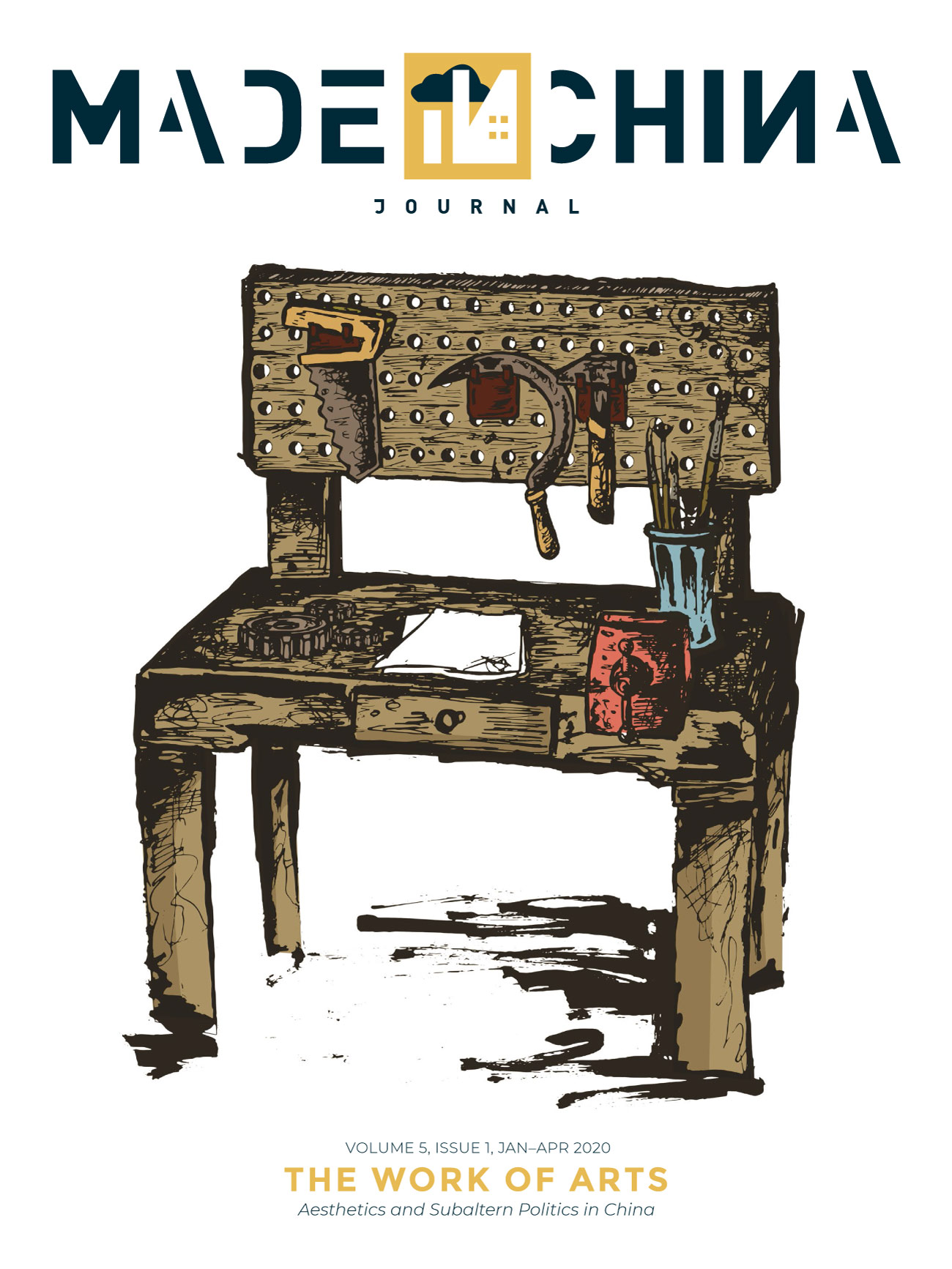
The Work of Arts

Aesthetics and Subaltern Politics in China

January–April 2020

‘Art must not be concentrated in dead shrines called museums. It must be spread everywhere—on the streets, in the trams, factories, workshops, and in the workers’ homes.’

Vladimir Mayakovsky, 1918


With these words, the great Soviet poet addressed the key question of how to bring art to people and people to art in a new world in which old aristocracies, elites, and their aesthetic privileges were fading away. In the words of art theorist Boris Groys, ‘the world promised by the leaders of the October Revolution was not merely supposed to be a more just one or one that would provide greater economic security, but it was also and in perhaps in even greater measure meant to be beautiful.’ Walking in these steps, the Chinese Revolution was a project of further experimentation and creation in the realm of the relationship between art and the people. The world it created was at once utopian and disfigured, radiant and desolate. While today that world is no longer, the questions it raised about the relationship between the working class, artistic production, and aesthetic appreciation remain with us.

This issue of the Made in China Journal offers a collection of essays that examine the ‘work of arts’, intended as the extension of art beyond the confines of the museum and into the spaces of ordinary life and production.

Download PDF

Amateur Art Practice and the Everyday in Socialist China

This essay examines amateur art practice during the socialist period in China. It argues that socialist amateur art practice not only changed the class and labour relations that had previously defined the fine arts, but also converted the expert and professional cultures of the fine arts into a grassroots practice of the everyday. Originating from small art study groups at industrial and agricultural sites, amateur artists met to create images depicting their labour and lifestyles. The result was a practice that challenged the art academy as a legitimising site of training, evacuated concepts of artistic genius and technical accomplishment, and embraced media primarily oriented toward the public, as opposed to the market.

Download PDF

Aesthetics of Socialist Internationalism

Lenin Films in the People’s Republic of China

In the twenty-first century, Lenin’s image in cinema exists as floating textual references to a Maoist collective memory that is sutured to a post-revolutionary existence governed by the Chinese Communist Party. Scholars including Geremie Barmé (2009), Guobin Yang (2003), Ming-bao Yue (2005), and others have identified the ways in which appropriation of revolutionary culture for […]

Download PDF

Subscribe to Made in China

Made in China publications are open access and always available as a free download. To subscribe to email alerts for each issue of the Journal, newly published books, and information about upcoming events, please provide your contact information below.


Back to Top